


A new report claims that neurodivergence is vastly undervalued in the tech industry.
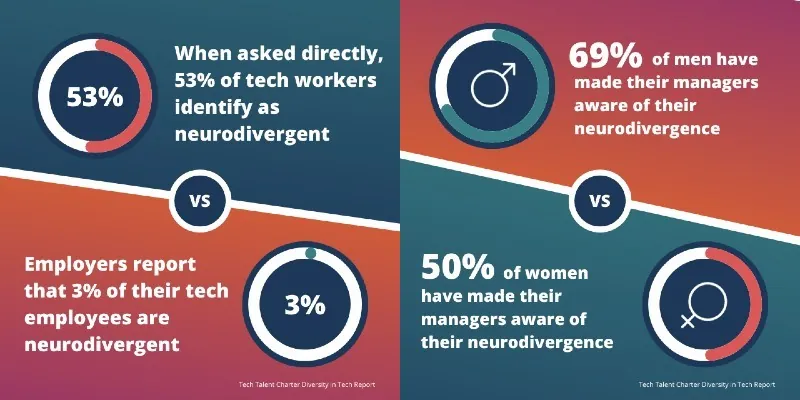
The Diversity in Tech report, published by the nonprofit Tech Talent Charter, found shockingly low levels of reporting for neurodiverse people in the tech industry, according to employers. and only 3% of the total population, compared to an estimated 15-20%).
However, another poll of UK tech workers, also conducted by the TTC and published in the report, found that more than half of tech workers identified as neurodiverse when asked directly. , highlighting serious flaws in the industry-wide diversity “self-identification” process.
The TTC’s annual report is the result of over 700 UK organizations working together to share diversity data and provide candid insights into the UK’s technology economy. The report draws on data from 708 companies, including sponsors Global, HP, Lloyds Banking Group, Nominet, PwC, Sky and BAE Systems Digital Intelligence, and is based on a sample of 230,000 UK technology employees. , reveals the latest statistics on equity and diversity.
The report is the largest of its kind and is supported by the Department of Science, Innovation and Technology (DSIT).
The report also reveals disturbing new statistics on several other areas of diversity, showing that the tech industry is not representative of the wider UK workforce.
This includes disability in the technology sector (6% compared to 23% of the workforce), socio-economic ‘working class’ diversity (9% compared to 39% of the UK population), transgender Includes representation (0.17%), gender and ethnicity. diversity in software engineering (20% and 22%, respectively), and gender and ethnic diversity in senior technical roles (21% and 14%, respectively).

Despite this worrying news, while every measure of diversity in technology lags behind other UK benchmarks, the TTC says companies are defunding their D&I efforts, and this trend continues They warn that it will only make the problem worse.
“Companies are abandoning D&I efforts because of tough economic conditions,” said Karen Blake, co-CEO of Tech Talent Charter. “The unfortunate truth is that abandoning D&I will only negatively impact productivity and performance in the long run.
“Even more concerning is the trend of well-funded companies moving away from the D&I space, which could generate troubling headlines.
“Unfortunately, the truth of the matter is that companies are using the economic climate as a convenient excuse to shelve D&I initiatives that could expose them to public criticism, but this is highly second-rate. It is impossible to avoid in a polarized society. It shows a failure of leadership to address our biggest challenges.”
‘No excuses! ‘ Martha Lane Fox challenges technology leaders on diversity
The percentage of women in the technology industry tracked by TTC for the past four years has reached a new high of 29%, but as companies invest less in D&I practices and the percentage of women in senior technology roles declines. , this modest progress appears likely to be reversed. My role has decreased compared to last year.
In response, this report poses a strong challenge to business leaders on what they need to do to turn the tide. This report provides an overview of companies that are enhancing their D&I efforts, including a list of the most popular D&I partners and resources that companies use to enhance their D&I efforts, the most common KPIs, and D&I business goals and objectives. Provides practical and unique insights into your activities. Key actions to support different areas of D&I practice.
Investment platform launches in Birmingham for underserved founders
Blake added: “68% of employers measure the neurodiversity of their employees, and while it is promising that awareness of neurodiversity in business will increase, this progress does not encourage neurodiversity to be promoted. It only makes sense if you create a work environment that is actually supportive, not just.” .
“Only 69% of neurodivergent men and 50% of neurodivergent women tell their line managers about their neurodivergentness. So companies are clearly making sure that employees are aware of their neurodivergence. You need to work on building a trusting relationship with your employees so that they can uncover any divergence and receive accommodation and support.” ”
Saquib Bhatti, Minister of Technology and Digital Economy, said: “Our technology sector is a global success story. The UK is the third country to achieve a technology sector valuation of $1 trillion and has created 152 unicorn companies since 2000. , plays an important role in driving growth and creating jobs nationwide.
“But as this important report makes clear, our technology sector does not reflect the UK as a whole and we must work together to solve this. I am proud to be a Muslim technology minister and know this is not only the right thing to do, but also the smart thing to do to unlock the full potential of innovation across the UK.”
Are they Britain’s future female unicorn bosses?