

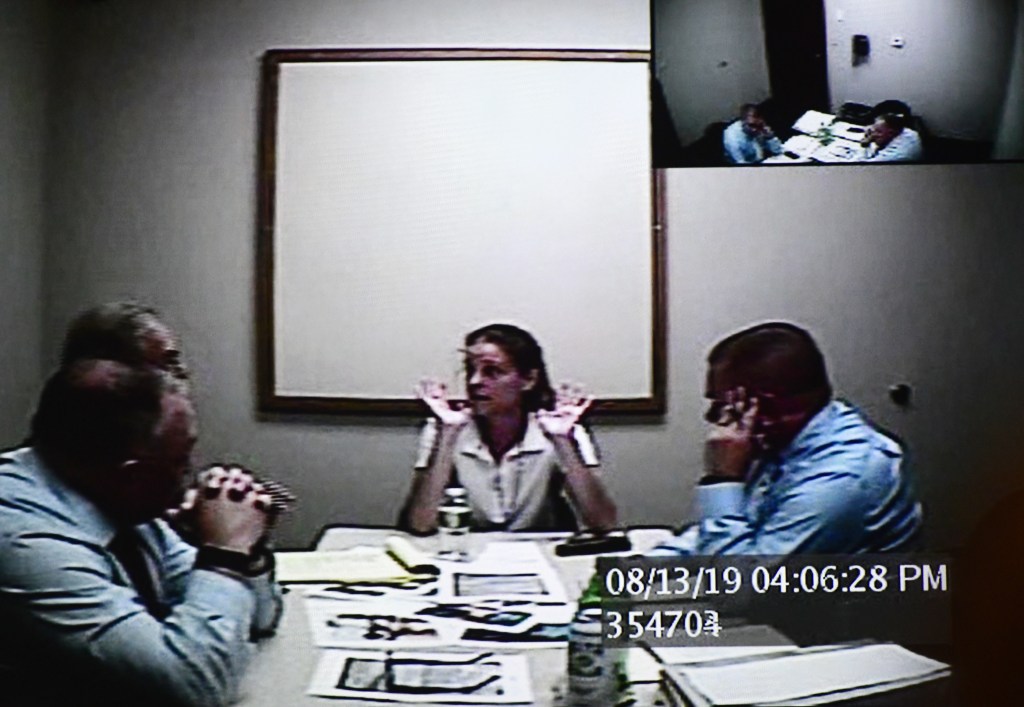
In the months after Jennifer Farber Dulos disappeared in 2019, Michelle Troconis sat down with investigators three times and underwent hours of questioning by detectives who were looking to find out what happened to the missing New Canaan mother.
After Troconis was convicted on all six counts she faced last week, her defense attorney Jon Schoenhorn said those interviews should have never happened at all.
In video recordings of the interviews in June and August 2019, Troconis is seated beside her then-attorney Andrew Bowman as detectives ask her question after question about her and Fotis Dulos’ movements on and around May 24, the day Farber Dulos disappeared.
They walked her through her timeline of the day, which changed in part from interview to interview, and told her that they had proof that her then-boyfriend, Dulos, had killed his estranged wife.
“Here’s a fact. Fotis killed Jennifer,” investigators are heard saying at one part of the first interview on June 2, 2019, at the New Canaan Police Department.
With receipts pulled from her red Longchamp bag, a photo of a Stop & Shop robot and visits to friends to back up her whereabouts on the morning of May 24, Troconis told investigators again and again that she did not know what happened to Farber Dulos. In fact, she said she didn’t even know if anything had happened to her.
“I think she’s still somewhere, I hope, hiding,” Troconis told detectives.
But then investigators, including lead detective John Kimball, told her that they knew for a fact that Farber Dulos was dead and that Dulos had killed her. And they told Troconis that they knew she wasn’t telling them the truth.
“He killed the mother of his five children,” they told her at one point. Dulos was eventually charged with murder in his wife’s presumed death but died after attempting suicide before going to trial.
Michelle Troconis guilty verdict: Some surprise in CT legal circles; what she faces next
The third time Troconis sat down with detectives and Bowman, Troconis said that she could not corroborate Dulos’ whereabouts that morning as they were written out on a timeline of the day. She had not taken a shower with him in their home at 4 Jefferson Crossing in Farmington. She said she hadn’t seen him at all that morning.
The six-person jury who found Troconis guilty on all six counts she faced in connection with Farber Dulos’ death watched videos of all three interviews: The first one at the New Canaan Police Department on June 2, 2019, the second at Bowman’s office on June 6, 2019, and the third in Bridgeport on Aug 13, 2019.
The jury watched as detectives picked apart her story and pointed out inconsistencies in her accounts of May 24, 2019, and the days that followed. They heard different answers as to the timeframe she saw Dulos in Farmington that day and questioned her at length about what she thought they were doing on a trip to Albany Avenue in Hartford that was captured on surveillance cameras.
Schoenhorn argued against the recordings of the first two interviews being shown to the jury at all during lengthy suppression hearings last fall.
After seeing the videos and hearing over 25 days of witness testimony, the jury deliberated for a little more than two days and found Troconis guilty of conspiracy to commit murder, two counts of tampering with evidence, two counts of conspiring to tamper with evidence and second-degree hindering prosecution.
Outside Stamford Superior Court just hours after their verdict came down, Schoenhorn questioned why she was ever allowed to take part in those interviews at all.
“In my view, the entire case, even as (the) closing argument set forth, was based on what she said to the police during these hours and hours of interrogation,” he said.
Mark Sherman, a criminal defense attorney in Stamford, said those interviews made Troconis the state’s strongest witness.
“Looking back, the state’s star witness was probably Michelle herself. The inconsistent interviews were too damning,” he said. “At least at trial, she would have had adequate time to prepare and the government would not have been able to use misleading interrogation tactics, which are allowed at the police investigation level but not in court.”
He said she would have been better off speaking in court than in those interview rooms.
“It’s a much fairer fight when you can control a narrative and have guardrails for questioning by the government,” he said.

Tyler Sizemore/Hearst Connecticut Media/Pool
Michelle Troconis’ first interview with the Connecticut State Police is presented as evidence on Day 10 of her criminal trial at Stamford Superior Court. (Tyler Sizemore/Hearst Connecticut Media/Pool)
Lindy Urso, the attorney for Pavel Gumienny, Dulos’ former project manager who testified against Troconis in her trial, also spoke with investigators back in 2019, but he had an immunity deal on the table.
Urso said he would not have let his client sit for such interviews without that deal.
“Never,” he said. “Never, because she had nothing to gain, she had nothing to gain going in there. And she had everything to lose, as we see today,” Urso said just after her conviction.
Schoenhorn too questioned why Bowman allowed those interviews to happen without a deal.
“I certainly would never have done that without some type of agreement,” Schoenhorn said. “I have no insight as to why any lawyer without either an immunity agreement or a proffer agreement would walk their client into a police interrogation without knowing very much about the offense. Now, that’s me, so you might want to ask the lawyer (who) did that.”
Bowman did not respond to a request for comment by press time.
Sherman said that in some circumstances, a decision like the one Bowman made allowed his client to speak to investigators, might make sense.
“Sometimes it is advisable to have a witness or suspect speak to the police but we defense lawyers like to go into those meetings with as much information as possible,” he said. “It’s always a good idea to show a jury that a suspect came in as soon as possible and was as transparent as possible. I believe that’s what happened here, it just didn’t work out.”
Schoenhorn said that in his view, the majority of the state’s case hinged on what Troconis said in the interviews and the accusation that she was intentionally lying to detectives.
“I believe that 90% of the evidence against her, as opposed to against Dulos, was based on statements and nothing else,” he said.
Schoenhorn said he wanted to call another attorney to testify about ineffective assistance of counsel during the trial, but the judge would not allow it.
Troconis, who used a Spanish interpreter during the trial, spoke briefly through the interpreter after closing arguments to decline her right to testify in her own defense. Schoenhorn said that because the jury saw the police interviews, there was nothing Troconis could have told them that they had not already heard.
Outside the courthouse after the verdict, he spoke to her decision not to testify.
“I don’t know if it would have mattered. The jury got to hear an unbelievable number of hours of unfettered interrogation. She answered questions until they had no more questions,” he said. “Some of those questions, in fact, were posed by her lawyer in those recorded interrogations. … So whether or not she needed to say anything … what could she say that she had not said during those interrogations?”
Bowman was by Troconis’ side when she made statements to investigators and even asked Troconis a few questions while she was being interrogated by detectives. Schoenhorn said that a defense attorney questioning their client in those circumstances was not the norm.
“It’s unusual if your job is to defend your client,” he said Tuesday.

Tyler Sizemore/Hearst Connecticut Media/Pool
Michelle Troconis sheds a tear as her first interview with Connecticut State Police is presented as evidence during her criminal trial at Stamford Superior Court. (Tyler Sizemore/Hearst Connecticut Media/Pool)
When Troconis was interviewed by detectives, she waived her Miranda rights on a form in English and spoke with detectives in English, though Spanish is her native language. Kimball testified that she did not ask for an interpreter.
Detectives Clabby and Kimball, who both testified in her trial, told her during the interviews that they found hard evidence of a murder, though Farber Dulos’ body has never been found.
“Was that an interrogation technique to get a reaction?” Schoenhorn asked during the trial.
“The reaction that we’re trying to elicit is truthfulness,” Kimball replied.
At another point, detectives told Troconis that they found a pillow in one of those trash bins with Farber Dulos’ blood on it. Troconis responded, “I don’t know anything about that.”
When Kimball took the stand, prosecutor Sean McGuinness asked Kimball whether forensic testing ever verified that Farber Dulos’ blood was on that pillow. He said it did not.
“Is this an example of a ruse?” McGuinness asked.
“Yes,” Kimball replied.
Sherman said that unlike in the courtroom, detectives are allowed to mislead people during interviews.
‘Police can say whatever they want and there are no consequences, at least in court there are rules regarding questioning and what can be put before someone accused of a crime,” he said.
A CT detective lied to Michelle Troconis in Dulos investigation. Was it legal and ethical?
John DeCarlo, a professor of criminal justice at the University of New Haven and former Branford police chief, said in an email to the Courant that “research consistently shows that deceptive interrogation tactics, including lying to suspects, can lead to false confessions.”
Police are allowed to lie to suspects during interrogations to gather evidence, with certain exceptions. The technique was upheld by the U.S. Supreme Court in 1969 in a case known as Frazier v. Cupp. In Connecticut, a law passed in 2023 made it illegal to lie to anyone under 18 during an interrogation.
Michael Lawlor, associate professor of criminal justice at the University of New Haven, told the Courant that what detectives did in interviews with Troconis is a typical technique.
“The kinds of things that would be typical would be implying that they have more evidence than they have or saying that someone else is throwing them under the bus,” Lawlor said.
During her trial, Schoenhorn brought forth expert witnesses, including memory expert Dr. Elizabeth Loftus, who testified that repeated questioning can contaminate a person’s memory.
She also testified that things like sleep deprivation and stress can affect a person’s memory processing, while their second expert witness, Northwestern University professor Viorica Marian, testified about how a person’s proficiency in a second language can impact their ability to understand certain things.
Schoenhorn repeatedly brought up that Troconis’ first interview was conducted out in New Canaan after she was woken up late at night and arrested in a hotel in front of her daughter.
Prosecutors countered claims of memory failure during the trial, pointing out that Troconis seemed to remember insignificant details, like that she bought parsley at Stop & Shop and tried to order a chocolate croissant at a West Hartford Starbucks that night, but could not remember whether she saw Dulos that morning.
Schoenhorn said that even small details told to detectives can be detrimental.
“People, in my view, should never sit down with the police for an interrogation. They should never do it,” he said after the verdict. “Because people forget it’s not just things that are bad that can be used against you, it’s anything that can be used against you … and that’s what I feel was done here.”
After the jury delivered their verdict, Judge Kevin A. Randolph increased Troconis’ bond from $2.1 million to $6 million. She was led out of the courtroom in handcuffs and taken to York Correctional Facility in Niantic. Schoenhorn said Tuesday that he does not expect her to be released on bond this week as was initially expected.
“It doesn’t seem likely that she will be getting out, certainly not this week,” he said. “Likely not anytime really soon.”
Schoenhorn said there are plans to appeal the conviction. He is expected to file post-trial motions this week.