


Russian President Vladimir Putin outlined his understanding of Russia’s history as the second anniversary of the invasion of Ukraine approaches in a recent interview with American right-wing commentator Tucker Carlson.
His comments build on his 2021 essay “On the Historical Unity of Russians and Ukrainians,” which argued that Russians and Ukrainians are one people and that the concept of Ukraine as a nation was invented by the Bolsheviks. There is.
During his interview with Karlsson, Putin traced Russia’s history back to the 9th century. In his view, southern Ukraine became part of the Russian Empire when Catherine the Great (commonly known as Catherine II) captured it from the Ottoman Empire.
Read more: How Catherine the Great influenced Putin’s invasion of Ukraine
Western historians treated Putin’s comments with disdain, accusing him of being a bad historian. But his claims reflect an important Russian claim: that Russia has a legitimate right to occupy Ukraine.
President Putin: “Russia saved Europe from the Nazis”
Today’s Russian identity is closely connected to World War II, or in Russian terms, the Great Patriotic War. In Karlsson’s interview, President Putin once again blamed Poland for the 1939 outbreak on Poland’s failure to meet Germany’s demands and the 1934 non-aggression pact with Germany.
Regarding the August 1939 agreement between the Soviet Union and the Nazis that partitioned Poland, Putin claimed it was a matter of expediency and distrust of the West.
Today, Putin’s government uses World War II as the foundation of modern Russia’s identity. The report notes that Russians under Soviet rule bore the brunt of the conflict, which ended in 1945.
The fact that 4.5 million Ukrainians fought in the Red Army is largely ignored, as Russia claims that the Red Army alone saved Europe from the Nazis.
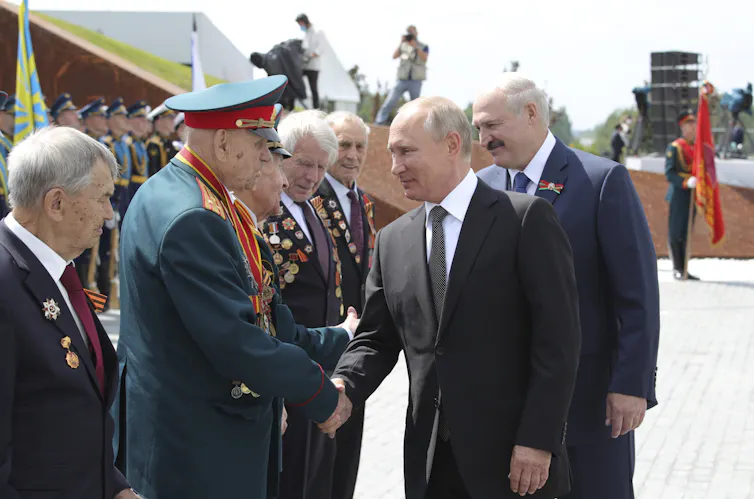
(Mikhail Klimenchev, Sputnik, Kremlin pool photo, via AP)
Takeover by neo-Nazis?
Today’s Russian mainstream and social media are dedicated to the task of reinforcing this version of World War II history. Media outlets have linked the war to the invasion of Ukraine, claiming the country was taken over by neo-Nazis in 2014. At the behest of Western powers, Ukrainian protesters overthrew elected president Viktor Yanukovych and installed neo-Nazis. -Nazi regime.
These alleged “Nazis” in Kiev are ideological allies of Moscow’s past enemies, followers of alleged traitors Stepan Bandera and Roman Shukhevich, who are still celebrated in cities including Edmonton. descendants.
It seems difficult to imagine how an educated Russian could believe that modern Ukraine is a haven for the Nazis. But you need to understand the environment in Moscow, where figures like Foreign Minister Sergei Lavrov and former Culture Minister Vladimir Medinsky are spreading the official narrative.
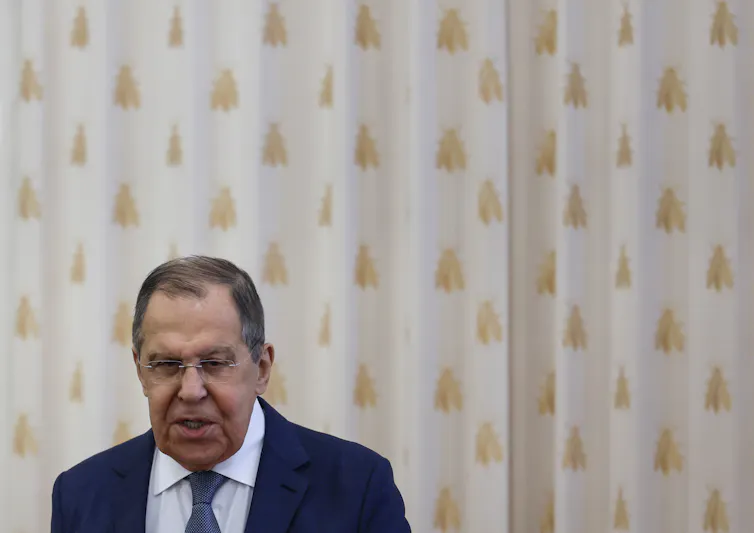
(Shamil Zmatov/Pool Photo via AP)
“Cleansing” Ukraine
Foreign Minister Lavrov recently claimed that Russia’s invasion of Ukraine had “cleansed” Ukrainian society of people who “do not feel that they belong to Russian history and culture.”
Medinsky, author of a 10th grade history textbook for Russian high school students, advanced a new interpretation of World War II that focused on the “genocide of the Soviet people.” New graves of Russian victims are suddenly discovered and excavated, and Soviet losses continue to be counted.
The Holocaust in neighboring Belarus is a subject studied by several Western scholars, but Jews and other minorities are now subsumed under the term “Soviet people.”
Just as history is constantly being rewritten and disseminated in Russian schools, the same thing is happening in Belarus. The two countries will soon produce a common textbook featuring new theories on the “genocide of the Belarusian people.” Memories of World War II are still alive in both countries.
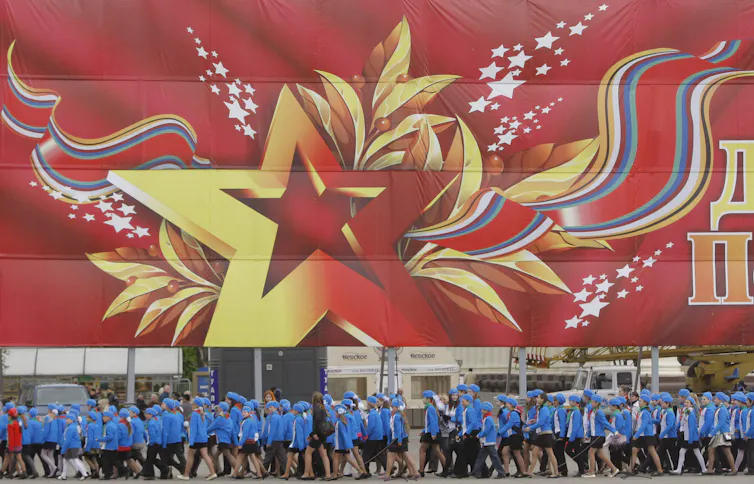
(AP Photo/Sergey Grits)
justify authoritarianism
Why is Russia paying so much attention to a war that ended nearly 80 years ago?
Because it legitimizes the rule of authoritarian states, dictators like President Putin and Alexander Lukashenko of Belarus, and, above all, the readjustment of territorial agreements concluded after the end of World War II in 1945. This is because it is used in
Western analysts who never thought that more than NATO expansion was the cause of the invasion of Ukraine, and their alleged promise not to expand the alliance with Mikhail Gorbachev in 1990, need to reconsider. be.
Read more: Ukraine-Russia conflict marks an alarming juncture for NATO
Contrary to some estimates, the current war is not about NATO, and NATO does not truly threaten Russia. If so, why did Putin refrain from condemning Sweden and Finland when they joined the alliance?
Nor are the causes of the war with Ukraine to be found in Kiev politics, the Euromaidan protests, or Ukraine’s efforts to join the European Union.
They exist in the past, within a narrow and distorted understanding of Russia’s history and its claims to the lands it once ruled.
Read more: The legacy of the Euromaidan revolution lives on in the Ukraine-Russia war
A return to colonialism?
Karlsson provided President Putin with a forum to outline his imperialist dreams.
If viewers accept President Putin’s interpretation of World War II history as legitimate, they will not only be returning to the era of colonial empires that once prevailed before the 20th century, but also the world. means that it is accepted by It gave Putin the green light to make similar claims against other countries that were once part of the Soviet Union, including Georgia, Moldova and other sovereign states.
During the interview, Karlsson failed to point out the facile nature of Putin’s claims.
However, former Mongolian leader Tsakia Elbegdorj published a map of Genghis Khan’s Mongol Empire on social media showing a much larger territory than Russia, mocking the Russian president and saying: We are a peaceful and free country. ”
The same may be true of Mongolia. But that is not the case in Putin’s Russia.