

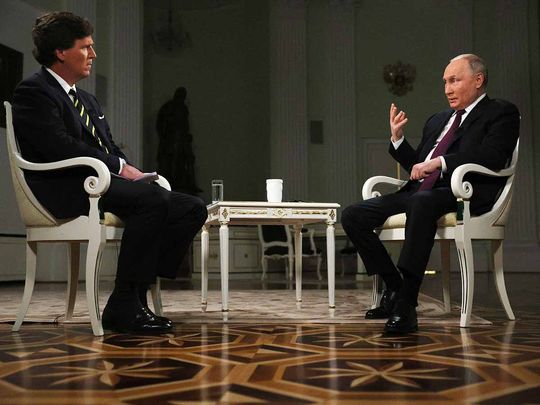
When Tucker Carlson, an American conservative commentator and popular cable TV talk show host, announced his intention to interview Russian President Vladimir Putin a few weeks ago, he caused considerable controversy in news and media circles. I stirred it up.
Many feared that such interviews would give Kremlin leaders an unwavering platform to express their views on the ongoing crisis between the Russian Federation and the West. I raised my voice. Despite these objections, the interview proceeded as scheduled and was subsequently published on YouTube. During the more than two-hour conversation, Putin delved into the Russian story and touched on various global conflicts.
Speaking at last week’s World Government Summit, Carlson reiterated his position and emphasized that he wants to offer Americans a different perspective. He described the interview as “incisive” and emphasized his intention to provide viewers with a different perspective on the issues discussed.
Putin has previously said that judo changed his life, saying that it is a sport that focuses on using mental and physical energy in harmony and throwing the opponent off balance without causing harm. It has been reported. However, the rules of judo do not apply to the world of politics or its rules.
The rationale for Russia’s announcement of a “military operation” in Ukraine was to prevent the expansion of NATO, but the result was the opposite: NATO expanded further. A few months before the outbreak of war, the French president likened NATO to being in a “recovery room.”
President Putin delved into Russia’s rich history, tracing the gradual expansion of the Russian state, before addressing the controversial and pressing issue of the Ukraine conflict. He spoke clearly on historical and political subjects and clearly indicated Russia’s position on relations with the West.
Russians are a tough people who have historically proven their resilience, and Western countries often find them difficult to conquer. Russians get sick, but they don’t die. President Putin outlined the series of events that culminated in the war, in particular the expansion of NATO to the east despite prior assurances to the contrary.
As a result, Russia felt besieged by “hostile forces” approaching its borders, ultimately leading to the conflict and the subsequent automatic expansion of NATO.
President Putin shows off his strength
During the interview, Putin pointed out that despite the economic sanctions imposed by Western countries, the Russian economy has remained relatively intact and has partially benefited from the blockade, as evidenced by certain indicators, and noted that the strong He projected his strength as a political leader.
He also portrayed himself as a responsible statesman when discussing military power, especially the deadly nuclear weapons. Looking ahead, Putin reviewed what he called a “peaceful preliminary agreement” with Ukraine, reached in Istanbul several years ago and signed by Ukrainian negotiators.
However, Putin claimed that former British Prime Minister Boris Johnson’s intervention persuaded the Ukrainian side to continue the war effort.
Putin said the West has provided significant financial aid amounting to about $70 billion to support Ukraine’s war effort, with most of it coming from the United States, followed by Germany, and additional contributions from other European countries. He claimed that.
Read more by Professor Mohammad Almayhi
The interview made clear that President Putin is keenly aware of the grave burden facing Russia and the world as a result of the ongoing war in Ukraine. He appears to be seeking an honorable solution to end the conflict while preserving Russia’s dignity. As he said, Russians are resilient, determined and figuratively prefer “death to defeat.”
The timing of the interview is extremely important as it coincides with the US election campaign. The race between Democratic and Republican candidates is fierce. Both potential leaders may face challenges related to trust due to a lack of extensive experience or concerns about their personal capabilities.
In these uncertain times, there is an increasing need to stabilize the international balance. Putin may be betting on his chances of returning to the White House, given Donald Trump’s past propensity for compromise and skepticism toward NATO.
Putin is not expected to talk about the inflammatory Middle East, and Carlson did not mention it during the interview. That may be because the world powers see the Middle East as an issue that can be addressed by reaching a settlement that Putin calls “multipolarity.”
But this suggests that the sacrifices, bloodshed, and waste of resources in the Middle East are only a small part of the struggle between the great powers. This emphasizes the importance of unifying the Arab Axis and pursuing regional security in order to protect the region from the negative effects of great power disagreements, which can be just as harmful as great power agreements. .
Mohammad Almayhi is a writer and professor of political sociology at Kuwait University