

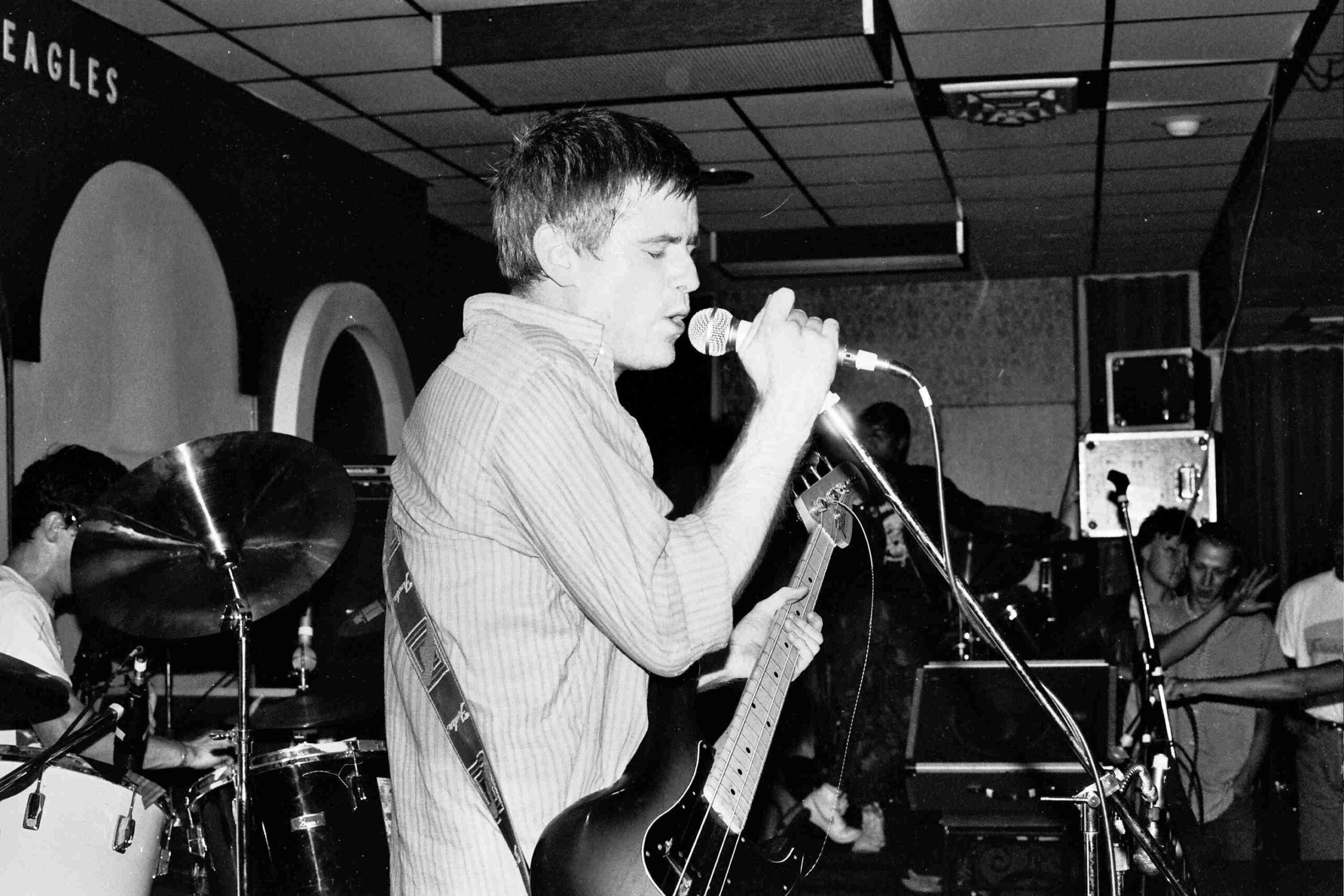
Victoria, Canada’s punk-rock outliers NoMeansNo never achieved global fame (they probably wouldn’t have wanted it anyway), but over the course of the band’s 40-plus-year life NoMeansNo built up a passionate and dedicated following. Formed by brothers Rob and John Wright and joined for extended periods by Andy Kerr, Tom Holliston and Ken Kempster, NoMeansNo have left an indelible mark all over modern music.
Having eschewed straight biography in favor of willing absurdity and surrealism during the band’s life time, new oral biography NoMeansNo – From Obscurity to Oblivion sees the former bandmates (alongside dozens, if not hundreds, of other voices) tell the story of the band.
A labour of love for author and long-time fan of the band, Jason Lamb, the book features interviews with friends, fans, people who worked with the band and a plethora of notable people who’ve been affected by the band (including members of Soundgarden, Neurosis, Entombed, Mr. Bungle and Minutemen, to name only a few).
Jason Lamb and John Wright joined New Noise Magazine to discuss the book, the band’s history, the enduring bond with fans of the band and John’s latest project Dead Bob.
When did the idea of the book originate?
Jason Lamb: I started getting into punk rock in my early teens, 1984/85. Dead Kennedys and another local band called The Dayglo Abortions were sort of the entry points for me on punk rock. I think I saw NoMeansNo, shortly after that, maybe within six months or so, and I just became an immediate fan. They became my favorite band. And the fact that we’re from my hometown was just a weird added bonus. I was too scared to ever talk to them back in those days. I mean, my God, they were very intimidating dudes, still are actually.

And John, when did you first become aware of Jason?
John Wright: Pretty late in the day. He ended up working for a radio station doing a punk show. He interviewed us a couple of times, towards the end, in the 2010s, I guess. We met him through that, just on a professional level, but it wasn’t until he approached us with this idea of writing the book and wanted to do it and had sort of talked to a mutual friend, we had Scott Henderson, who is a fellow that, that we have been working with, I’ve known and since the late ’70s, very good friend, did a lot of music, but then a lot of recording a lot of playing. He still lives in Victoria just like Jason; we were all gone from Victoria and moved over to the mainland to the big city. I think I was the last to move in about 1993. So from that point on, I didn’t have a great deal of connection with Victoria except with friends. And then Jason approached us. When was it?
Jason: It was February of 2020. Right before COVID.
John: Right before the world collapsed.
Jason: Exactly.
I imagine that people being stuck at home during COVID made it easier to get hold of people. How did you figure out who to approach?
Jason: That’s a really good question. And the COVID thing is 100% true. The timing was really oddly perfect in that sense because everybody was home; everybody was bored. A lot of these people who would normally be on the road or in the studio, especially people that are really, really busy and famous and all that stuff (were available).
As far as getting them and why and how I sort of learned about them, I just sort of—I said, okay, I knew I wanted to do this oral history format, right from the very beginning. And just only because of my hesitation, as a writer myself, I didn’t think I could write a narrative very well. I realized there were so many people involved, it needed to be that. So I just started reaching out to people everywhere
Every time I talked to somebody, it would lead to, sometimes half a dozen or more names. Because I already had experience in radio journalism, music journalism, I am pretty adept at tracking people down, but again, for every 10 people, you try to get a hold of maybe one or two will respond. So it’s just a big crapshoot. But I was really surprised and blown away how many passionate fans of NoMeansNo are out there that went on to successful careers themselves. So it became a bit of a word of mouth thing and I realized pretty quickly, I can either talk to nobody or I could talk to everybody. I ended up with 500 or so interviews over a few years. Insane, man. Yeah, it’s ruined my life.
John, NoMeansNo had a very playful attitude when it came to documenting the band. What’s it like to have all these people talking openly about your history and to have you talking openly about the history? Does that feel peculiar?
John: Oh, it’s rather embarrassing, really. NoMeansNo, we all are goofballs, really, and all the things that revolve around music, that aren’t the music themselves, are mostly absurd. Plus, we were big Residents fans and (fans of) the whole idea of obscurity. It was all about being fun. I think it’s just better to be funny than to be boring. So that’s the way we approached it.
I’ve always thought this about documentaries, if you just talk to the band off the bat it’s boring. It’s how fans see us and what they feel about the music, what it makes you feel like. Does it make you happy? Do you enjoy yourself? Does it cause you to be introspective? Does it cause you to dance? It can be a physical, mental, emotional reaction and that’s what it’s all about.
We are, of course, experiencing the same thing performing; we’re putting ourselves into this. We all have our perspective on it, but it seems to me that the best thing is for the perspective of the people who are absorbing all of this. Our whole history was like, well, it doesn’t matter what our history is. The only thing interesting is, what is this music? And why are people a fan of it? And what are their thoughts and feelings about the band and the music?
 NoMeansNo, OAP Hall 1985-11-02, photo courtesy of Derek Sheplawy
Jason: One of the first things that John said to me when I was starting with going with it, he said to me, “Are you going to talk to the fans? Because I think it’d be really important to have some fan perspective.” I already kind of had that in my mind. I thought that was a great idea. So interspersed through it all are just little stories and thoughts from regular people that are fans of NoMeansNo from all over the world. I think that really makes the book a little bit unique.
As far as telling the actual story of NoMeansNo (John, his brother Rob, Tom and Andy), it’s weird to read about yourself and your life. I’ve had to kind of navigate it with these guys a little bit. I think enough time has gone by since they retired that it’s okay to tell the story and take that sort of goofy mask off a little bit that everybody knows NoMeansNo for. It was a delicate dance in a way. It is a really interesting story, and they had so many adventures and dozens of tours and met so many people. I thought it was worth telling.
Punk rock is a key term throughout the whole story. Rob seems to have been an early convert with the Ramones. For John, was it when DOA played in Victoria, that was a significant turning point for you?
John: Oh, 100% That was the pivotal moment. Up until then I’d heard Robbie’s playing his records. I’m in school playing jazz music and listening to pop rock. He was eight years older than me. So discovering punk rock was at a different level. Going to see DOA was like, “Holy crap, this is amazing” and I completely started thinking about how to play music differently.
All those influences in the 70s other than punk rock are alive and well in me, but punk was this energy that was just absent from all other music including rock music. It existed in other music I just didn’t recognize. The DOA show was eye opening to that whole other universe in music. Punk rock really sort of encapsulated it and that was its unbridled energy. Somewhat anti-social, of course, like rock and roll always has been, but more just this is for everyone, including the audience.
Audiences just didn’t act that way at any other musical event, including rock and roll. Dancing, sure, disco and all that, but not just going crazy and in a non violent, non malicious way. Punk rock is definitely male, teenage testosterone, without question, and that describes me to a tee. I’m not trying to completely masculinise the music, but that was the energy that I was feeling. That said, my friends were pretty much equally boys and girls. The whole inclusiveness of punk rock totally invited that in, whereas a lot of other music didn’t. I’ve always been the type of person who thinks of themselves as rather fair-minded and very upset when fairness is missing and lacking around me. That whole thing about inclusiveness, which is totally the zeitgeist now, punk rock was at the forefront of tha—musically, anyway.
It seems clear too that you didn’t you didn’t exclude any influences from what you made.
John: Oh, 100%. Inclusion is a theme that should run through everyone’s lives, whatever they’re doing. Musically, I draw from everything that I listen to and I can find something to enjoy in almost anything. I will always remain open that way. My brother was the forefront of the expression of the band. He was writing most of the songs. Although I was writing a lot of the music, I’m not a super prolific lyricist. And although I could have very long, deep discussions with my brother, he was also able to put those into lyrics, which is no mean feat. I’ll tell you that right now. The band was always from his perspective, which was from our own perspective, as well, as we embrace that idea that punk rock was really looking inward.
Jason: I would say, when it comes to Rob and lyric writing, we’re talking about a very unique situation, which I don’t think I can think of another band that in the same way, where Rob was literally reading heavy duty philosophy books at a very young age and rereading it and then rereading it and then and really exploring himself and then writing about it in a really deep and but also broad way that that touches everybody they understand it all in their own ways and their own terms. I don’t know how much of it was intentional, but because they weren’t singing, you know, screw Thatcher or what’s going on in Cambodia or whatever, it allowed the music to be a bit more timeless.
John: I think you hit on the point there with who Rob is and who he was as a young man, and then as a middle aged man, and then as an old man. You feel something from it, but you’re not exactly sure why sometimes. It’s about being in touch with what’s going on inside of you, even if you don’t really understand it. The music might be all over the place, but the energy has to be in your face. It has to be unrelenting energy that demands that you pay attention. The tone is always sort of with humor but also melancholy. There is sadness in all of us, that is not necessarily a bad thing. And humor runs through everything, it’s how we make sense of that.
 Photo courtesy of Ray Auffrey
Even in the most terrible situations there is humor to be found, and even in the funniest situations there can also be melancholia or even tragedy.
John: One hundred percent, and everybody experiences that in their life; there’s not a soul that doesn’t. I think that’s part of why NoMeansNo kind of touches people because they see it in the music. And talking about this book, there’s hundreds of voices in there, but by reading those voices, you go, “Hey, that’s my voice,” and you feel part of this book, too, because you’re listening to people say the things that you’re thinking as well. I think that’s sort of the charm of the band and the charm of the book, that you’re all invited and everything you think about it is valid.
Talking of voices in the book, Jello Biafra features heavily. How do you both assess his contribution?
Jason: Jello was integral because he was their label boss. He’s the one who got them out into the world and still let them have the freedom they wanted. He’s a huge part of what they’re all about and he does like to talk for sure.
John: Jello is a very, very passionate man. When he first saw us and became a fan, I think (like everyone) he was attracted to the passion of the music, the intensity, the volume, the attitude of the band members. Alternative Tentacles was an important punk rock label and is still going today. The normal trajectory is, you want to get on a major label; you want to make more money; you want to sell more records; you want to play bigger concerts. That’s all good, but for us, this music is not commercial music. With Jello, it was always about, just do what you do, and we’ll put your records out. Back in the day your label was kind of important. Fans would be interested in what that label was doing. Certainly in punk rock in the 80. So, yeah, we owe it all really to Jello.
John, you have a current project Dead Bob, what can you tell us about that?
John: I ended up with about three albums worth of music, all in various stages of completion. The first album is the nine songs that I thought went together well and I was able to complete, but I did need some help from friends for a few things. I decided to put a band together and try to recreate this live. I’ve got all these folks, Byron Slack, Ford Pier, Kristy Lee Audette, and my friend here Colin MacRae, who was from Victoria as well, who played in a band called Pigment Vehicle for years, very crazy and eclectic. They’re all great songwriters on their own. So now we have this massive collection of music to draw from, a lot of writers. The first album was all me, the second album is mostly me again, but yeah, sky’s the limit really where it can go.
I have no desire to be NoMeansNo, 2.0, getting on the nostalgia-tour circuit, playing the old-timey songs for the old-timey crowd. Everyone’s welcome of course, but I wouldn’t be doing this unless I feel as though I’m playing something relevant. That means something to me now that the music is fresh. It was a bit of an accident, a bit unintentional, but I think we got something good going and there’s a lot of room to grow. We are playing some NoMeansNo songs, of course, but we’re trying to pick the right ones that will suit us.
Jason: Here in Western Canada, Dead Bob is almost like a little bit of a supergroup. They did nine dates. I saw three of the shows. Obviously, I’m biased already, but they were fantastic, and the new stuff that John’s doing is really, really good and fresh. Of course it’s really a treat to have them do a couple of NoMeansNo songs in there too, but they did it in a really well sort of choreographed way that wasn’t just sentimentality for sentimentality sake. I’m super excited that they’re actually a band. I know they want to get over to England and Europe. For anybody who’s reading this, I would highly suggest you go check it out.
Final thoughts on the fans?
John: A last note of the NoMeansNo arc (if I should put it that way) is that we always dealt with people who are fans. Bands have fans, and bands have people that want to work for them and want to support them and bands often have their eyes on something beyond that. They abandon the people that work diligently to help them in the early days because they’re fans and they go for a pie in the sky. One thing is we were terribly loyal to people we work with because we know that they’re honest with us and that the work they’re doing is because it’s something they want to do, not something that’s come across their desk. So the whole grassroots approach doesn’t necessarily make you rich, but they’re the ones that are passionate. These are the people that basically make up our fan base. So these are the people you want to support because they’re supporting you.
NoMeansNo: From Obscurity to Oblivion: An Oral History is out now on PM Press. Order it directly, or get it from your local bookshop.
Cover photo courtesy of Andrew Tolson