

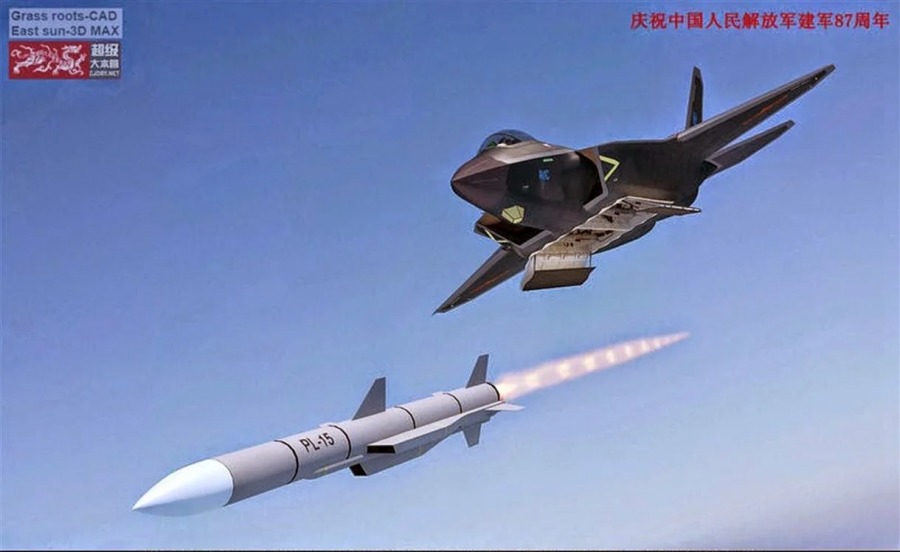
The United States is working to create a “dilemma” for the People’s Liberation Army Rocket Force (PLARF) in the face of the rapidly increasing missile stockpile of the Chinese Rocket Force, which is within range of U.S. naval assets and bases in the Indo-Pacific. Its stealth technology and camouflage technology.
The Pentagon’s 2023 Annual China Military Power Report highlighted that the People’s Liberation Army is adding a wide range of missiles to its repertoire capable of attacking the U.S. mainland.
China is developing air-to-air missiles that can attack beyond visual range, conventionally armed intercontinental missile systems, and an increasing number of nuclear warheads. China aims to develop the world’s first conventionally armed intercontinental missiles and submarine-launched weapons that can be launched from safe coastal waters.
The 2021 China Military Power Report mentioned the PL-15 missile, a beyond-visual munitions considered equivalent to the U.S. AIM-120 AMRAAM.
However, while China’s progress in developing military aircraft has been well-publicized, its advances in air-launched weapons and air-to-air missiles have been underappreciated, according to reports.

The biggest highlight of China’s domestic missile program is that it is exploring dual-mode guidance capabilities that use both active radar and an infrared homing seeker to improve target selection capabilities and enhance the missile’s countermeasures.
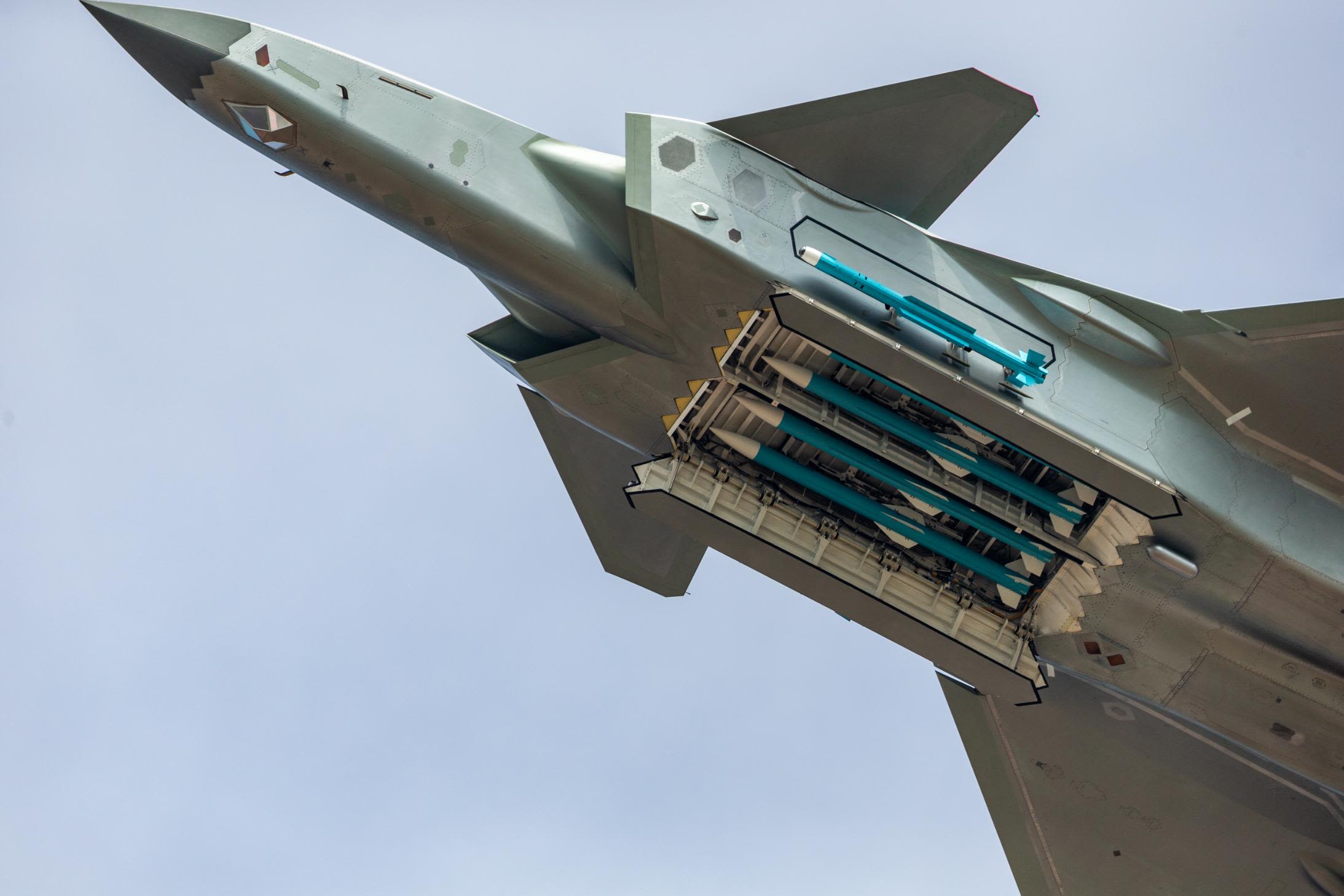
The PL-15 was designed from the beginning to be mounted inside the J-20, resulting in reduced dimensions. It also uses dual-pulse rocket motors and has a reported range of 124 miles.
The missile is currently deployed on JF-17 Block III and J-10C fighter jets.
In the field of surface-to-surface weapons, U.S. military officials feel that if China succeeds in developing conventional intercontinental missiles, it will spell an end to the advances of the PLA Rocket Force. It would give the People’s Liberation Army Rocket Force the conventional capability to strike the United States for the first time and threaten targets in Hawaii and Alaska in the continental United States.
In an interview at Fort Wainwright in Fairbanks, Alaska, USARPAC commander Gen. Charles A. Flynn said the Chinese missiles were meant to defeat American air and sea forces.
Flynn explained the argument that rocket forces can kill targets if they can see and acquire them, and that the U.S. military could evade detection by hiding signatures and other military deceptions to confuse Chinese missiles. , said it is considering ways to avert the threat.
“I think what we are proposing is a dilemma that China has not factored into its A2AD (area access and area denial) arsenal until now,” Flynn said. China bases its A2/AD concept on Russia’s preferred “maritime denial” or “Bastion” strategy, which includes very long-range land, air, and sea precision fires and ballistic missiles to deter adversaries. Includes the use of abilities. Force elements at risk over much longer distances.
Former Army Chief of Staff Gen. Mark Milley said in 2019 that camouflage technology is important. “Advanced camouflage technology is extremely important. We spend significant amounts of money on advanced camouflage systems for individuals, units, vehicles, etc.” “If we can see a target with precision weapons, we can hit the target. We know that enemy acquisition systems are very capable in that regard,” Milley said. “Therefore, camouflage systems that destroy electronic and thermal signatures are important.”
As an alternative, U.S. lawmakers in 2023 will require the Secretary of Defense to develop a strategy to work with allies to create a “Ring of Fire” in the Indo-Pacific region to close the missile gap with China. submitted a bill.
The bill includes a list of potential locations for missile systems in the region, the designation of a specific commander tasked with overseeing that effort, and a list of allies for which the U.S. can develop a strategy. There is.
Geologically, the “ring of fire” refers to a 40,000-kilometer-long belt marked by earthquakes and volcanic eruptions that extends in a horseshoe shape around the Pacific Ocean.
American advanced camouflage technology
Military camouflage technology has advanced dramatically over the past decade, with the invention of vehicle cloaking and invisibility cloaks. Camouflage such as BAE Systems’ adaptive vehicle cloaking technology, Hyper-Stealth Biotechnology’s light-bending quantum stealth materials technology, and Japan’s cloak of invisibility that uses nanoantenna technology developed by Dr. Susumu Tate to redirect light waves around objects. A concept is being developed. developed.
The U.S. Army is actively developing advanced camouflage technology to improve the concealment of soldiers and military assets. The main one is the Ultra Light Camouflage Net System (ULCANS). His ULCANS, developed by Fibrotex, are designed to hide the positions of soldiers, vehicles, tanks and aircraft.
The system is designed to hide these assets from advanced electro-optical sensors and radar. ULCANS improves performance for night vision, thermal imaging, and radar detection.
The net is reversible, allowing for different prints suitable for different environments. The US Army has awarded Fibrotex his 10-year contract worth US$480 million for the production of ULCANS.
Another system is the Improved Ghillie System (IGS), which is considered an advancement in camouflage technology. IGS increases the effectiveness of a sniper’s ghillie suit, allowing the sniper to seamlessly blend into the surrounding environment. Improved opacity to thermal imaging and other detection methods.
These innovations are critical to allowing U.S. soldiers to hide in plain sight, even in difficult environments. The U.S. military aims to protect its forces and maintain tactical advantage by countering advanced sensors.
aircraft cloaking
Hiding a fighter may seem difficult, but it’s not impossible.
Chinese scientists have claimed to have developed a new generation of plasma stealth technology that allows aircraft to disappear from radar.
The “sealed electron beam plasma stealth device” protects aircraft from radar interception and can be turned on instantly, the South China Morning Post reported.
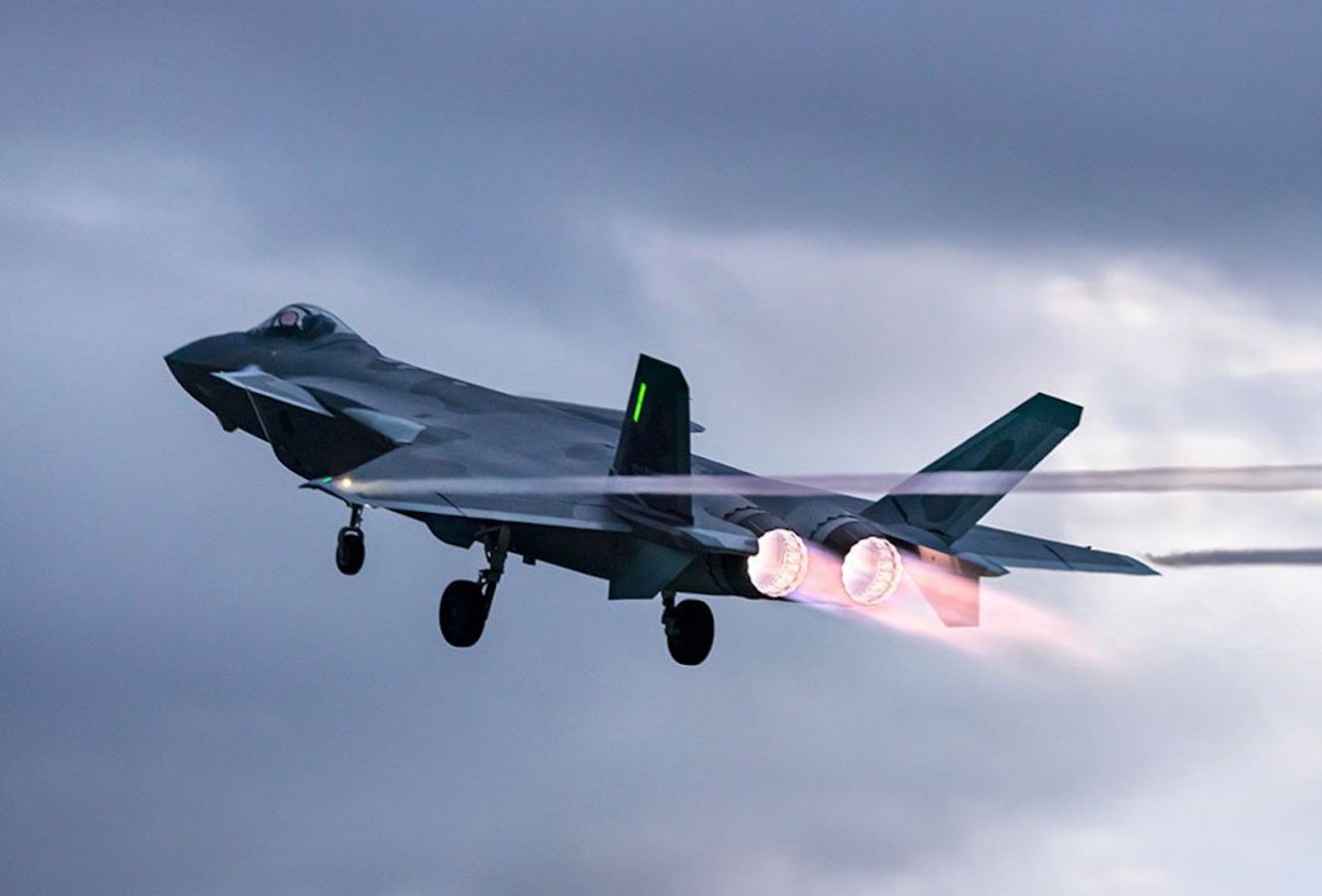
Plasma stealth uses ionized gas (plasma) to reduce an aircraft’s radar cross section (RCS). It deflects or absorbs radar waves by creating a layer or cloud of plasma around the vehicle. This method includes electrostatic discharge or radiofrequency discharge, as well as more complex laser discharge.
Another way to confuse radar is to use radar-absorbing materials. Stealth aircraft use special materials and coatings that absorb or scatter radar signals. These materials minimize the aircraft’s radar signal and make it less visible to enemy radar systems. Aircraft design plays an important role in mitigating radar reflections. Stealth aircraft feature angled surfaces, smooth contours, and faceted shapes to minimize radar reflections.
Coatings are applied to the surfaces of aircraft to absorb or scatter radar waves. These coatings can be conductive, dielectric, or a combination of both. Cooling the exterior surfaces of aircraft helps minimize electromagnetic radiation, especially in the infrared spectrum. Reducing heat output makes the aircraft less detectable by thermal sensors.
The results of a research project led by Tang Zhang and his team at China Aerospace Science and Technology Corporation, published in the China Radio Science Journal, suggest that these stealth features impair aerodynamic efficiency.
For example, the F-22 faces challenges in close combat scenarios, the F-35 is unable to maintain supersonic speeds, and invisibility technology with radar-absorbing materials can be costly, SCMP said. said.
- Ritu Sharma has been a journalist for over a decade, writing about defense, foreign affairs and nuclear technology.
- Contact her at ritu.sharma (at) mail.com.
- Follow EuroAsia Times on Google News