

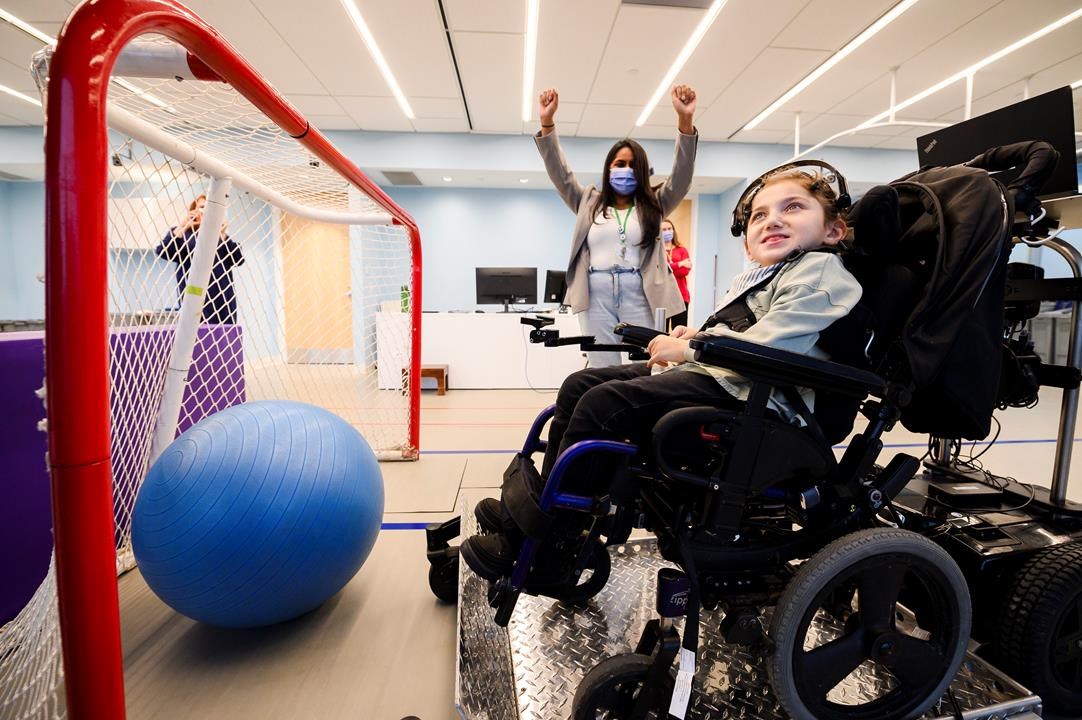
TORONTO — Eight-year-old Gisele Alnasser wants the Elmo stuffed animal sitting on a stool across the room, and she’s using her brainwaves to try and get it.
While her mother encourages Elmo to go, “Let’s go, let’s go,” Gisele concentrates as the platform under the wheelchair seems to be rolling towards Elmo on its own. She smiled as she got to her chair and her occupational therapist handed her a toy.
Gisele was diagnosed with the CAMK2b gene mutation when she was a toddler. It affects her brain’s ability to communicate with the muscles, leaving her unable to walk or move her arms much, and unable to speak.
The Brain Computer Interface Program at Toronto’s Holland Blueview Kids Rehabilitation Hospital is developing technology that allows Gisele and dozens of other disabled children to use their minds to move and play.
“[They]can’t move themselves in space,[they]don’t have reliable movement, they don’t have verbal communication, or they have difficulty communicating verbally, so in practice The only way they interact with the environment is through their thoughts,” said Susannah Van Dam, an occupational therapist and team leader for the hospital’s clinical BCI program. .
Brain-computer interfaces work like on/off switches that are triggered by electrical patterns in the brain. While wearing a headset with EEG electrodes, the child is asked to think about something specific, which acts as a “command” thought. The child is then asked to relax and bring the mind into a quiet, passive state, which acts as “stop” thinking.
The electrodes send those electrical signals to a computer, where they are stored. Through artificial intelligence, the computer is trained to recognize those specific brain patterns when it sees them again and activate or deactivate connected devices, such as Gisele’s rotating wheelchair platform.
“As long as an individual can generate activity in their brain, they can flip a switch and control that activity,” said Dr. Director Tom Chau said.
Gisele generates “command” thoughts by thinking about moving quickly in her wheelchair or by concentrating on the phrase “go, go, go.”
But whatever you think is fine. The key is for the child to concentrate while the computer records the electrical brain patterns it creates.
And when a child wants to make something happen, they think the same idea again, producing the same brain patterns that computers currently recognize.
“When[the child]sends that ‘go’ signal, the computer simply interprets it as a command to start, to start whatever is connected,” Van Dam said.
As another activity, teams connect their computers to a bubble maker. Bubbles can now appear using the same command thoughts that Gisele uses to move her wheelchair.
In the game “Freeze”, the computer is programmed to play music when she thinks of her commands. As Barney’s dance song plays, Gisele turns her music on and off, and her mother and hospital staff dance around her. Gisele smiled happily as she stopped her music and froze them in place.
“Even if you have a physical disability that prevents you from playing your favorite music or playing a video game, you can use your brain power to do it,” Van Dam said.
Gisele’s parents, Sama Darwish and Nasser Al-Nasser, said it was “amazing” to see their daughter using BCI technology.
“Like any parent, you want your children to be able to take care of themselves…to move around, to play, to learn, and everything else.” Mr. Alnasser said.
“Be yourself. Be a child.”
BCI research has been conducted around the world for decades, but in recent years a Canadian network consisting of Holland Blueview, Alberta Children’s Hospital in Calgary, and Glenrose Rehabilitation Hospital in Edmonton has recently established a Some are at the forefront of providing this technology to children and young people.
“One of the things we’ve noticed as a group of clinicians who work with children and their families is that despite the rapid advances in BCI technology, “The pediatric population was actually being ignored.” He leads the BCI program at Glenrose.
“We are trying to figure out how to make this accessible to children, learning from children and their families, how to make this emerging technology accessible in its current form, and the technology and expertise around it. We wanted to know how we could co-develop how knowledge could be developed in the future,” Andersen said, noting that Holland Blowerview’s Chow was a pioneer in the group.
On-and-off activities can help children and young people with neuromotor disorders have more control over their lives, but the development of BCI technology to help nonverbal children communicate could be the next big thing. researchers say it’s a step and a priority for parents.
“We’ve been researching communication for 20 years now, but we’ve finally reached the point where we can translate it,” Chau said.
It is hoped that in the near future, children will be able to use BCIs to use their minds to communicate their wants and needs, he said.
“[It’s]going to really unlock huge potential for kids who have basically been trapped in their own bodies,” Chau said.
“They had so much to express, but they just didn’t have the means to do it.”
This report by The Canadian Press was first published Feb. 20, 2024.
Canadian Press health coverage is supported through a partnership with the Canadian Medical Association. CP is solely responsible for this content.
Nicole Ireland, Canadian Press