

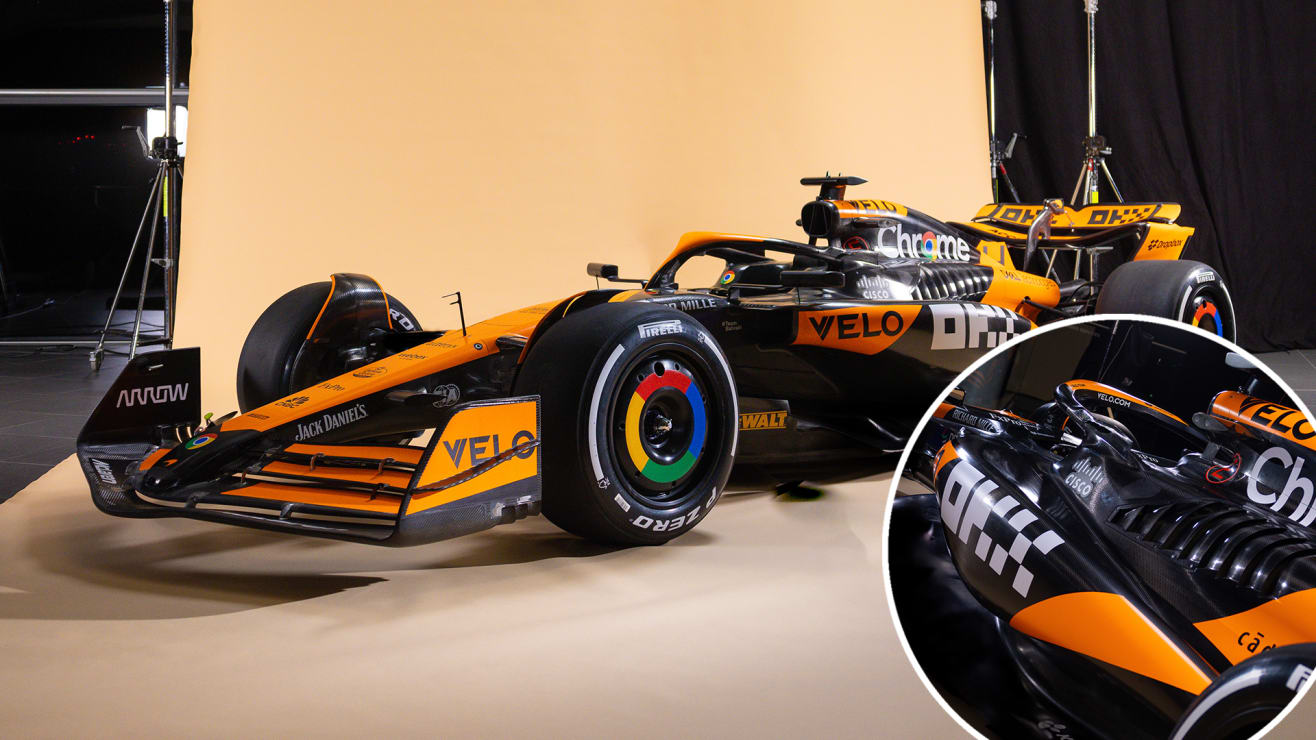
McLaren’s new MCL38 is the first car to be developed in the team’s new on-site wind tunnel, following in the direction of development seen in last year’s car’s significant upgrades. But this time, some basic physical hardpoints have been rearranged to take even more advantage of that direction.
Last year’s Austrian upgrade completely reworked the front of the sidepod to create a larger undercut and more separation of the radiator inlet from the bottom of the front of the sidepod, completely changing the car’s competitiveness. .
First look: McLaren unveils new F1 car ahead of Silverstone shakedown
On the new MCL38, its sidepods have been quite radically reworked, exposing the upper side impact bars (a Mercedes innovation for 2022), which are used aerodynamically in combination with a reinforced lip on the radiator inlet, and the upper accelerate the flow along. side pod.
As with all cars of this generation, the changes to the sidepod geometry are just the visible manifestation of efforts to enhance airflow through the underbody, where most of the performance improvement potential lies.

It’s about guiding the floor to create more ground contact effect, as well as making downforce available at the widest possible range of speeds and car attitudes to improve lap times. This always requires compromise, and as the team iterates on the design, new understanding tends to require changes to physical hardpoints in the chassis.
To improve airflow over the top of the sidepod, McLaren decided to leave space at the front of the sidepod to expose the Upper Side Impact (SIS) bar, as mentioned above. This counters the tendency of the tops of the sidepods to create lift and allows for a more efficient, less draggy airflow around the radiator intake at high speeds.
Gallery: Check out more angles of the new McLaren MCL38 Challenger
The more efficient this airflow is, the less it will impede the flow of air to the rear of the car along the underside of the sidepods and the edges of the floor. These flows are very important in really activating how strongly the diffuser works and therefore the amount of downforce the underbody produces, especially at the high ride heights found in low-speed corners.
To achieve this, more radiator area appears to have been moved from the front of the sidepods to the centerline around the cooling louvers. This comes with an increase in the height of the car’s center of gravity, but improved aerodynamics are prioritized.

Team principal Andrea Stella recently expressed great optimism about the extent of these achievements, saying: “In terms of wind tunnel development and CFD development, the gradient that we established last year led to the Austrian development, and then the Singapore development, which looks like it could be sustained. So I would expect the launch car to be there at the beginning of the season. I am.”
The MCL38 follows the trend of increasing anti-dive levels in the front suspension, with the rear upper wishbone mounted lower. This is to keep the aerodynamic platform flatter when the car attempts to pitch or dive.
Watch: The amazing story of how the McLaren MP4/4 redefined supremacy in F1
As Stella emphasizes, the wind tunnel is not the only practical application of this car. “It has been developed in new simulators and composite and metal parts are being produced in new manufacturing infrastructure and facilities that we have delivered,” he added.
Changes to the car from last year, made possible by new physical hardpoints, should result in further platforming, and Stella hints at that. He added: “Behind the scenes, we have already started working on further developments that we hope to realize relatively early in the season, and those are likely to be very interesting as well.”