

Xreal has made a name for itself with its amazing-looking augmented reality glasses, which put a display in front of your eyes, allowing you to watch TV and play games on a giant screen projected just for you. But unlike, say, Apple’s Vision Pro or Meta’s Quest 3, Xreal doesn’t have any software or content built into it — it’s just a screen inside the glasses. This is great in that it lets you connect lots of other devices, but it limits the kinds of things you can do with the glasses.
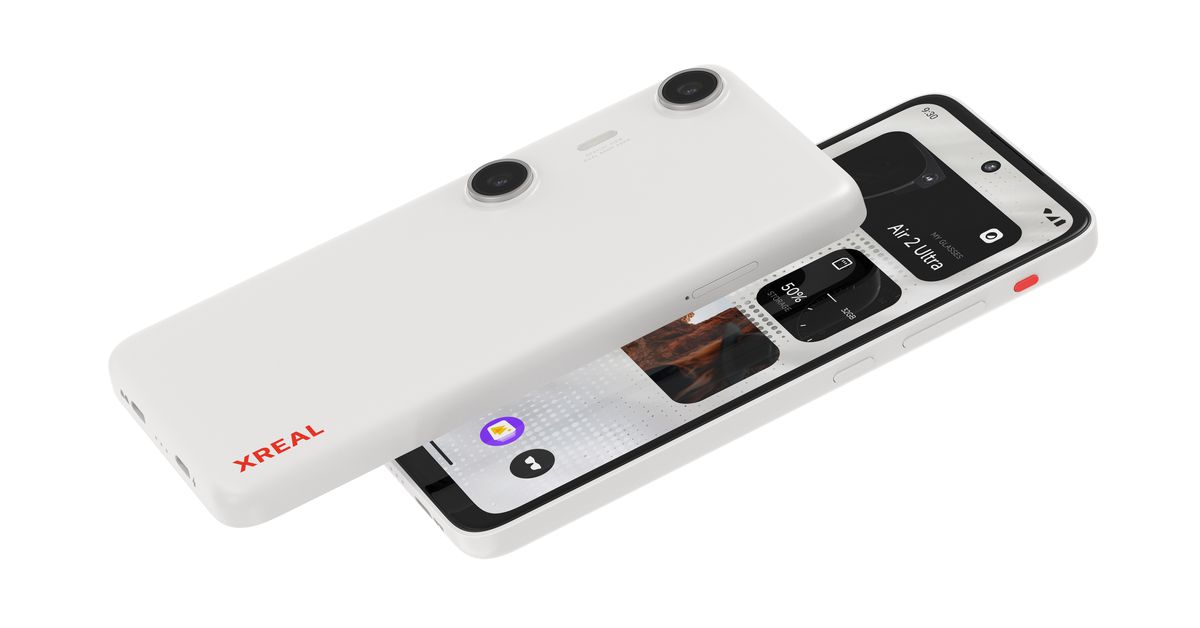
The new Beam Pro is Xreal’s latest attempt to fill that gap. It’s a handheld device about the size of a smartphone, but Xreal thinks of it as a companion to the glasses. It runs a customized version of Android 14 (Xreal calls it NebulaOS), and you should be able to load most apps onto the face screen. There’s also a dual-lens camera on the back that can shoot spatial and 3D video for viewing on the glasses (or Vision Pro can shoot it; Xreal says Beam Pro footage can also be played on Apple’s headset).
The specs here are pure smartphone. The Beam Pro has a 6.5-inch, 2400 x 1800 screen, runs on a Qualcomm Snapdragon processor (it’s unclear which), has 6GB or 8GB of RAM, and 128GB or 256GB of storage. The cheapest model is $199, but you probably won’t want it unless you’re willing to shell out a few hundred for Xreal Glasses.
However, there are some telltale signs that this is no ordinary Android phone. First, there’s a dual 50MP camera, something we don’t see much of on smartphones these days. The Beam Pro also has two USB-C ports, so you can charge the device and connect to the glasses at the same time. NebulaOS’ tweaks to Android are also all about AR. When you connect the glasses, you can use the Beam’s screen as a touchpad, and the device is designed to have two apps open side-by-side in your field of view. When you first connect the glasses, a home screen of the app will pop up, which you can open and interact with using the Beam Pro as a remote.
The Beam Pro looks like a big upgrade over the Beam, which was basically just a remote control for Xreal Glasses. While the Beam certainly solved a problem for Xreal owners, it did have some issues. Many reviewers and users found it clunky and unreliable, and Xreal struggled to explain to users why the product even existed in the first place. The screen makes the Pro much easier to use, and the camera makes it more than just a smartphone replacement. Sure, you can still use Xreal Glasses with a Steam Deck or by connecting your smartphone, but this feels like a more integrated approach.
Xreal’s approach few Xreal is more integrated than the offerings from Apple and Meta, both of which are determined to put an entire computer on your face. But there’s something clever about what Xreal is doing: using a fully-fledged device category to do all the heavy lifting, with as little strain on your face as possible. For now, at least, it feels like a smart strategy.