

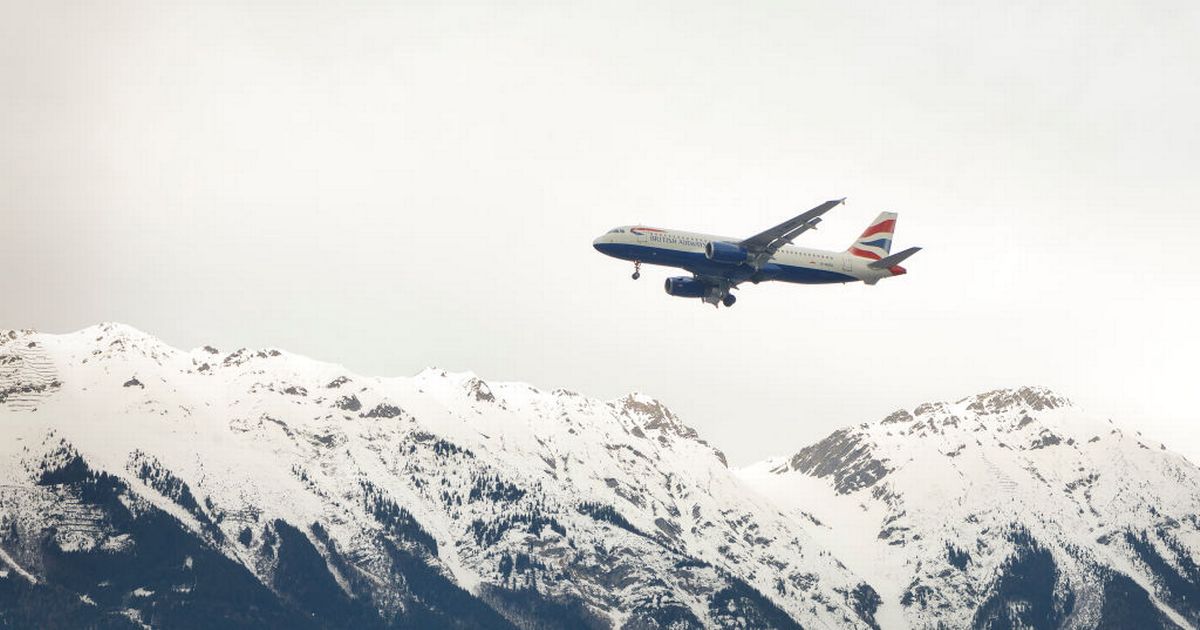
The world’s most turbulent flights have been announced, with two European short-haul flights making the list. This data follows a recent incident in which a Singapore Airlines flight plummeted 6,000 feet due to turbulence.
New data reveals the most disruptive flight routes around the world from more than 150,000 long- and short-haul flight records.
Two short-haul flights across Europe feature in the top 10 of the world’s most turbulent flights, according to turbulence prediction website Turbli. The one-hour hopper flights between Milan-Geneva and Milan-Zurich ranked fifth and tenth on the list, respectively. Topping the list was the 1,905km journey between Santiago in Chile and Santa Cruz in Bolivia.
The latest ranking comes after a Singapore Airlines flight encountered severe turbulence, killing a 73-year-old British man on board. The Boeing 777 jet hit an air bubble and plummeted 6,000 feet in five minutes before making an emergency landing at Bangkok airport in Thailand. There were 211 passengers and 18 crew on board.
While turbulence is usually harmless and common on long-haul flights, a sudden ascent or descent of an aircraft can injure passengers and crew and/or damage the aircraft itself. Disturbances are usually ranked on a scale from “minor” to “severe.”
Turbli ranked flights using the “Eddy Dissipation Ratio” (EDR), which measures the intensity of turbulence at a particular point — for example, 0-20 is mild turbulence, while 80-100 is extreme turbulence.
Topping the list is the 1,905km route from Santiago, Chile to Viru Viru International Airport in Santa Cruz, Bolivia. The average EDR for this flight was 17.5. The second most shaking flight was a 210-mile flight from Almaty, Kazakhstan, to Bishkek, the capital of Kyrgyzstan. EDR was 17.4.
Six of the top 10 routes are in Japan and China, which Tabri attributes to atmospheric turbulence caused by a more active jet stream. The most turbulent European route was the 132-mile flight path from Milan to Geneva, with an EDR of 16.3. By comparison, routes around the United States were less turbulent than the most turbulent routes in Europe. The most turbulent U.S. route was the 441-mile flight path from Nashville to Raleigh, with an average EDR of 14.7.
Just like waves hitting rocks, turbulence is also caused by wind hitting mountains and turbulence in the air called “mountain waves.” Disturbed air causes turbulence, which can cause planes to shake as they pass. Thunderstorms usually cause the most severe turbulence because they create huge vertical flows of violent air.
Singapore Airlines flight SQ321, heading from London Heathrow Airport to Singapore Changi Airport, plummeted 6,000 feet in severe turbulence on Tuesday. The plane landed at Suvarnabhumi International Airport in Bangkok, Thailand, and made an emergency landing shortly before 4pm local time. The plane was picked up by 13 ambulances and transported dozens of passengers to hospitals. Singapore Airlines confirmed that 47 of the 211 passengers were British.
Despite the recent incident with Flight SQ321, accidents involving Singapore Airlines are rare and the airline frequently ranks among the top 20 safest airlines in the world. In 2023, it was ranked 5th.
According to Turbli, the top 10 most turbulent routes in the world are:
1. Santiago (SCL) – Santa Cruz (VVI)
2. Almaty (ALA) – Bishkek (FRU)
3. Lanzhou (LHW) – Chengdu (CTU)
4. Centrair (NGO) – Sendai (SDJ)
5. Milan (MXP) – Geneva (GVA)
6. Lanzhou (LHW) – Xianyang (XIY)
7. Osaka (KIX) – Sendai (SDJ)
8. Xianyang (XIY) – Chengdu (CTU)
9. Xianyang (XIY) – Chongqing (CKG)
10. Milan (MXP) – Zurich (ZRH)