

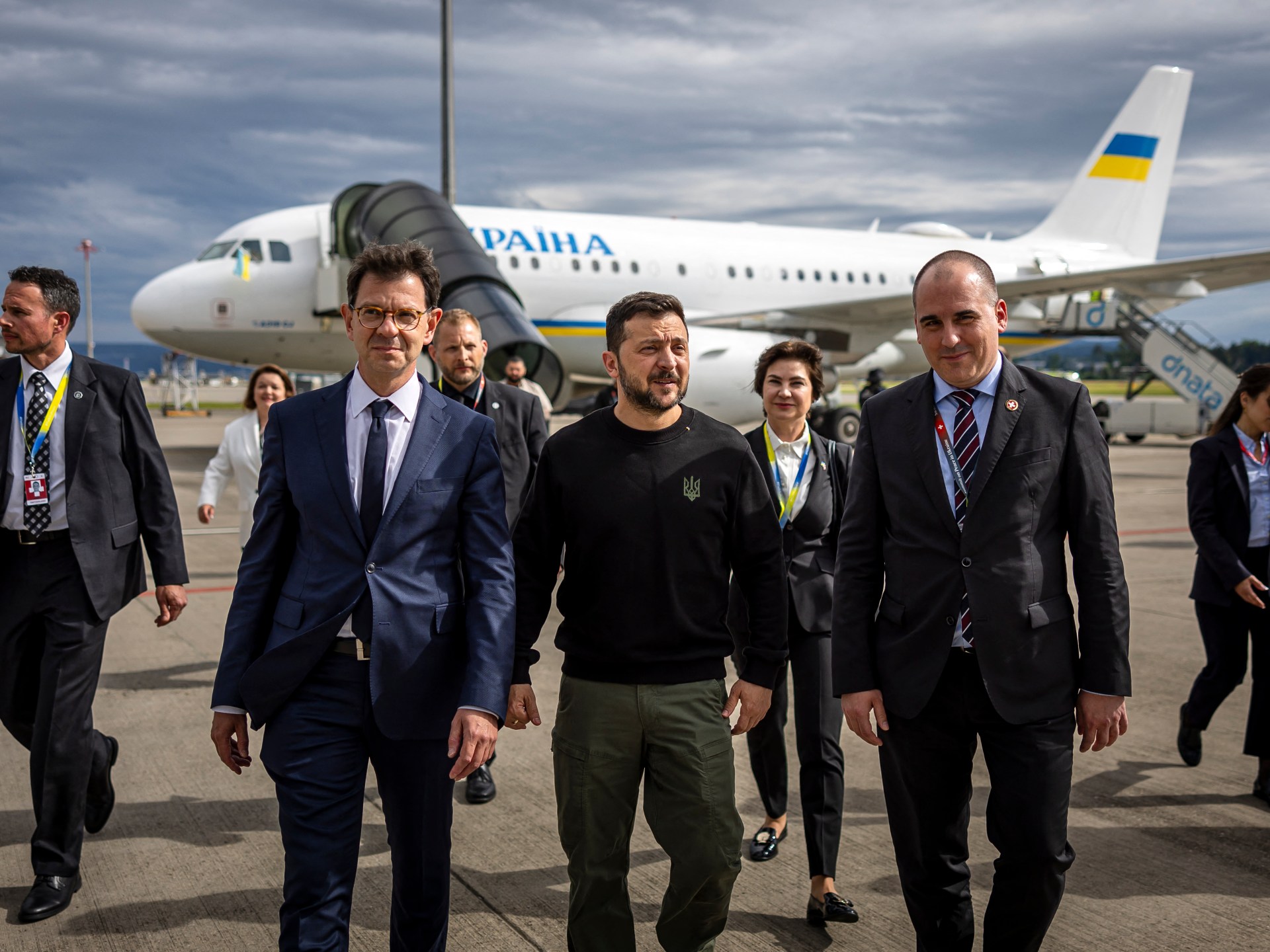
World leaders are gathering in Switzerland for a summit aimed at pressuring Russia to end the war in Ukraine, but the absence of Moscow’s powerful allies such as China is expected to weaken its potential impact.
The summit, which began on Saturday, was attended by US Vice President Kamala Harris and the leaders of Britain, Canada, France, Germany, Italy and Japan, along with Ukrainian President Volodymyr Zelensky.
In total, Switzerland, the host country, said more than 50 heads of state were due to attend, along with foreign ministers and junior delegations from dozens of other countries, including India, Turkey and Hungary, which have warmer ties with Russia.
However, China has refrained from attending the conference after Russia dismissed it as “useless” and was barred from attending.
China’s absence has diminished Western hopes of isolating Russia, while recent military setbacks on the battlefield have left Ukrainian forces at a disadvantage.
“The summit risks showing the limits of Ukrainian diplomacy,” said Richard Gowan, U.N. director at the International Crisis Group.
“But this is also an opportunity for Ukraine to remind the world that it adheres to the principles of the UN Charter.”
However, President Zelenskyy predicted “history will be made” at the meeting, speaking to reporters on Saturday.
President Zelenskyy, speaking alongside his Swiss counterpart Viola Amherd, said the meeting itself was already a positive development.
“We have succeeded in reintroducing to the world the idea that through joint efforts we can stop wars and establish a just peace,” he said.
He added that attendees must decide “what a just peace means for the world and how to achieve it in a lasting way.”
That vision could be “communicated to Russian representatives,” he said.
Meanwhile, German Chancellor Olaf Scholz called the meeting an important step towards progress.
“Many issues related to peace and security will be discussed, but the most important issues will not be discussed. That was the original plan,” he told Welt TV in an interview before leaving for Switzerland.
“It’s a small plant that needs to be watered, but of course with the prospect that much more will come from it.”
Meanwhile, Polish President Andrzej Duda said the summit was aimed at making geographically separated countries realise the magnitude of the threat Russia poses to the world.
Moscow’s demands
Russian President Vladimir Putin said Friday that Russia would end the war if Ukraine abandoned its ambitions to join NATO and agreed to hand over all four provinces claimed by Moscow, a demand that Kiev swiftly rejected as tantamount to surrender.
Ukraine, the United States and other Western allies quickly rejected Putin’s request, but Scholz said “everyone knows that the proposal was not taken seriously and had something to do with the peace conference in Switzerland.”
On Saturday, European Commission President Ursula von der Leyen warned that she would oppose any deal that would allow Russia to remain on Ukrainian territory.
“Freezing the conflict while foreign forces are occupying Ukrainian territory is not a solution,” she said. “It will only invite future wars of aggression.”
“Instead, we need to support a comprehensive, just and sustainable peace that restores Ukraine’s sovereignty and territorial integrity,” she said.
Still, some see Putin’s comments as reflecting growing confidence that the Russian military has the advantage in war.
Russian forces already control large swaths of eastern and southern Ukraine and have been expanding their territory in recent months.
But Ukrainian forces have recently recaptured large swathes of territory, particularly near the southern city of Kherson and the northern city of Kharkiv.
Peter Zalmayev, director of the Eurasian Democracy Initiative (EDI), told Al Jazeera from Kiev that a pledge made by G7 leaders earlier this week to use interest on frozen Russian funds to fund a $50 billion loan to Ukraine would provide a “lifeline”.
Still, he said the war remains “one-sided” in Moscow’s favor and has already become a war of attrition for both sides.
Talks were probably the only way to broker an eventual peace, he said, adding that “the two sides have remained apart throughout this entire conflict.”
Russia frames its so-called special military operations in Ukraine as part of a broader struggle with Western countries seeking to bring Russia to its knees.
Ukraine and the West reject this and accuse Russia of waging an illegal war of conquest.