

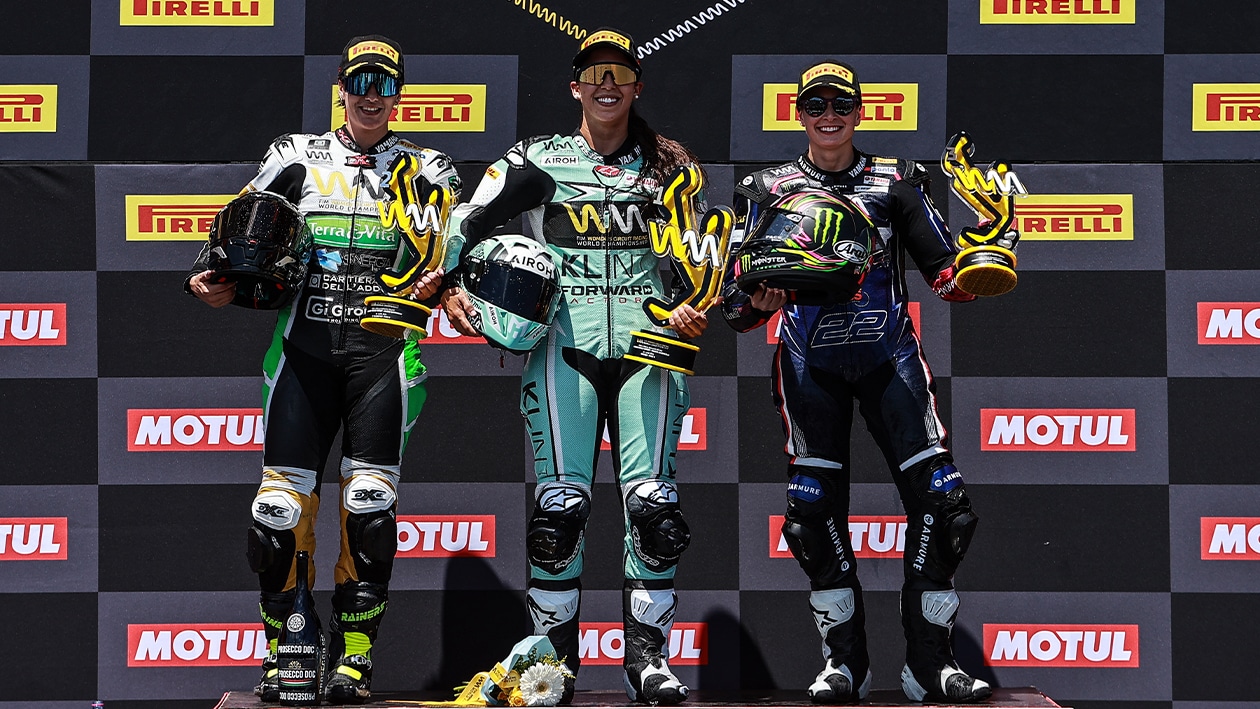
It’s been a long journey for female bike racers…
In October 1962, the FIM (Fédération Internationale de Motorcycling) banned women from competing in the solo motorcycle world championships. This was the governing body’s response to the ambitions of Britain’s Beryl Swain, who had competed in the 1963 50cc World Championship and was set to become the first woman rider in the world championships.
When the news reached the FIM, the reaction was swift: Count Giovanni Lurani Cernuschi and his sporting committee were against women taking part in the races, fearing that “in the event of a fatal accident, it would bring the sport into disrepute”. Curiously, this fear did not apply to women in sidecars.
“One of my motivations is to encourage other women to follow their dreams.”
Swain appealed the decision, but was simply told that “no one wants to think that someone so attractive would get hurt racing a bike,” and as a result, she gave up a promising racing career.
There is no evidence that this rule was ever overturned, so perhaps it was quietly forgotten as the FIM adopted a more progressive stance in line with the times.
Since then, many female motorcycle racers have made history. In 1989, Finn-Tal Rinne became the first woman to score world championship points and lead a GP in the West German 125cc race at Hockenheim. In 2001, Germany’s Katja Poensgen became the first woman to score points in a 250cc GP. In 2018, Spain’s Ana Carrasco became the first woman to win a road racing world title in the SSP300 class.
And last weekend at Misano, Maria Herrera, riding a Yamaha R7 twin, won the first-ever women’s world championship race in the WCR (FIM Women’s Circuit Racing World Championship), a one-make series that runs alongside the World Superbike championship.
The FIM World Series was established in 2020 and is the next step after the FIM Women’s European Championship which uses SSP300 bikes.
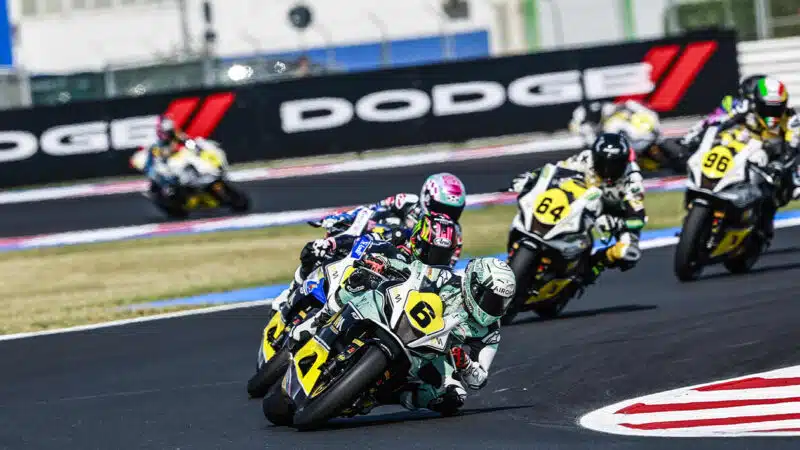
In the second race on Sunday, Herrera led Carrasco, Neira, Sanchez and Roberta Ponziani, all riding the same Yamaha R7.
WSBK/Dorna
There has been much debate in recent years about the merits of a women-only road racing championship, but the Women’s Motocross World Championship has been running for 20 years, and while many female road racers would prefer to continue racing with men, they also see the benefit of having their own series, which would increase their profile and encourage more women to take up motorbike racing.
“I don’t think we need an all-female championship, but we can use it to inspire other women,” said Mallory Dobbs, the only American in WCR. “One of the things that motivates me in my work is to encourage other women to follow their dreams and do what they love, whether that be in motorsport or not.”
“The WCR gives us opportunities we wouldn’t have otherwise. I think the sport needs to appeal to a wider audience and get more people involved.”
Dobbs earned points in Sunday’s second WCR race after crashing in race one where he was gunning for a top-10 finish.
There was chaos throughout the weekend, with Race 1 being red-flagged twice. Mia Rusten of Norway suffered severe head injuries in a crash and subsequently underwent surgery to relieve a brain bleed and intracranial pressure. She remains in hospital in a stable condition.
Herrera followed up his opening race win with another win on Sunday, but both victories were hard won, having been in a relentless battle with Carrasco in Race 1. The pair have a bad relationship and things are likely to get even worse after their last-lap collision.
Herrera won a four-way battle on Sunday, her biggest rival this time being Sara Sanchez, who she beat by just 0.085 seconds, while Carrasco battled chattering problems to finish third ahead of Beatriz Neira, who has won every Women’s European Championship to date.
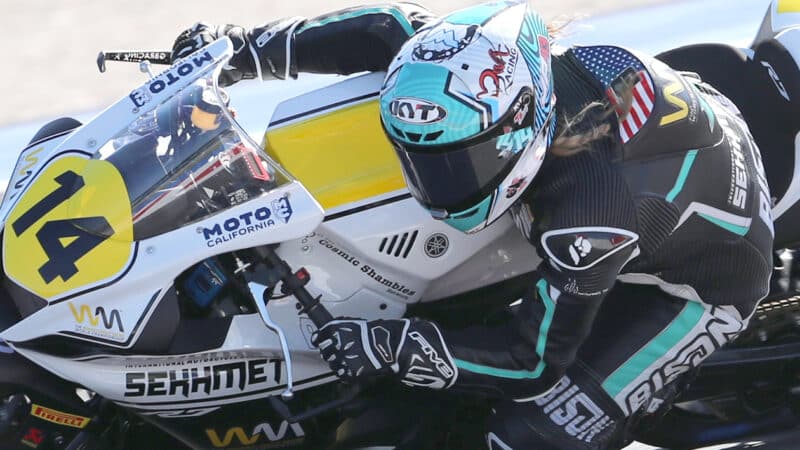
Sekhmet Racing’s Dobbs crashed in the first race and finished in the points in the second race.
Sekhmet Racing
Crashes, injuries and obvious animosity between the top riders – the WCR has already proven that women’s racing isn’t all that different from men’s.
on the other hand…
“The atmosphere is definitely a bit different,” added Dobbs, who rides for the UK-based Sekhmet team. “It’s been great so far and we’re all getting to know each other, but it was quite stressful over the weekend because there was a lot of pressure. We’re on the world stage and we all want to do well.”
“In any sport, at the top level, there are some people who are not so nice, so for me, the great ones are the kind and humble ones. I’m really glad I met Maria.” [Herrera] I’ll be talking to her about riding and racing. I asked her a lot of questions and I think she’ll be a great source of information. She’s a very good racer and it’s great that she’s willing to help and support me.”