

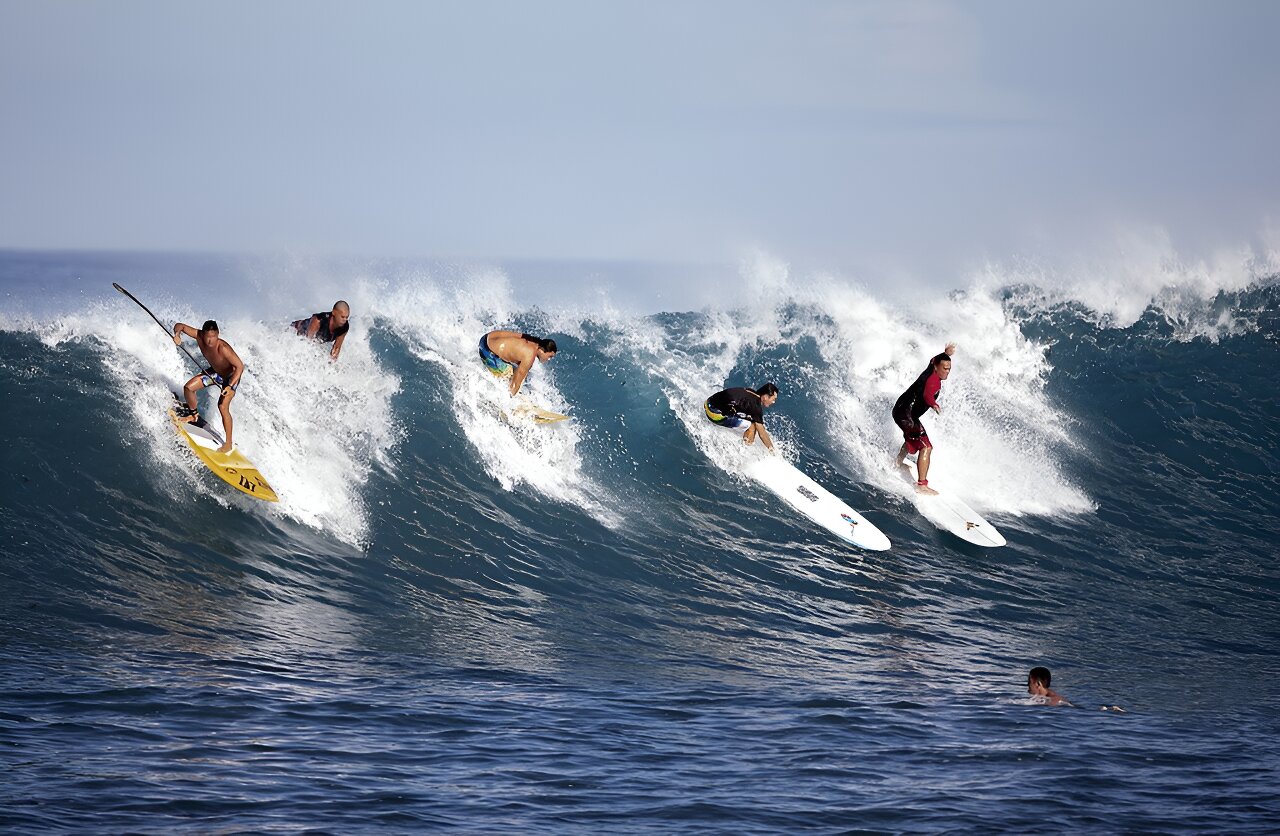
A surfer rides a wave in Paea, Tahiti.Credit: Brigittebourger Brigitte Bourger, via Wikimedia Commons
× close
A surfer rides a wave in Paea, Tahiti.Credit: Brigittebourger Brigitte Bourger, via Wikimedia Commons
Last year, the International Olympic Committee announced that the two-day surfing competition at the 2024 Paris Summer Games would be held on the South Pacific island of Tahiti. The location in question, Te Aupoo, is revered among surfers for the speed and ferocity of its legendary waves. The abundance of food available here, the pristine clarity of the lagoons where families swim, and the vibrant coral reefs are equally revered by locals.
Currently, the commission plans to install a 1,615-square-foot aluminum referee tower in the middle of this iconic reef. The structure will include more than 130 drill holes in the reef to lay the concrete foundations. The permanence of the towers and the necessary construction could cause irreparable damage to coral reefs. It is also likely to destroy local marine ecosystems.
Ajit Subramaniam, a biological oceanographer at Columbia Climate School’s Lamont-Doherty Earth Observatory, expressed concern about the feasibility of mitigation measures. On average, corals grow at a rate of about 1 centimeter per year, which means that “planting new corals can take longer to grow to compensate for or replace reef damage caused by construction.” “Yes,” he says. Why should such a fragile ecosystem be damaged, especially since Olympic visitors are likely to visit Tahiti not only for the surfing competition, but also for its natural beauty? he has doubts.
Carly Kenkel, assistant professor of biological sciences in the department of marine and environmental biology at the University of Southern California, believes the size of the tower necessitates removing some of the coral from the site. However, coral reefs are not 100% coral. According to data, approximately 24% of Tahiti’s reefs are covered by coral. Coupled with the fact that the average water temperature in this region is 1-2 °C higher than normal, any relocation project must take special care to ensure the safety of the corals that reside there.
Plans are reportedly underway to relocate some of the coral, but with just six months until the opening ceremony, more than 1,000 live corals (representing 24 species) will be safely relocated from the site. is a difficult task. One estimate claims that construction and implementation of the tower could cause $1.3 million in ecological damage. In December, footage emerged of a construction barge tearing apart a shallow coral reef with its propellers in an attempt to create a safe passage into the lagoon.
“We can’t afford to lose coral by mistake these days. This year is predicted to be a year of major bleaching, so anything that puts further stress on coral reefs should be avoided, especially this year.” says Kenkel.
Paris 2024 claims to be focused on sustainability, with its website pledging a pledge to halve emissions. It also said that 95% of its events will use existing or temporary venues, and that unavoidable emissions will be offset.
Beijing 2022 touted similarly lofty sustainability claims, with a goal of 100% carbon neutrality. However, millions of gallons of water and potentially dangerous chemicals were used to create the large amounts of artificial snow needed for these events. Thousands of trees were uprooted to build the ski center.
Although the Olympics have claimed to be more environmentally responsible with each cycle, they have actually become less sustainable over time. There are countless reasons for this, but two are particularly noteworthy.
First is the scale of the event. Spectators, officials and athletes fly in from all over the world. While the Olympics’ commitment to 100% clean energy is commendable, the energy grid may prove to be lacking some capacity. Some countries will ignore 100% clean pledges to keep athletes fit if renewable energy proves insufficient to keep athletes cool during the hottest months of the year I haven’t ruled out the possibility.
Another problem is the Olympics’ focus on carbon reduction. Carbon reduction is important, but relying on offsets as a tool is problematic, as they are notoriously difficult to track and quantify. Even if all the carbon emitted during the Games were truly offset, what about other environmental concerns? The roots of protests against Tahiti’s towers lie not in carbon, but in ecosystems and tradition.
Protecting our environment starts with not damaging it. All too often, countries with historically low emissions are bearing the brunt of the impacts of developed economies like France. For a convention committed to having a very low environmental impact, installing permanent equipment for a two-day event is overkill.
The goals set for Paris 2024 are laudable. But they threaten to be revoked if such heavy marks are left on pristine sites. Because, after all, long after the Olympics are over, the people living around the lagoon will have to look at that tower every day and be reminded of how their world has changed.