

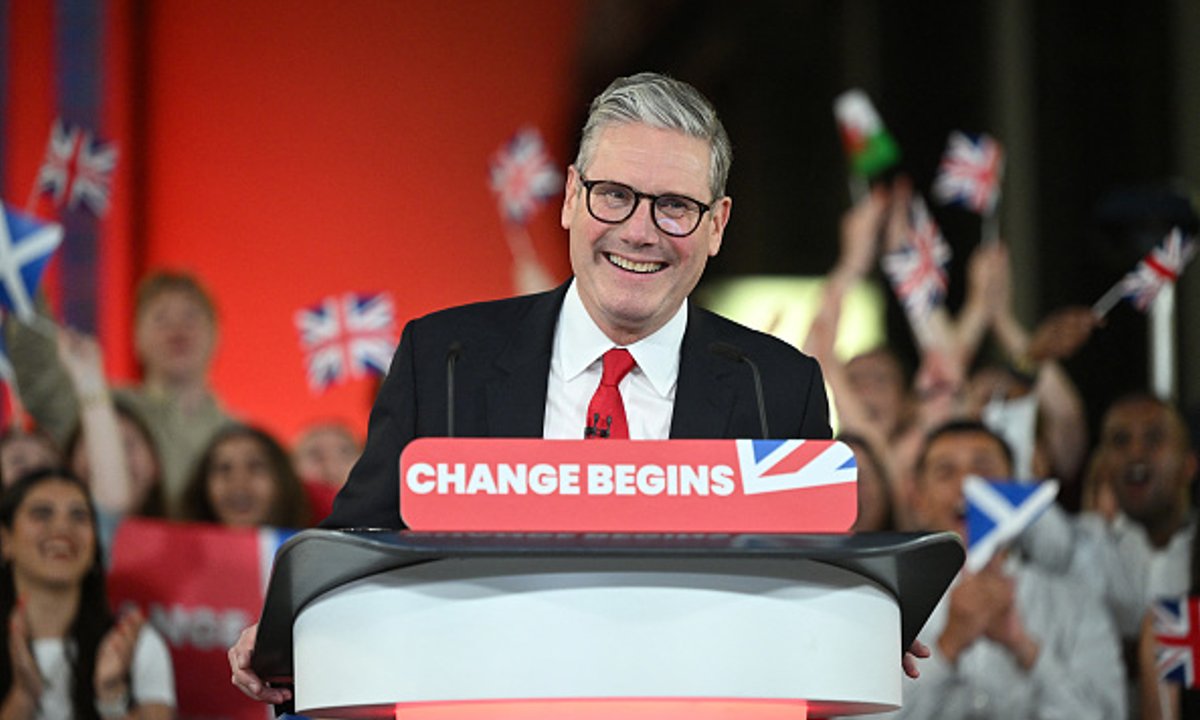
The Labour Party won a landslide majority in the UK general election, and its leader Keir Starmer will enter 10 Downing Street today with 410 seats (the Conservatives have so far secured 119 seats, the Liberal Democrats 71). With such compelling support, arts workers will be looking to see if the cultural sector will be transformed in some way, possibly through extra funding (Labour published its Arts and Culture Plan in early June). Following Labour’s victory, we asked some prominent figures in the arts world what they expect from the new Labour government.
Tristram Hunt, director of the Victoria and Albert Museum in London
In no particular order, emergency financial support for local museums on the brink of insolvency, working towards a faster and more transparent process for appointing trustees, the Treasury approving exhibition tax relief for museums and galleries, establishing a Soft Power Council to support the UK’s creative industries, restructuring European Union relations to support smoother movement of creative practitioners, musicians and young people between the UK and the continent, including infrastructure and maintenance for museums and galleries in Green New Deal funding, and freedom for Mayors to introduce a hotel tax to fund arts and culture.
Tiffany Jenkins, author Keeping their marbles: How treasures from the past ended up in museums and why they should be kept there
I call on this Labour government to welcome the arts with the same enthusiasm as the previous Labour government, but avoid instrumentalizing them. The arts should be defended for their own sake, freed from irrelevant demands imposed by policymakers and pundits. I call on the government to abandon snobbish and crass expectations that culture should strengthen economies or identity, promote diversity, address climate change, or any other of today’s fashionable objectives. Instead, the government should seek to recognise and value the arts’ most important and essential role: the pursuit of beauty and truth. This approach will benefit everyone, now and in the future.
Ryan Gander, artist
The understanding that ephemeral things are more valuable than material things. Conservatives have made us obsessed with understanding the world through possessions, things, money, and growth. We need magic, stories, memories, conversations, relationships, and other values that are intangible and immeasurable. YOLO [you only live once]And you can’t take it home with you. It was never right.
Sally Bacon, Co-Chair of the Cultural Learning Alliance
The Cultural Learning Alliance wants to abolish the EBacc (English Baccalaureate) because it excludes the arts. And Labour’s planned curriculum and assessment review is really bold and ambitious, firstly addressing the purpose of schooling and ensuring that equivalent curriculum areas, including expressive arts, are aligned with new, clearer purposes. We need to provide all students with a holistic educational experience that is future-proof.
Martin Clarke, director of the Camden Arts Centre in London
I hope the new government will not only understand and promote the value and contribution of arts and culture, but also recognise that a relatively small economic investment in museums and galleries – one of the few areas in which this country continues to lead the world – will have a disproportionately transformative effect on institutions and communities across the UK. The figures needed to improve the NHS, social care, schools and more are staggering. The figures needed to transform access to life-changing arts and culture for millions of people are modest in comparison.
Aaron Cesar, Director of the Delfina Foundation (London)
Given that direct funding for the arts is quite low on the list of priorities, I would like to see a Labour government implement tax incentives for charitable donations. All parties seem to expect private charities to make up the shortfall, but there is virtually no incentive for individuals or businesses to do so. Relatedly, Labour needs to carefully consider the negative impacts of its policies on non-residents. [non-domiciled residents] People who make significant charitable contributions to the arts and other fields.
Wendor Grosvenor, art historian and broadcaster, Art Newspaper
My hope is that Labour will fully implement their (fantastic) creative industries manifesto, which includes greater distribution of art from national galleries to local areas and open access to museum images. Both policies will incur resistance from the national galleries’ leadership team, who don’t really like change, but need to be implemented immediately to nurture future audiences.
Joe Scotland, Director of Studio Voltaire, London
Support and protect the rights of transgender people.
Jenny Waldman, director of the Art Fund
Museums and galleries play a vital role in improving wellbeing, education, economic growth and enjoyment in communities across the UK. I hope that a Labour government will take some important first steps, including a strategic investment and review of local authority funding, a Museum Collections Bill to support the sharing of collections, and a national curriculum to encourage every schoolchild to visit a museum or art gallery every year.
Axel Lueger, Secretary and Chief Executive, Royal Academy of Arts, London
We welcome the new Labour government and its determination to build back a prosperous and welcoming Britain.
The Royal Academy of Arts is an independent charity and does not receive government funding, but we look forward to supporting and working with them in their ambitions in culture, education, tourism and employment.
Arts education is at the heart of our mission and our wish list includes a passionate DCMS Secretary who will work closely with the Department for Education to ensure that arts education is at the heart of the school curriculum, delivering for all the benefits to children, society and the economy. The arts are a serious subject.
They would also like to see greater support for young international artists by the government increasing the number of visas awarded to students who want to study in the UK. Currently, RA schools can only accept British citizens or those with the right to remain, settled status or special talent visas.
Finally, we will further recognise the vital role of culture in the UK economy and aim to increase our efforts to boost tourism, reintroduce duty free shopping, improve transport and create jobs in the cultural and creative sectors.