

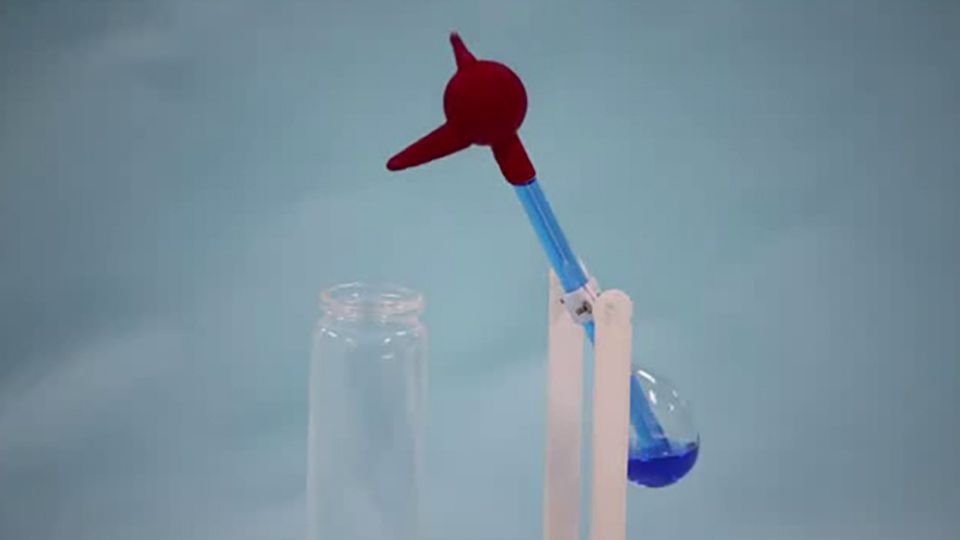
The top-hatted “drinking bird” once commonly used in science classes to illustrate the fundamentals of thermodynamics is making a surprising comeback — as the inspiration for new clean-energy generators that may one day power your watch or cell phone.
Scientists in Hong Kong and China have developed an engine that can harness the power of water evaporation to generate electricity using a famous toy also known as “Dippy Bird,” they said in a research paper published Thursday in Devices magazine.
The new method works by converting the energy produced by the birds’ characteristic back and forth motion into electricity.
The physical principle behind it is relatively simple: the toy consists of two glass spheres representing the bird’s head and body, connected by a long glass tube, which contains methylene chloride, a highly volatile liquid.
If you dip the bird’s beak into a glass of water, it will naturally return to an upright position and the water will begin to evaporate and cool its head, which causes the pressure difference to force volatile liquid up the tube from the lower valve, as a result of which the bird’s center of gravity will begin to shift and the beak will tilt back into the water.
It’s a process that has entertained generations of children and adults alike, and it’s also a process that occurs naturally on Earth and can be harnessed to generate clean energy.
In nature, evaporation occurs when sunlight warms the Earth’s surface and breaks the bonds that hold water molecules together. This converts liquid water from oceans, lakes, and other surface waters into steam. This is what powers Earth’s natural water cycle.
According to the study, this process consumes half of the solar energy absorbed by the Earth’s surface, resulting in “the largest energy transfer on Earth.”
If scientists could capture this energy and convert it into electricity, it could create “a huge opportunity for renewable energy,” the authors say.
Lead author Hao Wu, a professor at South China University of Technology, said the drinking bird’s method was a “unique” way to generate electricity using water, a “readily available fuel source”.
“I’m still amazed and excited when I see the actual results,” Wu said.
During his doctoral studies, Wu realised that the drinking bird model was more than just a tool to illustrate a physics concept.
“We started thinking about how we could convert the energy of evaporation into mechanical energy and then convert it into electricity,” Wu says, “and then we came up with the idea of using a drinking bird toy.”
Wu and his colleagues attached two nanogenerator modules — tiny devices that convert mechanical energy into electricity — to either side of a bird “engine” they made from commercially available toys.
The researchers then tested the prototype’s ability to power a variety of electronic devices in ambient conditions, including liquid crystal displays (LCDs), temperature sensors, and calculators, with the goal that in future the generator could be used in common everyday devices.
Previous attempts to convert evaporation energy into electricity have suffered from low conversion efficiency, but using the drinking bird method, scientists have succeeded in using just 100 milliliters of water to generate an output of 100 volts, enough to power small electronic devices.
The authors claim that their drinking bird generator can produce much more power than previous experiments using other methods.
The team’s next goal is to design their own drinking bird that can harness the power of evaporation more efficiently.
If they’re successful, retro drinking birds might be here to stay.
For more CNN news and newsletters, create an account on CNN.com.