

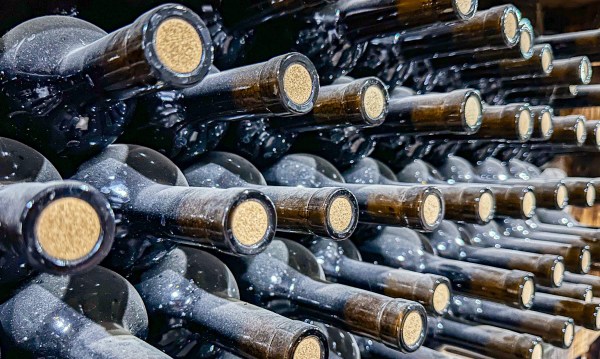

Archaeologists have discovered the world’s oldest wine jar, dating back nearly 2,000 years.
You might think this is a pretty cool vintage find, but unfortunately the jar also contained something else.
It’s got all the human remains mixed in. It’s delicious.
In 2019, a Roman tomb was discovered in Carmona, Spain, containing a variety of burial urns and the remains of a man and a woman.
One of the urns contained a reddish liquid along with the remains of cremated bones.
Because wine had religious significance in the ancient Roman world, the team, led by Professor José Rafael Ruiz Arebola of the University of Córdoba, suspected that it may have once been wine, but after such a long period of time the drink would usually deteriorate, lose its essential characteristics and no longer be considered wine.

The team analysed the liquid (rather than drinking it) for indicators such as acidity, the absence of organic matter that would have disappeared over 2,000 years, and mineral salts.
More rigorous testing included determining whether certain elements or chemicals, such as potassium levels, came from the wine or cremated remains.
But the key to determining whether the liquid was still wine hinged on the presence of polyphenols, a biomarker found in all wines.
Although the team was not sure where the wine was made, they found seven specific polyphenols that are also found in wines from the nearby Andalusian wine regions of Montilla-Moriles, Jerez and Sanlúcar.

Finally, the absence of a specific polyphenol, syringic acid, also indicates that the wine was originally white, despite its current reddish color.
Carmona archaeologist Juan Manuel Roman said the team was very surprised to find liquid still preserved in the burial jar, given its antiquity. The fact that it was still wine was even more shocking, but the tomb was completely intact and tightly sealed, and had never leaked or been flooded, making it perfect for drinking.
The discovery, reported in the Journal of Archaeological Science, means that the “new” wine breaks the previous record held by a bottle discovered in 1867 that was thought to date to the 4th century AD.

And in another rather sexist twist to this story, it appears that it was no coincidence that a man’s body was in the wine.
In ancient Rome, women were forbidden to drink alcohol. Apparently, it was a “man’s drink.” Instead, the woman’s body was buried with three amber jewels, a patchouli-scented perfume bottle, and remnants of fabric, which initial analysis suggests were made of silk.
Relics were often buried with their loved ones to accompany them on their journey to the afterlife. As in many other societies, death had a special meaning in ancient Rome, and people wanted to be remembered.
Thanks to their incredible state of preservation, 2000 years later, these men and women have not been forgotten and are in fact making news headlines.
Read more: Major breakthrough in fight to treat and prevent Parkinson’s
MORE: Would you let this creepy robot chauffeur take the wheel?
Read more: Major breakthrough in treating depression
Get the latest news, inspiring stories, analysis and more you need to know
This site is protected by reCAPTCHA and the Google Privacy Policy and Terms of Service apply.