

In contemporary China, Chinese traditional mythology referring to Chinese history, Chinese style and Chinese spirit continually contributes to the national construction of Chinese popular culture (i.e. films, TV, animations and games) within the Chinese political framework of soft power. Scholars (Lent and Xu, 2010; Chen and Lau, 2021) state that contemporary Chinese animated films apply Chinese cultural heritages to produce a popular culture that fulfils the political imperatives on the one hand, and attracts international audiences on the other hand. For example, two computer-animated films including Monkey King Hero is Back (2015) and Nezha Zhi Motong Jiangshi (hereafter Montong Jiangshi, 2019) derive from Daoism and Buddhism that have achieved great success in the Chinese film market.
The nationalist project of ‘Chinese soft power’ strengthens the Chinese screen culture in global film markets (Clark, 2018; Fan, 2018). Scholars (Voci and Luo, 2018; Fan, 2018; Frangville, 2018; Zhang, 2018) suggest that the post-socialist cinema and the influence-seeking project of ‘Chinese soft power’ should reconsider a Chinese-inflected humanism which constitutes modern values across geopolitical borders and nationalistic discourses. Through examining the film of Motong Jiangshi (2019), this article argues that contemporary Chinese blockbuster reflects an ideological change that the discourse of ‘Chinese soft power’ states the power of Chinese culture and humanism within a modern and scientific paradigm, which promotes the Chinese national identity and national style are more international.
Chen and Lau (2021) point out that the stereoscopic and computer-animated feature film, Motong Jiangshi (2019) was released in China and the international film market in 2019 and made more than US$742 million at the box office in 2021. Buchan (2013, p. 2) elaborates that animation “is as much a cinematic and digital technology as it is an art form and artistic medium.” Additionally, animation has many formal, aesthetic and critical interactions with discourses of art and philosophy (Buchan, 2013; Gunning, 2013). The Motong Jiangshi (2019) is a computer-generated and three-dimensional aesthetics film, thus its narrative and technology are different from the traditional two-dimensional image film of Nezha (1979). By examining the aesthetics, forms and narrative, numerous scholars (Whyke et al., 2021) argue that Motong Jiangshi (2019) represents digitality, technological advancement and Chinese modernity.
The film of Motong Jiangshi (2019) is also a good case for demonstrating that the Chinese national style of animation is not fixed within the idealised framework of pure or original national style in post-Socialist China, but the integration of foreign culture and Chinese tradition to extend the Chinese national style within a larger or global context. For example, Lamarre (2017) and Voci (2010) claim that the contemporary animated film of Motong Jiangshi (2019) is not influenced by the aesthetics of Chinese traditional painting which was applied in the film Nezha (1979), but represents an international aesthetics by absorbing Japanese and American styles. Chen and Lau (2021) argue that the contemporary representation of the mythological figure of Nezha represents a new Chinese personhood in post-Socialist China that integrates individualistic and Confucian collectivistic ethics, which is shaped by Confucian-influenced politics (Wang and Meng, 2015) and a state-managed form of capitalism (Yan, 2009) in mainland China.
Similar to Nezha (1979), the adaption of the Story of Nezha in the film Motong Jiangshi (2019) sets in the Chinese historical and cultural context. Although Motong Jiangshi (2019) is set in the Daoist mythological discourse, the film’s narrative is independent of the original texts of Fengshen Yanyi and can be read as a new Story of Nezha. The film tells us of a mythology about Huanyuanzhu (a natural spiritual pearl) which derives from the cosmos. Because the Hunyuanzhu contains both evil and good sides, and thus the spirit of Huanyuanzhu has been controlled by the Daoist master Taiyi. Then, Taiyi’s master is named Tianzun, who divides the natural spiritual pearl into two spiritual pearls. The two spiritual pearls give birth to Nezha and the Dragon King’s son (Aobing) separately. However, the Dragon King’s son (Aobing) and Nezha are friends, and both struggle against natural authority (Tianzun) in the filmic discourse. Ultimately, Nezha and the song of the Dragon King choose to sacrifice themselves to protect massive people and therefore have been adored as heroes by local people.
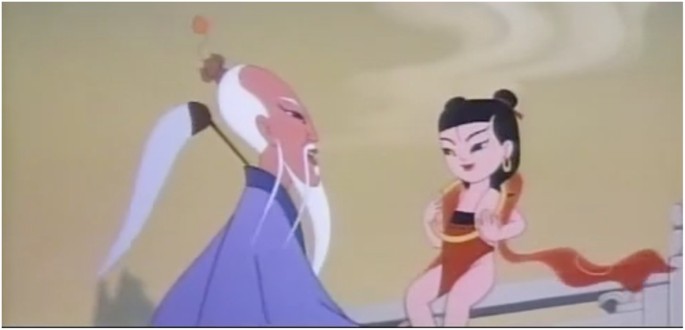
The original name of Nezha was Nalakuvara/Nalkubala in the Buddhist sutras, and Nezha is the Chinese translation of his Hindu name (Liu, 2009). The original image of Nezha in the Chinese translation of Buddhist texts has been portrayed as a powerful and fiery-temper deity who has three heads and six arms. As I discussed earlier, the androgynous image of Nezha in Nezha (1979) has been reshaped by the Daoist ideal of the Yin-yang balance. However, in the film of Motong Jiangshi (2019), the image of Nezha was portrayed as the stereotypical image of a Buddhist deity who has a fiery temper. For example, there is a scene in Nezha’s fight with Aobing, the character of Aobing transformed into a huge white dragon and Nezha transformed into the powerful Buddhist deity who uses his six arms to lift the huge ice storm. In contrast to the androgynous, joyful and childish representation of Nezha in Nezha (1979), the transformed image of Nezha in Motong Jiangshi (2019) represents robust masculinity that is macho, competitive and aggressive (see Fig. 4). The gender representation of Nezha in Nezha (1979) is a powerful immortal referring to the Daoist concept of Chizi, but he is not as aggressive and violent as the image of Nezha in Motong Jiangshi (2019).

The transformed image of Nezha in Nezha zhi Motong Jiangshi (2019).
Consequently, the image of Nezha in the Motong Jiangshi (2019) highlights the significance of human subjectivity through a modern view. The robust image of Nezha in Motong Jiangshi (2019) has been portrayed as a hero to against patriarchal authority in the film’s narrative. Thus, this article argues that the character of Nezha in the Motong Jiangshi (2019) functions as a meaning, interpretation and articulation of modern values such as the construction of human subjectivity. Smith (2010) argues that if the natural world exists independently of knowing subjects, there is no doubt that “the human being is a self-interpreting animal condemned to meaning (p. 127)” and that humans are deeply engaged in subjective modes of being through the construction of human subject society. In the case of the film of Motong Jiangshi (2019), regardless of the distinction between the signifier of ‘Tianzun’ (i.e., God, Heaven, Dao, Nature) in Western and Daoist cultural traditions, the motif of the film is the construction of human subjectivity. While Nezha calls for “my life is controlled by myself instead of god”, the figure of Nezha articulates Nietzsche’s discourse on human subjectivity between metaphysics and modernism. Zima (2015) elaborates the Nietzsche’s discourse is that humans could decide their destiny and the meaning or reality should not be discovered by pre-existing universal principles, but also created by humans individually. By following Nietzsche’s discourse, the transformed image of Nezha in the film has been portrayed as a self-determined and self-empowerment hero and his struggle with human subjectivity is justified and functions as meaning within a modern view.
Needham’s arguments provide us the critical explanations to understand how the premodern Daoist philosophy such as the cosmological Daoism articulates the modern and scientific paradigms in the film of Motong Jiangshi (2019). Needham (1956, p. 33) argues that Daoist naturalism tends to explore the true knowledge of Nature, or Order of Nature, rather than seeking “Confucian scholastic knowledge of the ranks and observances of feudal society”. In the Science and Civilisation in China: History of Scientific Thought, Needham (1956, pp. 33–34) states that Daoist naturalism is a unique and interesting combination of philosophy and religion that contains the ‘proto-science’ and magic, and thus the Daoist system of thought was not profoundly anti-scientific and never rejected the true knowledge of Nature. Significantly, Daoist naturalism has several terms, including bian and hua, used to signify the natural phenomenon of change, metamorphosis or transformations such as all kinds of changes in nature (Needham, 1956, pp. 74–75). Importantly, Needham (1956, p. 34) states that 16th-century science was commonly called ‘Natural Magic’, Gunning (2013) further elaborates that the creation of moving images derives from the realm of natural magic in the history of animation studies. Macdonald (2016) argues that the Chinese cultural heritage adds a historical aura to Chinese national-style animated films, however, the foreign culture such as the sciences supports the establishment of a new cultural paradigm in China since the May Fourth Movement in the early 20th century. In the 21st century, the film of Motong Jiangshi (2019) combines the Daoist thought of nature and the Western scientific paradigm of nature, which reflects the ideological change in post-Socialist cinema. The construction of a Chinese national identity in contemporary China welcomes a combination of Western scientific and Chinese cultural paradigms.
The representation of heaven (see Figs. 2 and 3) in the film of Nezha (1979) applies authentic Chinese aesthetics and represents a distinctive Chinese national style, however, the representation of heaven in Motong Jiangshi (2019) refers to a combination of cosmological Daoism and the scientific paradigm. For instance, the film Motong Jiangshi (2019) unfolds a mythological story and introduces Tianzun as a personified figure who sits in heaven and numerous planets are moving around Tianzun that signifies Tianzun is God or Dao/Nature to rule the cosmos (see Fig. 5). The Motong Jiangshi (2019) first introduces that Tianzun (Dao/Nature) divides Hunyuanzhu as two different spiritual pearls and give birth to two binary things, the mozhu and lingzhu referring yin and yang individually. According to cosmological Daoism, Dao gives birth to yin and yang, and both yin and yang give birth to the cosmos. The cosmos, planets, human beings and the myriad things are ruled by both yin and yang, which is the Order of Nature/Dao. Both yin and yang are constantly changing and combing with each other. (Ames, 1981) For example, the transformations of yin–yang rules in four seasons, yin and yang vary among different seasons, but we cannot conclude that one season is definitely superior to another season. Based on the Daoist philosophy of nature including the yin–yang theory, Motong Jiangshi (2019) combines cosmological Daoism within a scientific worldview of the universe, which elaborates that Daoist thought of the Order of Nature is a nonbinary and proto-scientific thought.

Tianzun and Heaven in Nezha zhi Motong Jiangshi (2019).
In addition, the Daoist theory of yin–yang balance is embodied through the harmonious relationship between the character of Nezha and the character of Aobing in Motong Jiangshi (2019). In the filmic texts of Motong Jiangshi (2019), the character of Nezha refers mozhu and the character of Aobing refers lingzhu is equally powerful. The natural magic of Nezha is fire signifying yang, and the natural magic of Aobing is water signifying yin. However, the two characters choose to collaborate rather than fight with each other, which represents the Daoist holistic concept of yin–yang balance.
Furthermore, according to cosmological Daoism, the primary type of Hunyuanzhu in the filmic discourse represents the Daoist tradition of Hundun (chaos or combination), which has been understood as the cosmogonic progression that myriad things have not separated into any binary structures. For example, the chapter of Tianrui in the Liezi elaborates the Daoist concept of Hundun.Footnote 4
“There is the Supreme simplicity, the supreme origin, the Supreme Beginning, and the supreme elemental. In the Supreme simplicity, qi had not yet begun to exist; the supreme original marked the first beginning of the existence of qi; the supreme beginning marked the first beginning of the existence of shapes, and the supreme elemental marked the first beginning of the existence of substance. Qi, shape, and substance were complete, but things were not yet separated from each other; this is Chaos, Chaos refers to when the ten thousand things were mutually intertwined and not yet separated from each other” (Michael, 2011, p. 116).
The nonbinary chaos is named Hundun by Liezi which derives from the representation of Dao that Laozi calls “Xuantong” (non-hierarchal combination) in the Daodejing that functions as the concept of Daoist “Nature”. Ames (2011, p. 4) argues that “Liezi on the other hand offers no such succour in following the indeterminate primordial simplicity, or dao, which is itself a mixture of perceptible order and inescapable chaos.” Similarly, Daoist sage Zhuangzi also treats the primeval chaos as a representation of approaching cosmic Dao. Based on the Daoist terms of Hundun and Xuantong, this article argues that the Daoist thought of the origin of the cosmos articulates the modern physical theory of the Big Bang, which was created by Georges Lemaitre in 1927.Footnote 5 The premodern Daoist texts such as the Liezi and Zhuangzi and the modern theory of the Big Bang share a similar understanding that the universe started as a single point (cosmological Daoist concepts of Hundun, Xuantong, etc.) and expanded as large as it is now and it could continue to stretch. Most importantly, the cosmological Daoism such as Liezi points out that the nature of the cosmos is the process of “change, generation, spontaneity and transformation (Berthrong, 2011, p. 77)”, and thus enables the Daoist proto-scientific thought of “Nature” to articulate the natural law of transformation including the origin of the universe.
Zielinski (2013) suggests that the history of animation studies is relevant to sciences, and the concept of origin such as the theory of the Big Bang is strongly connected with the methodological development of animation studies. In the case of Chinese national-style animation, this article finds that Motong Jiangshi (2019) creatively incorporates a scientific framework such as the theory of the Big Bag into Daoist mythology through the application of digital technology. The film Motong Jiangshi (2019) uses 3D computer technology to demonstrate the mysterious nature of the cosmos through the application of Daoist philosophy and simultaneously demonstrates the scientific worldview from a cosmological one which formulated by the modern physical theory. For example, the film of Motong Jiangshi (2019) uses an animated scene to create both the Daoist and scientific worldview of the beginning of the universe. In the filmic texts, the combination of the symbol on Nezha’s forehead and the symbol on Aobing’s forehead signifies that the two sections of Hunyuanzhu combined. Then, the Hunyuanzhu creates the cosmos, planets, time and space that articulates both the Daoist philosophical concept of Hundun and the scientific theory of the Big Bang. Here, the transforming images of Nezha and Aobing not only concern the fantasy of Daoist mythology but also link cosmological Daoism to the important scientific concept of origin. However, the Daoist philosophy appeared in premodern China, and the deployment of digital technology greatly supports Daoist theory including Dao, nature, yin-yang and Hundun within a scientific worldview of the cosmos, and simultaneously highlights the significance of human subjectivity through the character of Nezha, which embodies a modern and international Chinese cultural identity for global audiences.