

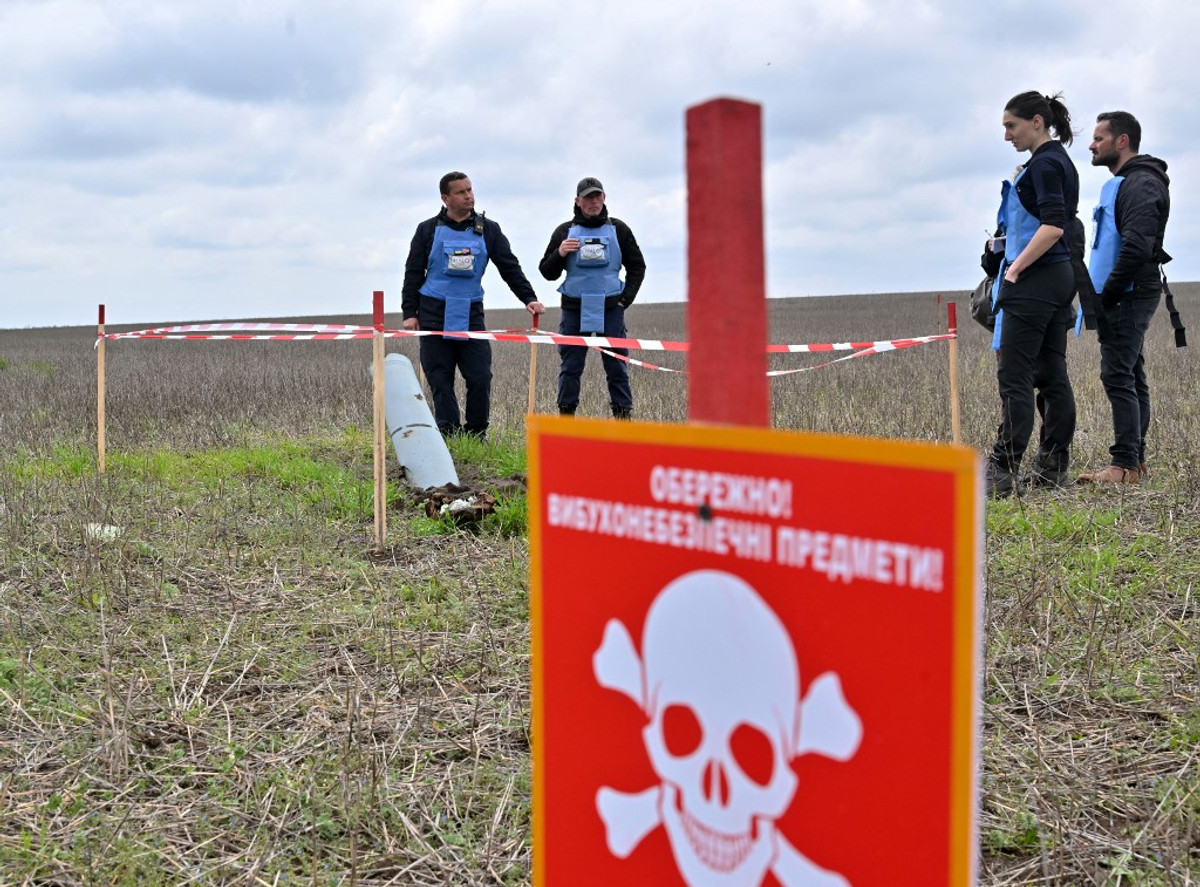
Now, with the sun occasionally peeking out from behind the clouds and temperatures slowly rising, hopes for spring in Ukraine are a key factor in maintaining optimism. Billboards are erected along highways advertising loans to farmers for seed planting campaigns. Most loans are offered by private banks, but the state-owned Oshad Bank also provides low-interest loans to farmers to finance field clearing.
The front has been relatively stationary for some time. This has allowed deminers to continue their work, with more than 275,000 hectares of land cleared last year. Approximately 200,000 hectares of this were “returned” to agriculture.
Demining is carried out even in winter. Explosives were removed from more than 21,000 hectares in January alone. The Kherson region received particular attention. Grains and vegetables will be sown there this spring. There is no doubt that Ukraine will bring a harvest this year. The question is, what happens to the produce if the harvest is too large for the domestic market?
Meanwhile, the agricultural war with European farmers continues. Since September 15th last year, it has become difficult to export agricultural products via Poland, Slovakia, and Hungary. Polish farmers regularly set up blockades on the Poland-Ukraine border, and farmers from neighboring Hungary and the Slovak Republic are always on hand to join the blockade. They consider the preferential conditions for Ukrainian agricultural products introduced by the EU to be a threat to their business.
Other interesting topics
Important messages from the World Congress in Ukraine towards the 2nd anniversary of Russia’s total war
The Ukrainian World Congress (UWC) has prepared important talking points for rallies and events to be held within the framework of the UWC’s global advocacy campaign “StandWithUkraine”.
Kremlin at war with cultural opponents
While Ukraine’s agricultural industry must find a way to navigate the minefield of international trade, the Kremlin has begun operating on other Russian targets. Currently, an all-out war has begun with Russian cultural figures who oppose the Kremlin’s strategy.
No one in Russia speaks out against the war anymore. There is no one there to fight with. However, intelligent Russian immigrants living in Europe are gaining confidence and becoming more active. As after the Bolshevik Revolution of 1917, Russian immigrant publishers and clubs could soon be seen operating in Europe. “Immigrant” anti-Putin online publications are already attracting new readers.
Perhaps this is what prompted the Kremlin to attack the most famous Russian writers living abroad, Dmitry Bykov and Boris Akunin. Their books can no longer be published or sold in Russia. This can be a serious financial blow to authors.
Boris Akunin still performs in Russian theaters, but he will no longer receive royalties from ticket sales and his name has already been removed from theater posters. The Academic Alexandrinsky Theater in St. Petersburg plans to continue hosting performances. 1881, which is based on Akunin’s play of the same name. Only now will the production’s artistic director be named and paid as the author.
It is not yet clear whether Russian President Vladimir Putin’s cultural special forces will succeed in persuading millions of Russians to abandon their favorite authors. But efforts to combat opposing cultural figures will continue.
Books by Lyudmila Ulitskaya, another leading Russian author and candidate for the Nobel Prize in Literature, have been withdrawn from sale. Russian universities have stripped her of her honorary professorship, while the media has been keen to portray Ulitskaya as one of Russia’s greatest enemies.
Writers are not the only victims of the Kremlin’s new campaign. Cult Russian rock band BI-2 recently arrived in Thailand and performed in front of many Russian nationals currently living in Thailand. However, the musicians were detained for not seeking permission from Thai authorities to hold the concert and for not paying taxes on ticket sales.
Russian diplomats have demanded that the musicians who gave anti-war speeches be immediately deported to Russia. Fortunately, the musicians have not only Russian, but also Israeli passports. The sharp deterioration in relations between Israel and Russia since the Kremlin sided with Hamas probably influenced this story. After the intervention of Israeli diplomats, the musicians were sent to Tel Aviv instead of Moscow. From now on, they will enjoy an early spring in Israel rather than a continuing cultural winter caused by the Kremlin. Winter will definitely continue in Russia even after the arrival of warm weather.
Russian authorities to families of mobilized soldiers
In Russia itself, no one openly opposes the war with Ukraine, but the authorities are fighting with the wives and mothers of Russian soldiers. These women have the “audacity” to come together in an organization called “The Way Home.” They are demanding that their men be demobilized from the military and that others be mobilized in their place.
They are not against war or Putin. They don’t give any speeches at all. They place a carnation tied with a white ribbon at the monument to the Unknown Soldier, take a photo of the carnation and post it on social networks. They have even written a letter to President Putin asking him to demobilize his men. They are detained and fined for these peaceful actions.
Russia’s main propagandists have denounced the women on television, calling them traitors and Ukraine’s accomplices. Police have also detained journalists who came to take photos of the Carnation “protest.” Officials do not want information about the movement to prompt other wives and mothers of soldiers to do the same. Mobilization in Russia will continue, but demobilization is not likely to occur anytime soon.
The views expressed are those of the author and not necessarily of the Kyiv Post.