

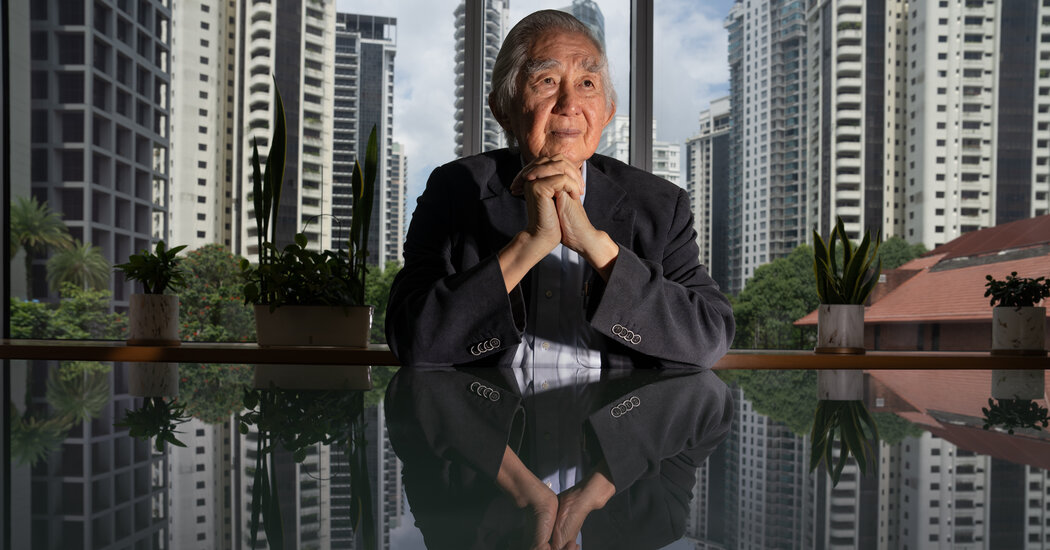
These high-rise apartments, some with panoramic views of Singapore’s tropical cityscape, are airy, light-filled and spacious enough for families to live comfortably in. They are also public housing, and have been extremely affordable for decades, giving Singapore an enviable high rate of home ownership.
But now, at least some of the apartments are selling for prices that were unthinkable not long ago: more than $1 million.
“It’s sad to see that because public housing should be affordable,” said Liu Tai-ke, the urban planner credited with creating the country’s widely praised approach to housing its people.
Now 86, Liu is responsible for overseeing the development of about half of the more than one million public housing units in this small but highly prosperous city-state of 5.6 million people and is considered the architect of modern Singapore.
But in the 1960s, the country’s economic situation was very different: it was one of the poorest cities in Southeast Asia, with three in four residents living as “squatters” in shabby tin-walled slums that were overcrowded and filthy.
At the time, Liu was working in the New York office of architect I.M. Pei and had recently graduated from Yale University with a master’s degree in urban planning.
“After four years, I felt like America didn’t need me. There were too many architects,” he says, “so I started thinking about coming back.”
He returned to Singapore in 1969 and became Head of Design and Research at the Singapore Housing and Development Board.
One of his main jobs was to create a “New Town” in Singapore – a planned urban centre. No one could explain what that would look like, but he had to figure it out.
After his research, he determined that the new Singapore would include self-sufficient neighbourhoods with schools, shops, outdoor food stalls and playgrounds.
Liu also wanted to avoid the public housing he saw in the United States and Europe, where apartments face each other and have barely lit central corridors, crowding low-income earners into what he called “concentrated poverty.”
He also wanted to stimulate a sense of community among his residents. To find out how, he asked sociologists to estimate how many households would need to live close to each other to maximize social interaction. The answer was six to eight households, so each corridor would have six to eight households sharing the same space, thus allowing neighbors to interact with each other.
As Liu’s vision for public housing began to be built and its success was recognized, Singapore’s first Prime Minister, Lee Kuan Yew, set him an ambitious goal of relocating all the slum residents by 1982.
By 1985, virtually every Singaporean owned a home.
“Mr Lee would often tell me the signs of an underdeveloped city were, number one, homelessness; number two, traffic congestion; number three, flooding; and number four, air pollution,” Liu said of Singapore’s founding father.
In Singapore, under Prime Minister Lee, who is criticised for stifling freedoms but praised for turning the country into a global economic powerhouse, public housing was meant to further government policy and give people a roof over their heads.
The government linked these affordable apartments to pro-family policies, support for the ruling People’s Action Party, and greater consolidation.
In 1989, the year before Lee stepped down as prime minister, his government enacted policies requiring each block or neighbourhood to have a balanced mix of the city’s main ethnic groups – Chinese, Malays and Indians – aimed at preventing racial isolation.
Liu said he supported the idea of integration because Singapore experienced violent racial conflicts around the time of its independence in 1965.
“In the West, experts criticized this as social engineering that violates individual freedoms,” Liu said, “but we did it and it worked.”
Liu was six years old when he arrived in Singapore from Malaysia in 1944. His father, Liu Kang, was a talented artist in Shanghai who fled to Malaysia during World War II.
After his mother begged him to study architecture to help support the family, Liu won a scholarship to enrol in a part-time course at the University of New South Wales in Australia, where he studied while working and graduated with first class honours.
Liu then went on to Yale University, and after graduating he was given the option to go to Harvard University to further his studies in urban design, or to work for IM Pei. Liu chose the latter.
It was a key turning point in his life: from Pei, Liu learned the importance of “flow” and “harmony” in building design, and he put those concepts into practice in Singapore.
From 1989 to 1992, Liu served as chief executive and chief planner of the Urban Redevelopment Authority of Singapore. In 1991, he created the “Concept Plan”, which divided Singapore into five regions, each into a small city, so that people would not have to leave their area to go shopping or to the hospital.
“The level of convenience we experience in Singapore today is largely thanks to Dr Liew and his team,” said Heng Chee Kian, Dean’s Professor at the School of Design and Engineering at the National University of Singapore.
After leaving the public sector, Liu worked in urban planning in about 60 Chinese cities, including Fuzhou, where he met Xi Jinping, the local top official. Xi asked Liu to design Fuzhou airport, but Liu initially turned down the project because he had no experience designing airports.
A few months later, China’s future leader, President Xi Jinping, visited Singapore and asked Liu to reconsider, according to Liu. This time, Liu agreed.
At age 79, Mr Liu started his own consultancy and now advises the governments of Fiji and the Chinese provinces of Sichuan and Guangdong on urban planning. He says working five days a week “slows down the ageing of my brain and body”.
Liu said one of his main tasks when he worked in the government on public housing was to ensure that housing prices “rose slowly” so that homeowners felt they “owned something of commercial value.” But he also wanted to avoid prices rising so quickly that “public housing became unaffordable.”
In Singapore, one of the world’s most expensive cities, record prices in the secondary home market are raising fears about rising living costs, but public housing remains largely affordable, at least for those who qualify for government subsidies to buy a home.
Currently, around 80% of Singapore’s residents live in public housing, and around 90% of those homes are owned on 99-year leases.
“The government remains committed to ensuring that public housing remains affordable for Singaporeans,” the Housing and Development Board said in a statement. Government officials said $1 million apartments sold on the secondary market accounted for only a small proportion of total transactions, with 54 apartments sold for more than $1 million as of May.
Families buying homes on the secondary market can receive housing subsidies of up to about $60,000, but must meet income limits.
Starting later this year, single people aged 35 and over will be able to buy one-bedroom apartments from the government wherever they are. Before the new rules, they were restricted to certain areas.
Liu said the Singapore model could be replicated in other countries, but acknowledged that acquiring land for development has become easier after the government implemented laws allowing it to buy land at market price.
“In most other democracies, it would be difficult to do so because landlords would protest,” Liu said.
Asked what he regrets, Liu said he has two: He should have built bike lanes in the city and “preserved hectares of squatter shacks and dirt roads and things like that for younger generations to see.”
He added: “Then they’ll really know how far we’ve traveled.”