

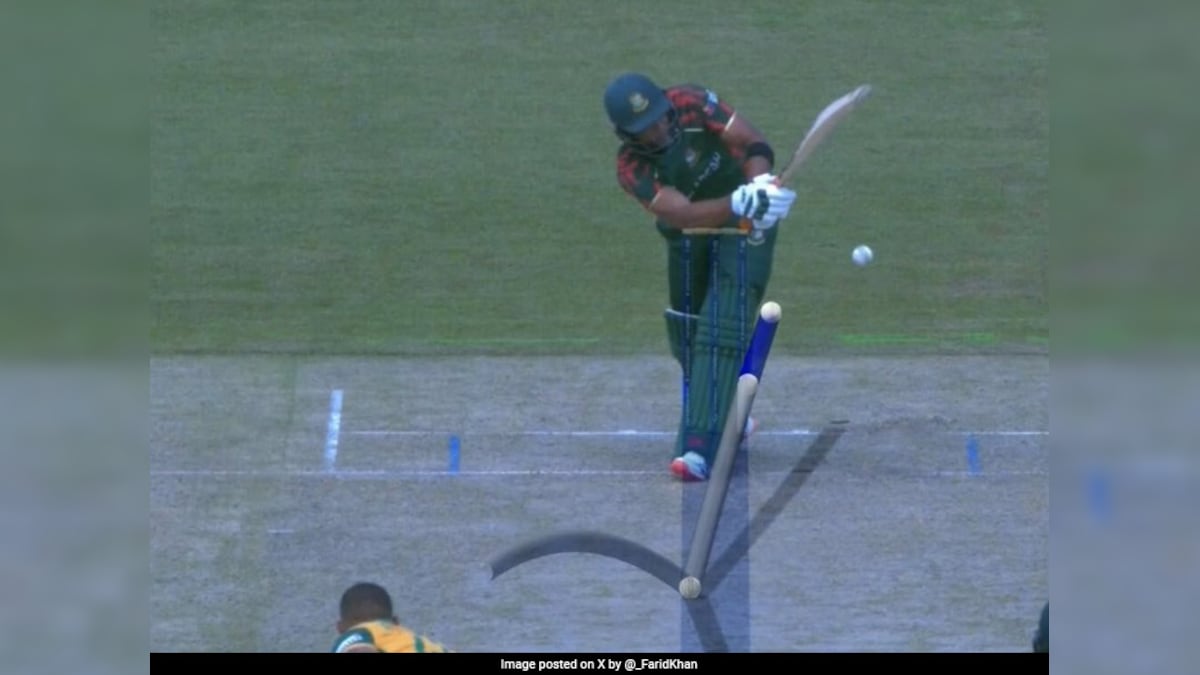
Bangladesh lose 4 runs due to LBW decision© X (Twitter)
The T20 World Cup 2024 match between South Africa and Bangladesh was a thrilling affair on Monday as the Proteas edged out the Bangladesh Tigers by four runs. Bangladesh looked likely to win the match, especially as they needed 27 runs in the last four overs to reach the target. However, a DRS loophole worked in South Africa’s favour and Bangladesh were denied a boundary which ultimately proved to be the deciding factor.
It all happened in the 17th over of Bangladesh’s batting, with Mahmudullah and Twyd Hridoy at mid-on. On the second ball of the over, Mahmudullah attempted a flick but the ball hit his pads and flew to the boundary behind the stumps.
After strong protests from South Africa, the umpire held up his finger and the ball was ruled dead, but Bangladesh reviewed the decision and the DRS showed that the ball had not hit the stumps, so the on-field umpire had to overturn the decision.
However, despite the decision being overturned, the boundary did not count towards Bangladesh’s total as the ball was deemed dead after the umpire raised his finger. Even if the umpire was wrong, a dead ball decision cannot be overturned under the ICC’s current Laws of the Game.
Several social media users, including former Indian cricketer Wasim Jaffer, suggested that Mahmudullah had fallen victim to a loophole in the rulebook.
“Mahmudullah was mistakenly called out LBW and the ball was ruled a leg bye for four. The decision was overturned with DRS. Even if it was wrong, the ball is dead once the batsman is out so Bangladesh did not score four runs. And South Africa won by four runs. I can understand how Bangladesh fans feel,” Jaffer posted on X.
What do the ICC rules say?
On this subject, the ICC rulebook states:
3.7.1 If, following a Player Review request, an original decision of out is changed to not out, the ball will be deemed to have become dead at the time the original decision was made (per article 20.1.1.3). The batting team will receive the benefit of the cancellation of the out decision, but will not receive the benefit of any runs that might have subsequently accrued from the delivery (other than any no-ball penalty that may have accrued under article 3.3.5 above) if the on-field umpire had originally made a decision of not out.
3.7.2 If an original ruling is changed from “not out” to “out,” the ball will be considered retroactively dead from the moment of removal. All subsequent events, including any goals scored, will be disregarded.
Law 20.1.1.3 Article 1 of the Dead Ball Law (the most important law in cricket) states: “The batsman is out. The ball is considered dead from the moment of the event which caused the out.”
Topics mentioned in this article