

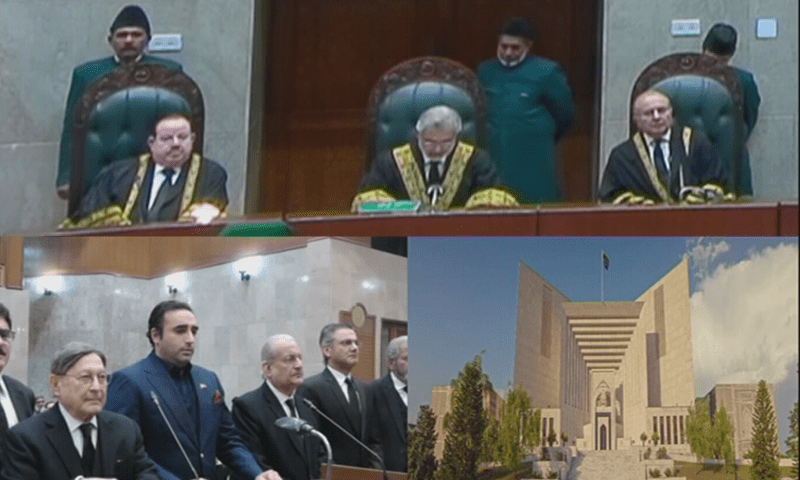
The Supreme Court said on Wednesday that the trial based on the 1979 verdict that sent former Prime Minister Zulfikar Ali Bhutto to the gallows did not meet the requirements of “fair trial and due process”.
Will the nine-judge bench headed by Chief Justice of Pakistan (CJP) Qazi Faez Isa issue a long-awaited opinion and review its verdict on the long-pending presidential referral? However, the PPP and legal scholars consider this a historical error.
The Grand Bench, chaired by CJP Isa, consisted of Justice Sardar Tariq Masood, Justice Syed Mansoor Ali Shah, Justice Yahya Afridi, Justice Amin-ud-Din Khan, Justice Jamal Khan Mandoker, and Justice Muhammad Ali Mazar. It consisted of Justice Syed Hasan Azhar Rizvi; Musarrat Hilari.
The proceedings were broadcast live on the Supreme Court’s website and YouTube channel.
A reference filed in April 2011 on behalf of former President Asif Ali Zardari sought an opinion under the Supreme Court’s advisory jurisdiction on the reconsideration of the death sentence awarded to the PPP founder.
CJP Isa issued a unanimous opinion today, saying, “The trial by the Lahore High Court and the appeals process by the Supreme Court of Pakistan do not meet the requirements of the fundamental right to fair trial and due process.” It was established under Articles 4 and 9 of the Constitution and later guaranteed as a separate fundamental right under Article 10A of the Constitution. ”
A detailed opinion is expected to be announced by the SC in the future.
The SC acknowledged that there were “several incidents in the history of our judiciary that created a public perception that fear or favoritism prevented the fulfillment of the duty to administer justice in accordance with the law.”
“Therefore, in a spirit of self-responsibility and as evidence of our determination to do justice with unwavering integrity and fidelity to the law, we must humbly face the mistakes and wrongs of the past. It must be done,” Judge Isa said. He said.
“Unless we acknowledge the mistakes of the past, we cannot correct ourselves and move in the right direction,” he added.
The CJP said that under Article 186 of the Constitution, the SC is empowered to express opinions on “questions of law” of public importance.
The Chief Justice said the hearing provided an opportunity to “reflect on the history of Bhutto’s trial, conviction and death sentence under the regime of military dictator General Zia-ul-Haq”.
He said the reference letter was submitted during the PPP government, and that successive governments of other major political parties “chose to proceed with this investigation and not withdraw the reference letter. It includes: […] Provisional Government.”
The CJP noted that the informant had asked five questions and read out his opinion on one of them. “The constitution and law do not provide a mechanism to overturn the sentence upon which Bhutto was convicted and sentenced.”
On the question regarding principles of law, the SC said, “The referenced question does not specify the principles of law pronounced by this court in the Zulfikar Ali Bhutto case and our opinion is sought in that regard.” said. Therefore, it cannot be answered whether the principles of law enunciated in the Zulfikar Ali Bhutto case were opposed or overruled. ”
On the question of whether the death sentence and maintenance is “justified or may amount to intentional murder”, CJP Isa said: “This court cannot re-evaluate the evidence and reverse its decision in the case. However, in its detailed reasons, it finds that there were gross constitutional and legal failings with respect to fair trial and due process. I plan to.”
On the issue of Islamic injunctions, the Supreme Court said it would not provide any assistance in this matter. “Therefore, it would be inappropriate to express an opinion on aspects of Islam,” he added.
Bhutto family praises ‘historic’ opinion of lawyers
As the opinion was read out, Bilawal Bhutto Zardari, grandson of the late Bhutto, stood next to lawyers Farooq H. Naek and Raza Rabbani, wearing a black shalwar kameez and navy blue jacket. He was seen standing solemnly wiping his face with a towel. handkerchief.
He then emerged from the courtroom wearing sunglasses and spoke briefly to reporters. The PPP chairman called the court’s opinion “historic” and added that he was awaiting a detailed opinion.
He hoped that after 44 years, the SC’s opinion would move Pakistan forward and finally put the “system” on the right track.
“The stain of this decision has made it difficult for the people of Pakistan to trust and receive justice from this court, especially when someone like the Prime Minister has not received justice,” Bilawal said. Ta. He thanked the judges and barristers who heard and argued the case.
in Post to XBilawal said the SC’s opinion “has come after 44 years and more than 12 years after the judicial murder.” [the] A presidential inquiry was filed. ”
“The pursuit of justice was a labor of love by President Asif Ali Zardari in the name of his wife Shahid.” Mortalma Benazir Bhutto. Our family has been waiting for three generations to hear these words. ”
sister Bakhtawar Bhutto-Zardari Said The Supreme Court “unanimously concluded that our grandfather was the victim of an unfair trial.” She thanked her father for “making her application” for her. [the] A true reference to history.”
Aseefa Bhutto Zardari said her grandfather’s “blood stains the steps of the Supreme Court.”
in Post to X, she called it “a permanent reminder of the grave injustice that weighs upon those hallowed halls.” “After more than 40 years, justice has finally prevailed,” Aseefa added.
Prime Minister Shehbaz Sharif congratulated the PPP leadership and workers, saying the SC’s opinion had “created a new history and tradition.” app report.
Lawyer Taimur Malik, who also ran as a PTI-backed candidate in the general election, welcomed the SC’s “approval”.
in Post to X, Malik said, “I hope other political leaders will not have to wait decades for a ‘fair trial’ decision.” Rule of law and timely justice remain the cornerstone of Pakistan’s progress. ”
Lawyer Hassan A. Niazi also appreciated this opinion, but stressed that “the structural problems that allowed such grave injustice to occur remain part of Pakistan’s political and legal system.”
In an apparent reference to jailed former prime minister Imran Khan, he wrote: The cases against him include an illegal nikkah conviction, and all trials were conducted in an unfair manner. ”
He also pointed out that the SC tribunal “allows the continuation of military trials” of civilians and “so far ignores the issue of arbitrary and illegal deportation of Afghan refugees.” insisted.
lawyer salar khan I got it. “This decision has long been condemned by the historical court.” “This SC would do well to consider what the verdict would be on that role today,” he added.
Case history
In March 1979, nearly two years after the ouster of the Bhutto government by then military dictator General Zia-ul-Haq, a seven-judge SC court sentenced the former prime minister to death in a split 4-3 verdict. Upheld the LHC verdict.
In April 2011, then President Zardari filed a referral under Article 186 (1) and (2) of the Constitution, which gives the president the power to refer issues of public importance to the Supreme Court for an opinion. giving.
The 10-page application drafted by Naek states that on October 9, 2018, Bilawal requested the SC to allow him to become a party to the case, stating that Bhutto was brutally executed as a result of the stroke of a pen. Stated.
At the Supreme Court in December last year, He cited the references and regretted the delay in correcting them.
In January, PPP submitted additional evidence consisting of various interview transcripts and video recordings.
In a subsequent hearing, the SC stated that it may reconsider its previous ruling if it finds that a serious miscarriage of justice occurred due to a deviation from the Constitution or the prosecution’s political considerations.
Senior Counsel Makhdoom Ali Khan, appointed by the court to the Bench, said this was a unique case in a common law jurisdiction where a judge, who was part of the majority of the court, was available for press conferences long after he had retired. Ta.
At a February 21 hearing, CJP Isa wondered whether revisiting the incident could enhance the military’s reputation and “heal the wounds” of the people. Justice Jamal Khan Mandoker said this could be an opportunity to end outside interference in court matters.
The Supreme Court also noted that then LHC Chief Justice Mushtaq Hussain had asked Justice Dr Nasim Hasan Shah to sit in the SC bench to hear a challenge to his order sentencing Bhutto to death. was deemed “inappropriate.”
In a separate hearing, retired SC judge Manzoor Malik pointed out the appalling irregularities in the former prime minister’s trial. Justice Sardar Tariq Masood expressed regret that it was clear that there was no order by the High Court to confirm the death penalty.
Justice Malik continued to advocate as a bench, asking the Supreme Court to either correct the miscarriage of justice or simply ignore it on technical grounds.
During the adjournment of the reference hearing on Monday, CJP Isa said that the court will issue an abbreviated order regarding references within a few days after consultation as one of the members of the bench, Justice Sardar Tariq Masood, is retiring soon. I was observing it intently.
Ahmed Raza Kasuri, whose murder case has been registered against former Prime Minister Bhutto, points out that the court has not crossed the hurdle of admissibility of evidence as a witness, and any opinion by the Supreme Court will flood the court. I was worried that it would open the floodgates for people to become witnesses. Courts are being flooded with a tsunami of lawsuits, including the Jan. 13 denial of the “bat” mark to PTI.