

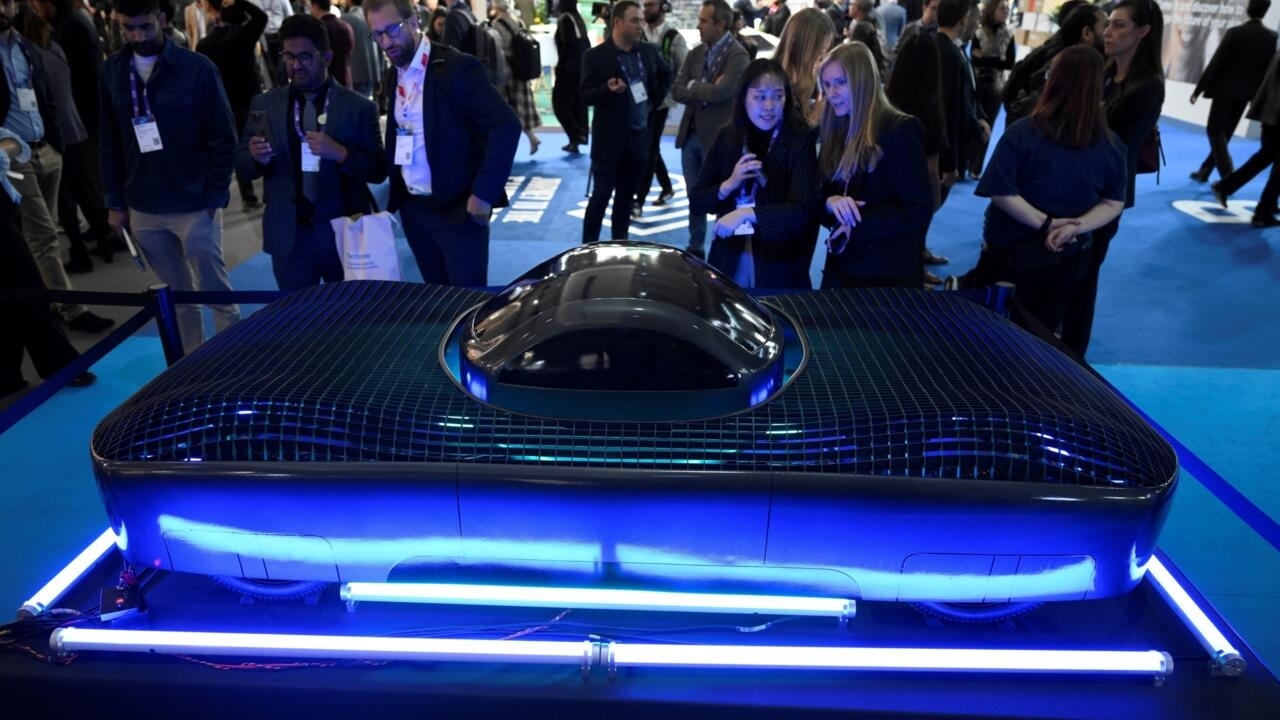
Barcelona (AFP) – Tech companies showcased countless connected gadgets at the four-day Mobile World Congress, the world’s largest wireless communications trade show, in Barcelona, which concludes on Thursday.
Publication of: change:
3 minutes
Below are some highlights.
“World’s first” flying car
American company Aleph Aeronautics has unveiled to the public for the first time what it claims is the world’s first working model of a true flying car.
“It drives like a car, looks like a car, and can take off vertically,” said Jim Dukhovny, the company’s president and CEO.
The electric vehicle has received special airworthiness certification from the US Federal Aviation Administration (FAA).
The current prototype can carry two people up to about 110 miles (170 kilometers), and the company plans to begin producing the final version at the end of 2025.
The company has already received nearly 3,000 pre-orders for the car, which will sell for $300,000.
robot dog
Chinese company TechnoMobile shows off a German shepherd-inspired robot dog that uses AI and powerful sensors to understand voice commands and perform life-like actions such as bowing, shaking hands, and climbing stairs. did.

This robot, named “Dynamic 1,” can also be operated from a smartphone app, and aims to provide the “joy of owning a pet” without the hassle.
transparent laptop
Chinese manufacturer Lenovo has unveiled a laptop prototype with a 17.3-inch clear glass screen that offers a “completely borderless, see-through display experience.”

Instead of a traditional keyboard, it has a touch surface that allows you to project keys or draw on the screen using a special pen. The company has not announced a release date for the product.
You can adjust the transparency of the screen, so not everyone passing by can always see what you’re doing.
“Transparent displays only existed in future movies, maybe AR glasses. As far as we can see, that’s a thing of the past,” Lenovo executive director Aiguo Zhen said.
Companion doll equipped with AI
With his cloth body, floral blouse, and brown hair, Fedor has the appearance of a child’s doll. But the Fedor, made by a South Korean company with the same name, is aimed at seniors.
Equipped with sensors and an AI-powered microprocessor, it can play songs, remind seniors to take their medications with voice messages, and notify the user’s parents if no movement is detected for a certain period of time. You can

The 35-centimeter (14-inch) tall doll is designed to speak when touched by the user, according to customizable time settings such as meal times.
“We are committed to helping older adults live independently while staying connected to their communities and loved ones,” the company said.
Faulty audio converter
Dutch startup Whispp has demonstrated a calling app that uses AI technology to translate voice impairments caused by conditions such as throat cancer, stroke, and even stuttering into the user’s natural voice in real time.
Unlike other solutions for people with voice disorders that convert speech to text, this app allows users to talk to anyone they want on their phone or laptop while still sounding like their own healthy voice. and maintain a natural flow of conversation.
Joris Castermans, co-founder and CEO of Whispp, said: “We are truly helping people who have lost their voice regain their voice,” adding, “We are truly helping people who have lost their voice regain their voice.” “For the world,” he added, adding that he hopes the app will someday be on every smartphone.
© 2024 AFP