

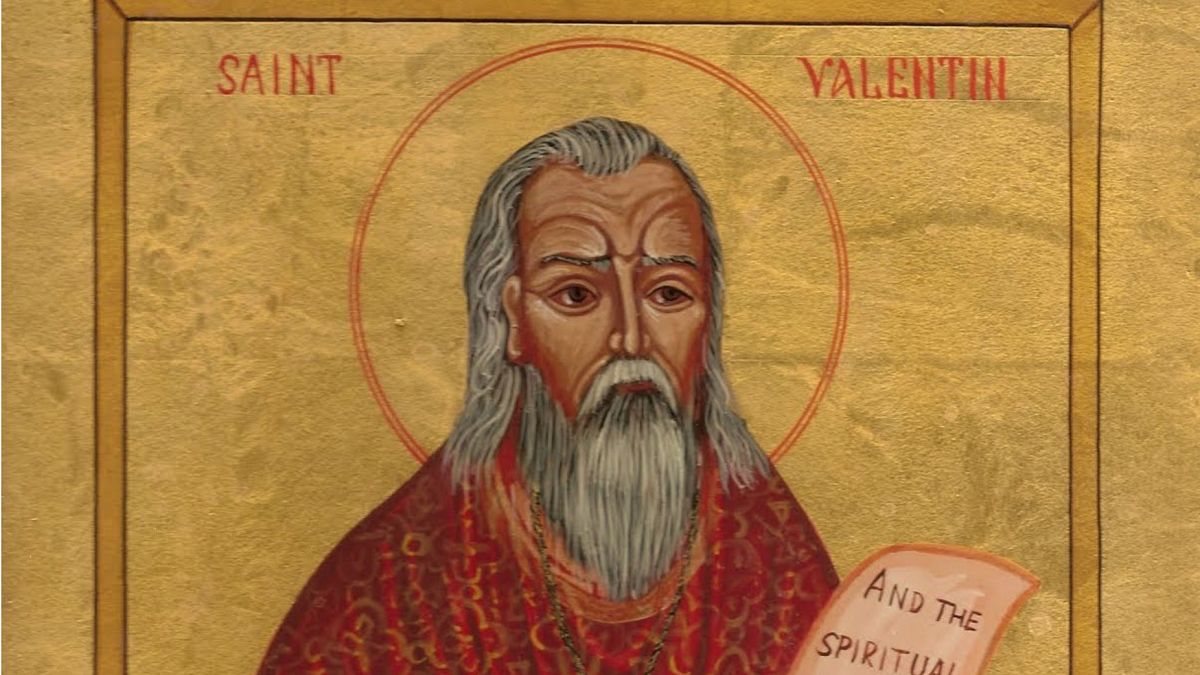
To commemorate this famous day in history, we traced the origins of St. Valentine and how its name came to be associated with the romantic holiday, and likes and dislikes, that we know today.
 advertisement
Ah, Valentine’s Day!
Celebrated on February 14th each year, the holiday of hearts, roses, chocolate, and romance are all celebrated in the name of St. Valentine.
But have you ever wondered where this tradition came from? And who was this mysterious saint?
Well, let’s just say the origin story is a bit confusing and there are various theories as to who he really is.
Officially recognized by the Roman Catholic Church and widely acknowledged to have lived in the third century AD, what is certain about Saint Valentine is his name and his date on February 14th. The only thing is that he was martyred and buried. Suburbs of Rome.
According to some estimates, there are more than 10,800 saints, including more than 30 Valentines and even several Valentinas.
But there are two Valentines in particular that stand out as likely candidates for the origins of the lovey-dovey tradition we have today.
Because of the many similarities, some researchers have speculated that the two Valentines may actually be the same person.
Let’s take a look.
A priest in Rome or a bishop in Terni?
Some believe St. Valentine was a Roman priest who lived around 270 A.D., while others believe he was a Christian bishop who lived in the small Italian town of Terni.
Both stories involve Emperor Claudius II. At that time, he issued a decree banning marriage, believing that married men would become poor soldiers because of the attachment they shared with their families and loved ones.
However, as is commonly believed, Valentine rebelled against the emperor’s orders and continued to perform weddings for young couples in secret, but was eventually arrested, imprisoned, and sentenced to death. .
While in prison, Valentine falls in love with the guard’s daughter, befriends her, and cures her blindness (quite literally, love at first sight). Before her execution on February 14, he wrote her a letter signed “From your Valentine.”
This expression of love is said to be the beginning of the tradition of sending cards on Valentine’s Day.
According to another theory, Valentine may have been put to death because he tried to help Christians escape the harsh conditions of Roman prisons, where they were frequently subjected to physical abuse and torture.
Today, the town of Terni celebrates St. Valentine as its patron saint, and it is believed that his holy relics are kept in the town’s church, St. Valentine’s Cathedral.
This church is a popular pilgrimage site for lovers and couples who come to pray for St. Valentine’s intercession.
Tourists can also see the skull of St. Valentine, said to be crowned with flowers, on display in the Basilica of Santa Maria in Cosmedin, Rome.
advertisementWhen did Valentine’s Day start being celebrated around the world?
The origins of Valentine’s Day are debated, with some believing it was chosen to commemorate St. Valentine’s death in mid-February, while others claim it was established by the Christian church in mid-February to replace the pagan Lupercalia festival. There are some too.
Lupercalia, celebrated on February 15, was a fertility festival in which goats and dogs were sacrificed, their skins used to gently beat women and crops in the belief that it would increase fertility.
A single person would then choose a woman’s name from the urn, and the couple would pair up for a year, often leading to marriage.
Some theories suggest that the Lupercalia festival was discontinued during the reign of Pope Gelasius in the late 5th century. In response, the Catholic Church designated February 14th as a feast day known as the Feast of St. Valentine.
Professor Jack B. Oluchi of the University of Kansas believes that British poet Geoffrey Chaucer was the first to associate Valentine’s Day with romance in his poem “The Parlement of Foules.”
advertisementIn the poem he writes: “It was sent on Saint Valentine’s Day, when all the wicked come to choose their spouses.”
However, this could also suggest that Valentine’s Day was already tied to the idea of choosing a spouse or partner, and that Chaucer was simply building on this tradition in his poem.
Obviously, the origins of Valentine’s Day are still very complicated and confusing.
But one thing is clear: whether you’re single, single, or somewhere in between, Valentine’s Day is the perfect excuse to binge on chocolate.