

Hostage negotiations between Israel and Hamas have stalled, with Prime Minister Benjamin Netanyahu accusing Hamas of delusions and halting further negotiations.257 people kidnapped in October attack on Israel by Hamas; 123 have been released so far
Efforts to secure a hostage release agreement between Hamas and Israel appeared to stall Thursday, a day after Israeli Prime Minister Benjamin Netanyahu accused Hamas of being “delusional.” The prime minister reportedly ordered the Israeli delegation to Cairo not to take part in further talks.
Hamas’ surprise attack on Israel on October 7 kidnapped 257 people, most of them Israeli civilians. In response to this attack, Israel launched a major retaliation against the Gaza-based terrorist organization aimed at overthrowing Hamas and freeing the hostages. Since then, 123 hostages have been freed. Most of them were released as part of a hostage deal with Hamas, and three were released in a military operation. The fate of the remaining October hostages is unknown. Israeli intelligence officials believe at least 30 people were killed, but the status of the hostages has not been confirmed. Four of the 134 hostages remaining in Gaza were abducted several years before the current war. Hamas is believed to be holding the bodies of two Israeli soldiers killed in a 2014 military operation, Hadar Goldin and Oron Shaul. Additionally, two civilians, Abela Mengistu and Hisham al-Sayed, are being held in the Gaza Strip. After wandering into it by accident.
Since the abduction, the hostages’ families have continued to watch every word of every media report. Reports have wavered between optimism that a deal is almost finalized and pessimism that the gap between the two sides is too large to bridge.
The current international effort is led by Egypt, which is hosting talks between the two countries, the United States, and Qatar, which has close ties to Hamas. The negotiations changed the debate within Israel. While early in the war there appeared to be broad agreement on the priority of releasing the hostages, there are increasing calls for Israel to carefully consider the price it would pay to free the hostages.
“Initially there was a national consensus on both goals of the war,” said Motti Nager, a professor at Bar-Ilan University’s School of Communication. “While there is an understanding that wars will take more than a few months, there is also an understanding that the goal of freeing hostages is being relegated to a secondary position.”
Relatives of the hostages demonstrated in front of the military and defense ministry headquarters in Tel Aviv last week amid reports that negotiations were stalled.
Leah Goldin has been waiting for her son Hadar since his body was taken by Hamas in 2014. Already fed up with her empty promises made by countless Israeli leaders, she also holds the international community accountable. Just last month, several members of the United Nations Security Council called for the “unconditional release” of hostages as a precondition for a ceasefire agreement. In January, the European Parliament, the European Union’s legislative body, adopted a similar resolution calling for his unconditional release. This resolution is just one in a series of resolutions adopted by various international organizations since 2014 calling for the release of those detained in Gaza before the current war, which have been ignored.
“We need to fight for humanitarian rights just as we fight for our enemies,” Goldin said. “Hamas violates humanitarian law and should not receive humanitarian aid. They are detaining our children and our loved ones, and this is a continued violation of international humanitarian law. .”
The first hostage release agreement, made almost two months after the start of the war, achieved broad consensus within the country. The women and children were released in exchange for a temporary ceasefire and an increased flow of humanitarian aid to Gaza. Israel’s agreement to allow humanitarian aid to Gaza has faced public criticism throughout the war. In recent weeks, there have been demonstrations and attempts by people to close the border to Gaza, preventing goods from entering the Strip.
Since the fighting began, it has been unclear how Israel would seek to defeat Hamas while negotiating with it. Israel could counter this with all its might, putting the hostages at risk and incentivizing Hamas to kill them rather than keep them alive as bargaining chips.
Nager said the Israeli leadership is clinging to its twin goals of freeing the hostages and overthrowing Hamas without being transparent with the public.
“These goals probably could not exist in parallel,” he told The Media Line. “This has created an illusion, because leaders try to maintain both goals while saying they support each other when in fact they don’t.”
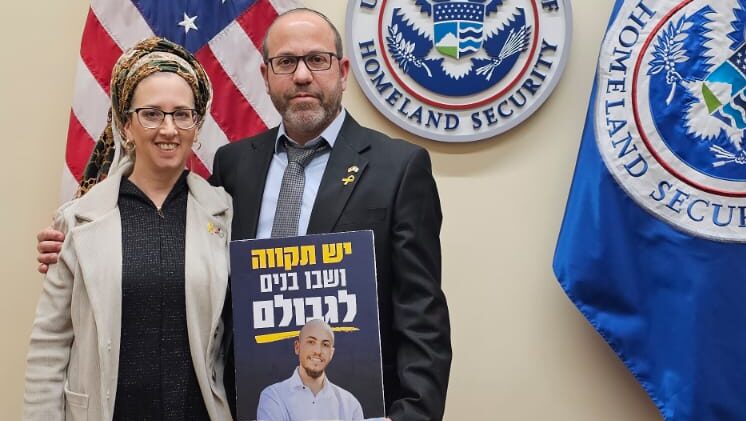
Eitan Mol is kidnapped from the Nova Music Festival after rescuing dozens of partygoers. His father, Zvika, opposes any deal that would release his son. Hamas’ demands, which reportedly include the release of thousands of prisoners, an end to Israel’s war effort against Hamas, and a complete withdrawal of troops from the Gaza Strip, are considered too high.
“Israel should not pay the price, Hamas should pay the price,” Mol, who founded the Tikva Forum, which opposes any deal, told The Media Line. “The people of Israel have already paid enough and surrendered to our remaining enemies, the thousands of terrorists yet to be released, and any vulnerable terrorist organizations motivated by those already free. We are not going to risk our safety by carrying out an attack. ”
Mol is not alone. Recent opinion polls show that Israelis are increasingly leaning towards a hostage deal under the terms currently being negotiated. A poll conducted Wednesday by the Jewish Institute for People’s Policy found that 40% of Israelis chose to overthrow Hamas, while 32% prioritized the return of the hostages. According to a poll conducted at the end of January by the Israel Democracy Institute (IDI), 60% of Israeli Jews support a deal that secures the release of hostages in exchange for the release of all Palestinian prisoners and a cessation of fighting in Gaza. It became clear that he was against.
“My son shares the same opinion as me,” Mol told The Media Line. “This is his background. Hostages should only be released by defeating the enemy.”
Mr. Mol is in the minority among the hostages’ relatives.
“But I have wide support among the people,” he added.
In an interview with Israeli public broadcaster Kan Radio, Ayala Metzger, daughter-in-law of 80-year-old hostage Yoram Metzger, strongly criticized Prime Minister Netanyahu.
“I don’t believe in him. I think he wants to prolong the war to stay in power,” she said of the Israeli leader, whose approval ratings have plummeted. “Something stinks. This is completely crazy. How can it be considered normal to discuss the value of hostages by the number of Palestinian prisoners?”
Recent demonstrations in support of the deal have also led to calls for early elections.
“The families are concerned that this issue will disappear from public view,” Nager said. “If it’s not there, it means the problem has diminished in importance.”
Many of the families are demanding the release of all Palestinian prisoners in exchange for their loved ones, arguing that such a deal would allow Israel to defeat Hamas.
“We are smarter. We can settle the deal with Hamas later,” Metzger said.
Since the current hostage crisis began, Leah Goldin’s phone has been flooded with calls and messages.
“If Israel had properly insisted on the release of Hadar and Oron, none of this would have happened. This is what I think and what people have told me,” she said. , said the responsibility lies with Israel’s current leadership. Many remain in decision-making positions, including Prime Minister Netanyahu. “They caused this failure and are still making decisions today. Why don’t they invoke international humanitarian law? Why hasn’t this happened for over nine years? Why is Hamas an equal Will it be treated as such?”
UN Security Council Resolution 2474, adopted in 2019, calls for the return of “people reported missing during armed conflict…without adverse distinction.”
In 2011, Israel released more than 1,000 Palestinian prisoners in exchange for one captured Israeli soldier. This was a deal that initially had massive public support. But later, it became a deal that hurt the Israelis. When the prisoners were released, it became clear that many of them continued to conspire against the Jewish state. Yahya Sinwar, the current leader of Hamas in Gaza and the mastermind behind the October 7 attack, is one of the prisoners released in exchange after four life sentences were reduced in the deal. .
“I cry every day for my son,” said Tzvika Mol. He opposed the agreement at the time and remains in that position today. “But I haven’t lost my compass. Of course I want him home, but paying the price for him means paying the price for others too, and that It is forbidden.”
For now, the rift between Israel and Hamas is clearly too wide. But increased international pressure for a ceasefire on Israel’s part and an agreement on Hamas’s side could lead to change.