

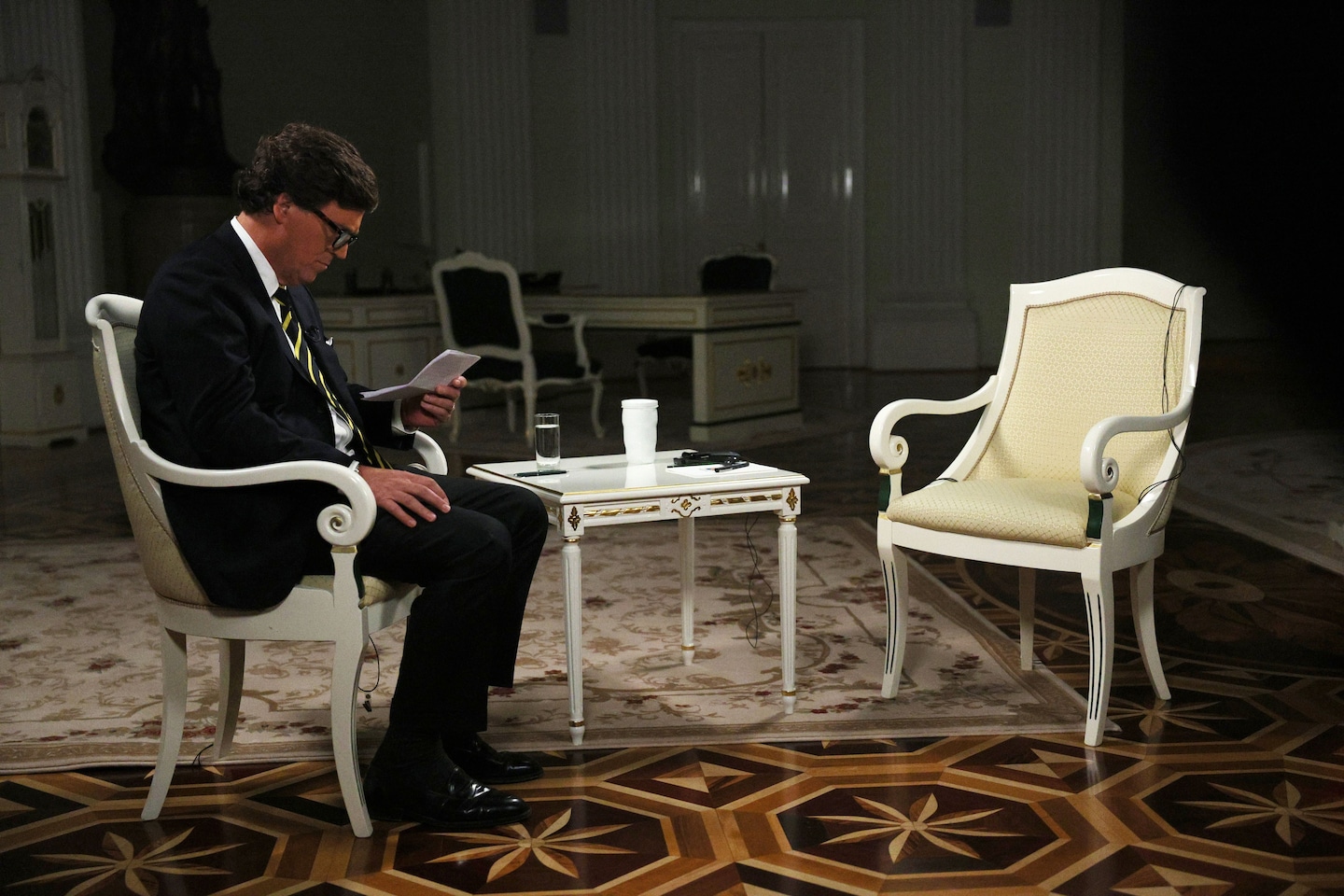
A few days after the interview, in Dubai, Carlson made a bizarre hodgepodge of claims. He considered Moscow’s architecture, food, and service to be better than any American city. Really? Outside Moscow’s small historic center, there are drab Soviet-era concrete buildings. The food in Moscow is very good, but is it better than New York or San Francisco? We need to go out more, Tucker!
Many of his rants were completely false. He praised Moscow, saying it was one of the “great places to live” because unlike the United States, Russia does not suffer from “raging inflation.” However, the Russian government’s own data last month showed the country’s inflation rate was 7.4%, almost 2.5 times that of the United States. As a result, interest rates in Russia are 16%, about three times the interest rate in the United States.
In a short video recorded in Moscow, Carlson shops at a local grocery store and shows that the cost of food to feed a family in Russia for a week is probably 4% less than the cost of similar food in the United States. I am amazed that it is only 1/1. This made him furious. However, Russia’s GDP per capita is about $15,000, compared to about $76,000 in the United States. Prices are higher in rich countries than in poor countries. Carlson should go shopping in Mexico. Groceries will also be much cheaper there. Perhaps he will gain new respect for the Mexican government.
Carlson also marvels at the grandeur of the subway stations, contrasting them favorably with those in New York. It’s true that the Russian capital’s subway system is excellent, but the reason the stations are so impressive is because they were built at huge public expense by Joseph Stalin in order to show off the superiority of Soviet communism. In contrast, New York’s subways are a product of capitalism, built and operated through various types of public-private partnerships that are more budget-conscious. It has always been true that a centralized authoritarian state can mobilize the entire resources of society to build huge vanity projects. Tucker should go see the pyramids and Taj Mahal in Egypt next. they are amazing
All of Carlson’s riffs on Russia are actually about the United States. He said he “grew up in a country with cities like Moscow, Abu Dhabi, Dubai, Singapore and Tokyo.” New York is one of his favorite cities, but he says that in his eyes, American cities are now falling apart. Carlson was born in 1969, so the New York he fondly remembers in the 1970s was actually a city rife with crime, riots, and graffiti. The city was so badly managed that it was declared bankrupt in 1975. The 1977 blackout became legendary for New York. It caused massive looting and crime. More than 800,000 people fled the city during that decade, and real estate values plummeted.
It wasn’t just New York. At the time, San Francisco was considered a hotbed of hippies, drugs, pornography, and radical experimentation. Dirty Harry, a movie depicting out-of-control urban crime, was set in San Francisco in the 1970s. Current crime rates in New York, like many major cities in the United States, are significantly lower than their levels in the 1980s and even in the 1990s.
Carlson speaks with envy of cities like Tokyo, Singapore, Abu Dhabi and Dubai. I have visited all these cities many times, some of them in the last few months, and each one is truly amazing in its own unique way. But what is surprising about all of them is that they are somehow meek and restrained, the product of authoritarian governments or conformist cultures, or both.
American cities are different. These are the products of decentralization, diversity, and democracy. Jane Jacobs, the great writer on city life, has always said that the best cities are bottom-up systems, seemingly chaotic but organic, and in the long run the abstract drawings of a central planner. I explained that it’s much better than that. American cities are expressions of democracy, places where people must negotiate their differences and find ways to live together. As a result, they become even more messy, dirty, and sometimes even chaotic. But perhaps that’s what has made these cities so vibrant and innovative, and what has put them at the forefront of making the United States a world leader in economics, technology, culture, and power. not.
American conservatives once celebrated America’s organic communities, rooted in freedom and choice and built bottom-up rather than top-down. But the new populist right despises these cities, and that distaste is partly a rejection of modern pluralistic democracy itself. They are becoming increasingly disillusioned by the clean and orderly ways of dictatorships, populist authoritarians and absolute monarchies.
After all, no matter what you say about Putin, he keeps the metro running on time.