

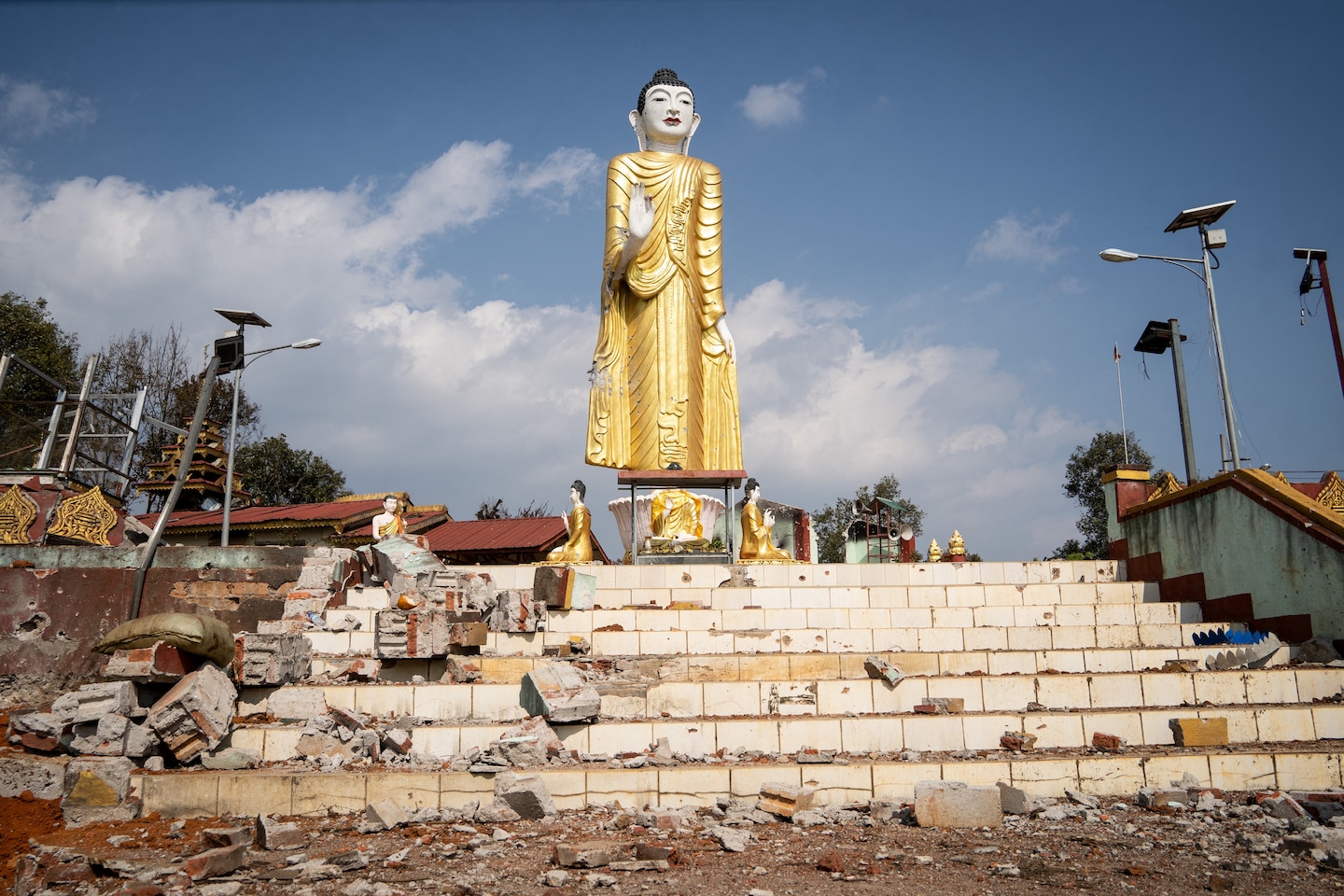
Since independence in 1948, ethnic militaries have been a feature of Myanmar’s difficult political situation. Since the offensive began on October 27, the insurgents, along with the PDF, have captured hundreds of townships and military outposts. In January, the military suffered its most humiliating defeat yet, with soldiers surrendering Laukhine, Shan State’s main city and regional headquarters, to rebels. There were conflicting reports as to the fate of the six brigadiers responsible for this debacle. Local media reported they had been sentenced to death, but the junta denied this.
Myanmar’s military finds itself depleted by battlefield losses, surrenders and desertions. In a show of desperation, the junta announced plans to begin conscripting young people into military service for at least two years. The announcement prompted thousands of people to attempt to flee across the border into Thailand or to queue up to obtain visas outside the Western diplomatic mission in Yangon.
However, the surprisingly rapid withdrawal of military forces from key areas does not mean that the military is on the verge of collapse. By retreating to more defensible positions, including major cities and the capital Naypyitaw, the military appears to be on the offensive for a long fight. Despite interference on the ground, the military continues to carry out devastating airstrikes against civilians, possibly committing war crimes. The rebels’ widespread use of drones, while effective, has not erased the regime’s advantage on the battlefield. Myanmar’s military is battle-hardened, well-armed, close-knit, and lives in near isolation from its people. Its soldiers are notorious for their brutality against civilians.
In contrast, rebel groups are divided along ethnic and regional lines. Myanmar, also known as Burma, has about 20 ethnic armies, totaling about 135,000 soldiers. And the People’s Defense Forces, formed after the 2021 coup that ousted the government of Nobel laureate Aung San Suu Kyi, who remains in prison, has about 65,000 fighters. . The PDF is the armed wing of the Government of National Unity, made up of legally deposed government figures. Many of the fighters are former students who have gone to the mountains and jungles and are guerrillas without heavy equipment, formal training, or a unified chain of command.
The military’s recent defeats have been at the hands of ethnic forces, not the PDF. Recent successes in Shan State were carried out by three independent rebel groups: the Myanmar National Democratic Alliance Army, the Ta’an National Liberation Army, and the Arakan Army, which has been operating jointly as the Three Brothers Alliance since 2019. ethnic group. On the other hand, the PDF may lack weapons, ammunition, and battlefield experience. However, they bring about the downfall of the government in exile.
For those who want an end to the conflict and a return to a democratic Myanmar, complete victory for the rebels still seems a long way off. Unfortunately, the conflict is likely to be prolonged and the people of Myanmar are likely to suffer further. According to the latest estimates, around 2.6 million people, or 660,000 people, have been forced to flee their homes since the October offensive. More than 95,000 refugees have fled to neighboring countries. More than 18 million people, a third of the population, are in urgent need of humanitarian assistance.
The world’s response to the crisis has been almost non-existent, with wars in Gaza and Ukraine sucking up all the diplomatic oxygen. Myanmar’s Southeast Asian neighbors have vacillated between indifference and maintaining ties with the military junta. China, on the other hand, maintains close ties with the military regime while supporting ethnic armies on the border, acting on both sides. The rebels’ success in Shan State is believed to be due to the Chinese government’s tacit support. China is primarily interested in controlling Myanmar’s lawless border areas, which have become havens for sprawling internet fraud centres, slavery and various other illegal activities.
The United States should do more to end the war decently. The Biden administration already has tools at its disposal to effect change. Congress passed the Burma Act of 2022, which was reauthorized in a watered down form late last year as part of the national defense authorization bill. Burmese law requires humanitarian aid, support for federalism and democracy, and the provision of non-lethal support to ethnic armies and the PDF. But the Burma law is not accompanied by any funding allocation, and so far US support has been scant.
Myanmar’s civil war is at a tipping point, and more U.S. support could make a difference now. The Biden administration should enter into dialogue with all insurgent groups and united governments and help unite them around a common agenda of federalism and democracy. And it should listen to what else the rebels need to win the war, from cutting the junta’s revenue sources to adding weapons. President Biden should also reinstate his idea to appoint a Special Coordinator for Democracy in Burma, a provision inexplicably deleted from the amended Burma law.
This may all seem like a big deal, given Congress’ inability to agree on funding for Ukraine and Israel. But we are witnessing the final end of this hateful regime. We need to start planning now for what comes next and ensuring our country has a chance at a democratic future.