

Microsoft
At its Build conference event on Monday, Microsoft announced a new AI-powered feature for Copilot+ PC called “Recall.” The feature will allow Windows 11 users to search and retrieve past activity on their PC. To make this possible, Recall records everything you do on your PC, including your activity in apps, your communications in live meetings, and the websites you visit for research. Despite encryption and local storage, the new feature has raised privacy concerns for some Windows users.
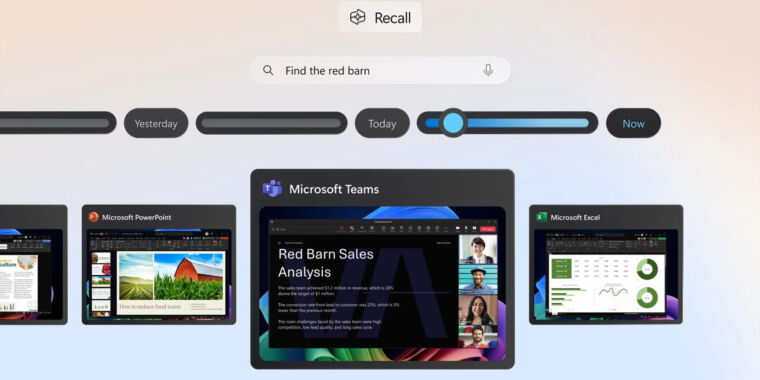
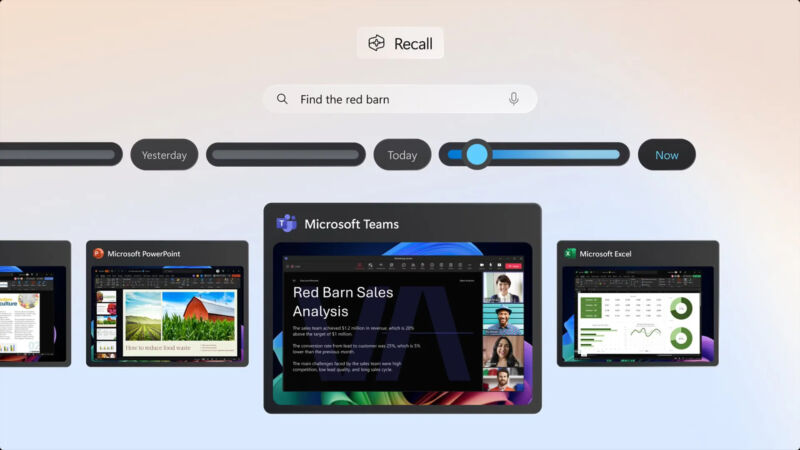
“Recall uses the advanced processing power of Copilot+ PC to take a picture of your active screen every few seconds,” Microsoft says on its website. “The snapshots are encrypted and stored on your PC’s hard drive. With Recall, you can find content you’ve viewed on your PC using search, or by using a timeline bar that lets you scroll through your snapshots.”
Recall actions allow users to access snapshots from a specific time period, giving them context for the events or moments they are searching for. They can also search for video conferences they attended or videos they watched, with AI-powered features that transcribe and translate audio.
At first glance, the Recall feature seems like a potentially serious violation of user privacy. Despite assurances from Microsoft, that impression doesn’t change even after a second or third look. For example, someone with access to your Windows account could use Recall to see everything you’ve done recently on your PC. This goes beyond the embarrassing connotations of viewing pornography and could actually threaten the lives of journalists or people considered enemies of the state.
Despite privacy concerns, Microsoft says that Recall indexes remain local and private on the device, and are encrypted in a way that’s linked to a specific user’s account: “Recall screenshots are linked only to a specific user profile, and Recall won’t share them with other users, make them viewable by Microsoft, or use them for targeted advertising. Screenshots are only available to users whose profile was used to sign in to the device,” Microsoft said.
Users can pause, stop, or delete captured content, and can exclude specific apps or websites. Recall does not take snapshots of InPrivate web browsing sessions in Microsoft Edge or DRM-protected content. However, Recall does not actively hide sensitive information, such as passwords or financial account numbers, that are displayed on the screen.
Microsoft previously explored a similar feature with Windows 10’s Timeline feature, but the company scrapped the feature in 2021, but it didn’t get continuous snapshots. Recall also shares some obvious similarities with Rewind, a third-party app for Mac that we covered in 2022 that records user activity for later playback.
As you might expect, recording all these snapshots puts a strain on your hardware. To use Recall, users must purchase one of the new “Copilot Plus PCs” that are powered by Qualcomm’s Snapdragon X Elite chip, which contains the necessary Neural Processing Unit (NPU). There are also minimum storage requirements to run Recall: a minimum of 256GB of hard drive space with 50GB of free space. The default allocation for Recall on a 256GB device is 25GB, allowing for roughly three months’ worth of snapshots to be stored. Users can adjust the allocation in PC settings, and older snapshots will be deleted once the allocated storage is full.
As for availability, Microsoft says Recall is still undergoing testing. “Recall is currently in preview,” Microsoft says on its website. “During this phase, we’re gathering customer feedback and developing more controls for enterprise customers to manage and govern their Recall data, improving the overall experience for users.”