


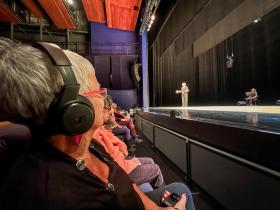
Watching a show with just the sound is similar to listening to an audiobook, but being surrounded by a live audience creates a special atmosphere in the theater. Celine Stegmuller / SWI swissinfo.ch
Although Switzerland signed the Convention on the Rights of Persons with Disabilities ten years ago, access to culture is still not a given for people with disabilities. Several associations are working to fill gaps in the system.
This content was published on February 10, 2024 – 11:00

The auditorium of the Théâtre du Passage in Neuchâtel is abuzz. People shuffle noisily along the lines to get to their seats. A dozen people are already sitting comfortably in the front row with headphones over their ears. They don’t turn around and look when a new audience member arrives, ticket in hand, or scan the hall to find where to sit.
Most people wearing headphones can’t see the stage, even though it’s only 1 meter in front of them. They are blind or visually impaired. Still, you can enjoy the production thanks to the live audio commentary hosted by the Ecoute Voir association.
Going to concerts, theaters, movies, and the opera is a basic human right. For many people in Switzerland, these outings are part of everyday life. But for others it remains a dream. In addition to architectural barriers and ticket prices preventing some people from attending cultural events, there remains a lack of specific accessibility measures for people with sensory disabilities.
There is no national strategy
This is different from France, where the establishment of cultural facilities has been mandatory by law since 2005.External link There is a challenge to improve accessibility for all citizens, but in Switzerland this issue is not yet the subject of a national strategy. Pro Infirmis said the federal government’s 2025-2028 Cultural Message, which sets the direction for cultural policy over the next four years, does not put enough emphasis on the inclusion of people with disabilities. The umbrella organization for disabled people published a position paper when the policy was circulated for feedback in June 2023.
When asked about this, Miriam Schleiss, Head of Cultural Participation at the Federal Office for Cultural Affairs, explained: “The Cultural Message is a very broad policy guideline that requires parliamentary approval and sets out the financial framework for cultural policy. Concrete measures based on the guidelines will be determined after parliamentary approval.”
The introduction of legal obligations such as women’s quotas for equality is not unanimously supported by all stakeholders SWI swissinfo.ch spoke to. France is certainly an example, but it is not perfect. There is still much work to be done, says Yann Grisset, president of SurdiFrance, France’s national federation of deaf associations. “If I had to give it a score, it would be 5 out of 10,” he says. “It’s not great. It means we’re making progress, but we can do better.”
see with ears
In Neuchâtel, the few people with headphones sitting in the front row can’t see the stage at the Théâtre du Passage, but they know what it’s like. Other audience members had the opportunity to walk around the stage with an audio commentator and discover the set with their own hands before being allowed into the hall. This touch tour helps you visualize the described scenes with headphones.
“Our goal is to extend this activity to all types of facilities, large and small, to be active in all French-speaking cantons of Switzerland and to make people aware that cultural events can be made more accessible and inclusive. “Yes, it can be done. It’s not very complicated, but it does require some energy and resources,” says Corinne Doret Bärtschi, founder and co-director of Ecoute Voir. No such association exists in German-speaking Switzerland, she added. There, interested institutions must request the services of an agent.
Cultural inclusion lags behind.
In September 2023, Pro Infirmis published the results of its first survey conducted among 22% of the Swiss population.External link That’s what it represents.According to survey results, 2 out of 5 people feel they are at their limits.External link When participating in cultural events.
Also includes cultural participationExternal link In the Convention on the Rights of Persons with Disabilities, which Switzerland signed in 2014,External link. According to a report released in 2022 by the United Nations committee that monitors the implementation of the treaty, Nicole Grieve, director of inclusive cultural activities at Pro Infirmis in French-speaking Switzerland, said:External link, it’s obvious. “We’re at an impasse when it comes to public funding for diversity and inclusion in the cultural sector. States say it’s the responsibility of cities, cities say the federal government should do more, and everyone says it’s a foundation. I say it depends,” she says.
Pro Infirmis’ nationally active Inclusive Culture Division was launched in 2016 to inform and assist institutions in setting up more accessible and inclusive programs and infrastructure. Did. Currently, more than 80 institutions and events have obtained the label proving their commitment in this regard. The future of the department was discussed at the end of the funding period. Going forward, the company will continue to operate with a smaller team and a more focused service.
Every organization SWI swissinfo.ch spoke to about their efforts to promote inclusion of people with disabilities highlighted the issue of funding. “For eight years, Pro Infirmis has provided expert advice to our partners free of charge. Ultimately, all consulting work should be paid,” said Stephanie Zaffrey, member of the Pro Infirmis Board of Directors. Masu. “Secondly, it is above all the role of the authorities and public bodies to make society more inclusive. Our association has given us the impetus to do so. It is up to public authorities, viz. It’s up to the government.”
Developing an offer
Meanwhile, people with disabilities can rely on various local, regional and supra-regional organizations to help them participate in cultural events until their rights are guaranteed.Movie screening with audio commentaryExternal linka tactile and interpretive museum visitExternal link subtitles in theatersExternal link These are just some of the activities held across the country.
In Lausanne, the Sinfonietta Orchestra is currentlyExternal link vibration vestExternal linkso that people who are deaf or hard of hearing can also enjoy concerts.
Zafry emphasizes the need for a change in the way disability is viewed in a broader social context, as well as more comprehensive measures. She points out how society views people with disabilities, which calls into question the legitimacy of their participation in cultural events. She said: “You can introduce all the cultural mediation you want, but if people don’t feel entitled to participate, they won’t participate.”
Adapted from French by Julia Bassam/gw

Compliant with JTI standards
More information: SWI swissinfo.ch is accredited by the Journalism Trust Initiative