

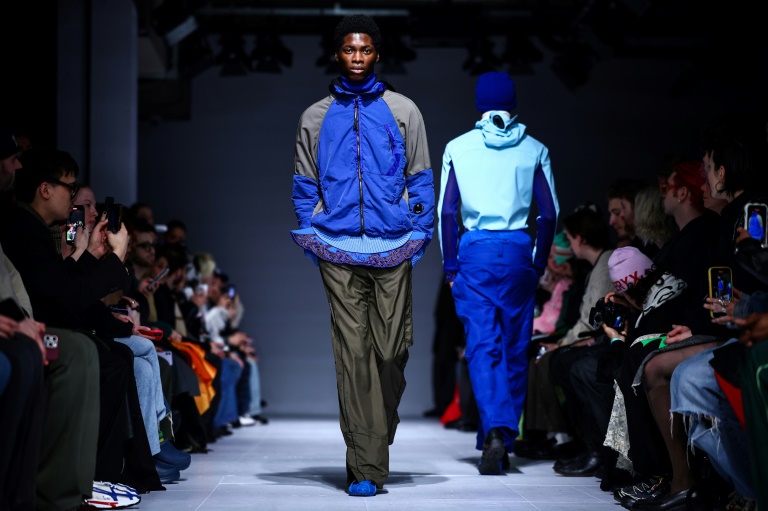

The cultural richness brought about by migration from around the world, family nostalgia and the frenetic pace of life in London graced the second day of London Fashion Week on Saturday, as up-and-coming designers explored the season ahead. He showed off his style.
Around 60 designers, from up-and-coming talent to big-name brands like Burberry, are showcasing new designs over five days in hopes of piqued by buyers and fashion influencers.
The 40th anniversary edition of the event introduces more diversity and inclusivity when it comes to model body types, ages, skin colors, and designer collections.
~Multicultural coexistence is in the spotlight~
Sierra Leone-born designer Foday Dumbuya’s label Labrum London closed out the day with its Journey Through Color collection, which celebrates the cultural diversity brought by immigration.
The winners of the 2023 British Design Awards Elizabeth II Prize focused on texture plays, newspaper patterns and monogram patterns in more classic cuts.
From royal blue to black, orange, brown, yellow and green, there were as many color tones as there were “inspirational stories” of immigrants.
Some models wear suitcases as headgear, representing the belongings of people fleeing conflict.
“People move for different reasons, and when they move, their culture moves with them. And tonight we wanted to celebrate that,” Dambuya told AFP.
One of the models carried a large picture frame depicting dozens of flags from “countries that have been involved in major migration throughout history,” including the Palestinian flag.
It was a political message and a call for tolerance, the creators claimed.
“It’s to show that we need to support each other. It doesn’t matter where we are. What matters is people’s lives,” Dambuya said.
“Wherever you are…Palestinian, Jewish, whatever it is, that world is ours. We’re just saying don’t demonize these people.”
– old photograph –
For his show, Dublin-born menswear designer Robin Lynch drew inspiration from his sister’s career as a Gaelic dancer, using old photographs of high kicks, sequined costumes and passionate audiences as inspiration.
The designer, who used Celtic knots and monograms in his designs, said: “I vividly remember spending the whole weekend in the sports hall at the competition, watching all the pomp and drama that took place on and off stage.” .
Lynch’s designs are laser-etched on a diamante-encrusted jolt (jean shorts), long lines on a parka with an elastic toggle belt, and in a color palette of hickory brown, screen blue, matte black, and oat milk white. It featured a pair of jeans.
~Living in a big city~
Earlier, models paraded on London’s famous red double-decker bus wearing costumes inspired by traditional dance.
British designer Ricky Wesley Harriott opened the show for his brand SRVC with a collection called “Human Resources,” which drew inspiration from contemporary “professional women’s attire.”
The designer paraded models in dizzying heels on London’s iconic red double-decker bus to “celebrate big city life.”
The show featured rigid, structured jackets with accentuated shoulders, dark colors and flashy accessories, from XXL silver hoop earrings to rings that covered every finger.
– fairy tale –
Designer Priya Ahluwalia, who draws inspiration from her Indian and Nigerian heritage, cheers after a show in which male and female models dressed in earthy reds, oranges and blues parade to the beat of thumping house music. was bathed in
The designer drew on Indian and West African fairy tales that she has been familiar with since childhood, such as “The Prince Who Wanted the Moon,” “The Magic Violin,” and “How the Leopard Found His Spots.” she told British Vogue.
“I was thinking about how stories have influenced my life. I thought about why we like the stories we like and how they are passed down.” she said.
Ahluwalia said the corset-like details in her knitwear designs were inspired by Netflix’s Queen Charlotte: The Bridgerton Story, which she watched while researching the collection.
The designer, who launched her own brand Ahluwalia in 2018, works with limited amounts of fabric, making extensive use of upcycling and patchwork techniques to reduce waste.
LFW comes at a tumultuous time for the UK fashion industry, amid post-Brexit trade barriers and the country’s cost of living crisis.
Difficult economic conditions have led some budding designers to question the feasibility of investing in British fashion events.
Last September, rising star Dilara Findikoglu made headlines when she canceled her show a few days before the event due to financial reasons.
The industry, which employs nearly 900,000 people in the UK and contributes 21 billion pounds ($26 billion) to the British economy, is facing “incredibly difficult times”, LFW director Caroline said. Rush told AFP.
srg/gv/mtp/aha