

The secularized framework of decolonization has failed to bring true liberation to the oppressed. Muslim communities need to come up with their own approaches.
Millions of non-Palestinians are marching through the streets of the Americas, Europe and other continents, demonstrating against Israel’s war on Gaza. Thousands of students around the world are also voicing their outrage at the brutal occupation and mass killings. Recent outbursts of dissent against politicians at public events across the country and elsewhere also demonstrate the level of contempt the world feels.
These voices and protests against the war certainly changed world opinion, and Israel lost any semblance of a positive image it had previously had. Nevertheless, those in positions to stop the killings in Gaza remain stubbornly steadfast in their assertion that Israel has the right to defend itself.
So what can or should be done to bring about major changes and shifts in policy? What can Muslim communities do in their role? Civic activism and standing up against oppression are necessary. There is no doubt that there is. But they are short-term tactics and far from a comprehensive strategy.
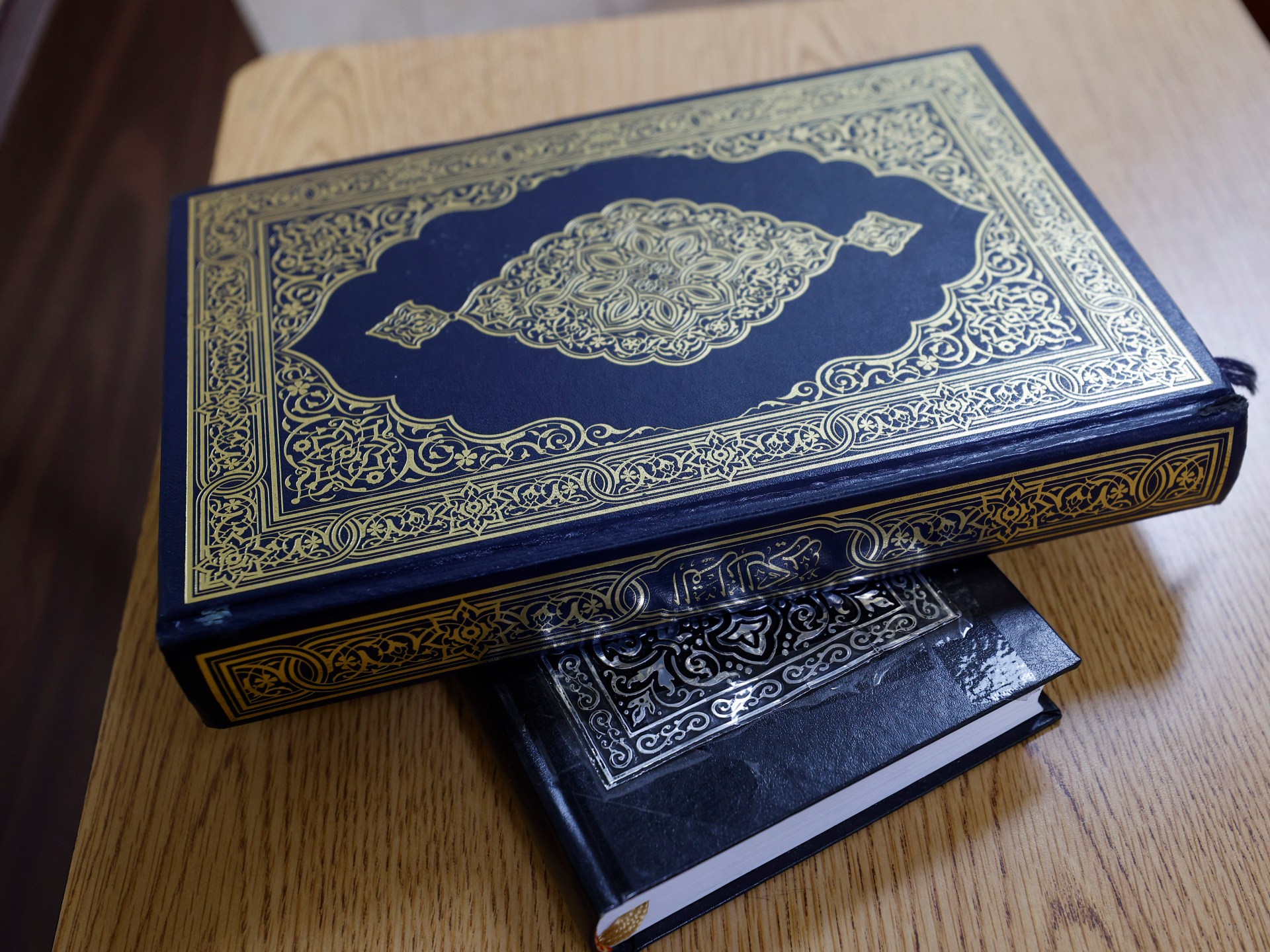
I suggest that we as Muslims seriously consider a long-term approach to liberation based on the Quran’s ayat (verses) that provide clear guidance for us as Muslims.
The first important guideline to consider is that the Qur’an does not condone the art of artists who have no connection to society or community events. In his verses 225-226, Surah as-Shu’ara speaks of poets who “wander in every valley” of imagination and “say what they do not do.” In today’s context, the equivalents of such poets and artists are generally “ivory tower” academics whose art and intellectual endeavors are out of touch with reality and civic engagement.
The Qur’an makes an exception and “praises” poets who believe, do good deeds, and put their art into practice. They also remember Allah well, so they live with reality and seek justice when the oppressed are wronged.
The second guiding principle found in the Qur’an is the idea of establishing and promoting academic engagement in the face of civil struggle. At the end of Surah Taubah (9), verse 122 says:
“It is not appropriate for believers to go out en masse and fight (in the path of Allah). Only groups of each group (remain) and strive to understand the religion (through study and research). If we allow people (who go out and fight) to advise when they come back, they (activists) need to be well-advised and take precautions.”
This is a clear call for a dual obligation of the Muslim community, reflecting the division of communal roles and activities. One division is responsible for maintaining peace and justice in the land, and the other division can be engaged in learning and research, i.e., writing, researching, and formulating policies through educational institutions, think tanks, and NGOs. These researchers and scholars will then advise policymakers and legislators to reform or change laws that are influenced by ijtihad or politics (siyasa).
While we call on Muslims to engage in short-term direct action, the Quran calls us to fund and support academic and research institutions for the longevity of Muslims. This is a model that has not yet been tested or tried in the modern international community. But there is historical precedent for this.
The great Indian freedom fighter Maulana Mahmud Hasan was imprisoned on the island of Malta by British forces who resisted the Indian occupation during World War I. However, during his time in prison he continued to work on academic writings. After his release after the war, he continued his revolutionary activities in both the political and intellectual spheres at the Darul Uloom Deoband Islamic Institute, seeing them as mirror images of each other.
For his achievements, he was awarded the title of “Sheikh Al Hind”, which honors his tireless efforts to resist British imperialism and oppression in the Indian subcontinent. The influence of his work in both the political and intellectual spheres is still felt today through the organizations and movements in which he was integral. His supporters did not see academic efforts as anything other than direct action to liberate oppressed peoples.
Maulana Mahmud Hasan’s efforts were set against the unique circumstances of his time and British imperialism in the early 20th century. The contemporary socio-political context calls for new approaches that are equally genuinely rooted in Islamic content.
The secularized language of decolonization has proven to be a failure in actual and complete liberation. Although colonized countries have nominally escaped the yoke of imperialism, much of the world remains economically, socially, and culturally within the grip of imperial power.
What is needed now is to develop a new concept of sovereignty and to define what true Muslim justice looks like in the modern world. Muslims are creative in ways that explore new possibilities for political and social theory at local, national, and international levels, in contrast to (and especially) Western notions of modernity, sovereignty, and justice in general. Don’t be afraid to become a target.
Muslim activism, which is still rooted in the framework of Western imperialist ideology and political theory, is not enough. We need to clarify our approach precisely on a theoretical and practical level.
If modern Muslims are to once again lead the international community in resisting oppression and standing up for justice, we recognize that political and intellectual struggle is a necessary precondition for the realization of true liberation. There is no other option than a two-pronged approach.
The views expressed in this article are the author’s own and do not necessarily reflect the editorial stance of Al Jazeera.