

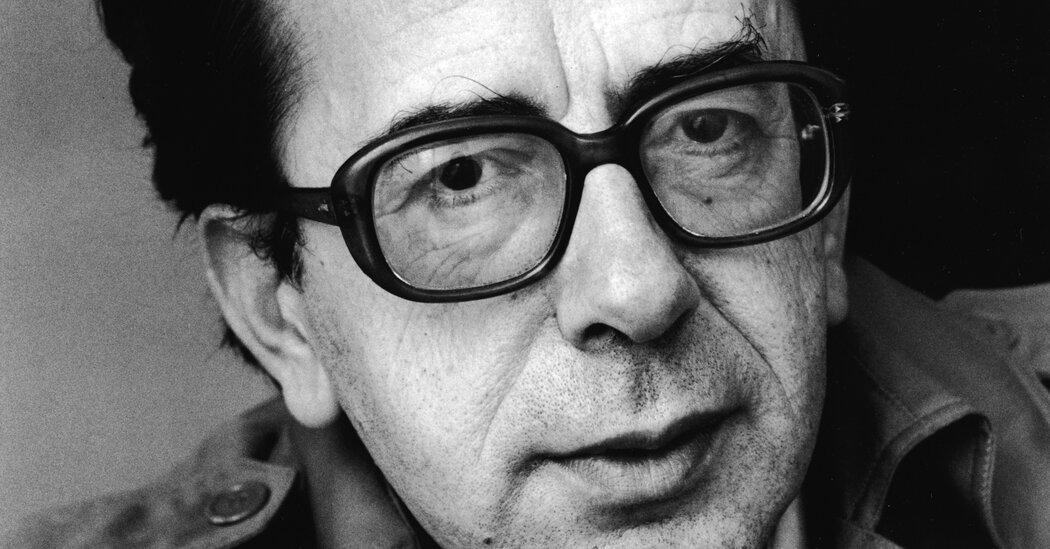
Albanian novelist and poet Ismail Kadare, who singlehandedly put his isolated Balkan homeland on the world literary map and produced dark, allegorical works that obliquely criticized his country’s totalitarian state, died on Monday in Tirana, Albania. He was 88 years old.
His death was confirmed by Bujar Khudri, head of his editor and publisher in Albania, Onufri Publishing House, who said he suffered cardiac arrest at home and died in hospital in the Albanian capital, Tirana.
During his literary career spanning half a century, Kadare has written many books, including novels, poetry, short stories and essays. His first novel, A General of the Dead Army, was translated into French in 1970 and gained him international fame. European critics hailed it as a masterpiece.
Kadare was nominated multiple times for the Nobel Prize but never won the honor. In 2005, he won the inaugural Man Booker Prize (now the International Booker Prize), which is awarded to a living author of any nationality for overall achievement in fiction. Finalists included literary giants such as Gabriel Garcia Marquez and Philip Roth.
In presenting the award, British critic and jury chairman John Carey called Kadare “a universal writer in a narrative tradition that stretches back to Homer.”
Critics often compare Mr. Kadare to Kafka, Kundera and Orwell. For the first 30 years of his career, he lived and wrote in Albania, then under the rule of Enver Hoxha, one of the Eastern Bloc’s most brutal and idiosyncratic dictators.
Fleeing persecution in a country where more than 6,000 dissidents have been executed and some 168,000 Albanians have been sent to prison or labor camps, Mr. Kadare walked a political tightrope. He served as a member of the Albanian People’s Assembly for 12 years and was a member of the regime’s Union of Writers. One of his novels, “The Great Winter,” portrayed the dictator in a favorable light; Mr. Kadare later said he wrote it to curry favor.
In contrast, some of his greatest works, including “Palace of Dreams” (1981), evaded censorship through allegory, satire, myth and legend and offered subversive attacks on dictatorial regimes.
Kadare “is fiction’s most masterful depiction of the psychology and physiognomy of oppression,” Richard Eder wrote in The New York Times in 2002.
Ismail Kadare was born in the southern Albanian town of Gjirokastër on January 28, 1936. His father, Halit Kadare, was a civil servant and his mother, Hatice Dobi, was a housewife in a well-off family.
When Hodja’s Communist party took control of Albania in 1944, Ismail was eight years old and already immersed in world literature: “At 11 I read Macbeth and the Greek classics, which struck me like a thunderbolt, and nothing else could control my mind after that,” he recalled in a 1998 interview with The Paris Review.
But as a young man, he was drawn to communism: “There was an idealistic side to communism,” he says, “and I thought certain aspects of communism might be good in theory, but I found them terrible in practice.”
After studying at the University of Tirana in the Albanian capital, Kadare was sent for postgraduate studies at the Gorky Institute of World Literature in Moscow, which he later described as “a factory for manufacturing the dogmatic nonsense of the Socialist Realist school.”
In 1963, about two years after his return from Moscow, The General of the Dead Army was published in Albania. In it, an Italian general returns to the mountains of Albania 20 years after the Second World War to exhume the bodies of his soldiers and repatriate them. It is the story of a Western industrialized nation invading a foreign land ruled by the laws of an ancient blood feud.
Pro-government critics charged that the novel was too international and not hateful enough about the Italian general, but it brought Mr. Cadare national fame; in 1965, authorities banned his second novel, “The Monster,” shortly after it appeared in a magazine. When “The General of the Dead Army” was translated into French and published in 1970, it “took the Paris literary world by storm,” wrote the Paris Review.
Kadare’s sudden prominence drew scrutiny from the dictator himself. To appease the regime, Kadare wrote “The Great Winter” (1977), a novel commemorating Hodxha’s 1961 break with the Soviet Union. Kadare said he had three options: “Stay with your convictions (which meant death), stay completely silent (which meant a different kind of death), or pay tribute, a bribe.” He said that by writing “The Great Winter,” he chose the third solution.
In 1975, after he wrote a poem criticising the Politburo, “The Red Pasha”, he was exiled to a remote village and for some time banned from publishing.
He responded in 1981 with the publication of “Palace of Dreams,” a scathing critique of the regime. Set in the Ottoman Empire, it describes a vast bureaucracy dedicated to collecting the dreams of its citizens and searching for signs of dissent. In a review for The Times, Mr. Eder called it “a moonlit fable about the madness of power, murder and suicide at once.” The novel was banned in Albania, but sold out before then.
Kadare’s success abroad had given him some stability at home, but he said he lived with fear that the regime “could kill me and say it was a suicide.”
To prevent posthumous tampering with the work, Kadare smuggled the manuscript out of Albania in 1986 and delivered it to French publisher Claude Durand, who used his own trips to Tirana to smuggle more copies out.
The cat-and-mouse game of the regime publishing and banning Kadare’s works continued after Hoxha’s death in 1985, until Kadare fled to Paris in 1990. After the regime’s collapse, Kadare came under attack from anti-Communist critics in Albania and in the West, and was seen as a beneficiary and even active supporter of the Stalinist state. In 1997, when Kadare was nominated for the Nobel Prize, an article in the conservative Weekly Standard urged the committee not to award him the prize, citing his “conscious collaboration” with the Hoxha regime.
Apparently to defend himself against such criticism, Mr. Kadare published several autobiographical books in the 1990s in which he suggested he had resisted the regime spiritually and artistically through literature.
“Every time I wrote a book, I had the impression that I was stabbing a dagger into a dictatorship,” he said in a 1998 interview.
Noel Malcolm, a historian at Oxford University, writing in the New York Review of Books in 1997 praised the “denseness of atmosphere” and “poetic tension” of Mr. Kadare’s prose but criticized his defensiveness toward critics.
“The author protests excessively,” Malcolm wrote, warning that “omissions and omissions” in Kadare’s “self-promotional writings” could damage his reputation more than the attacks of his critics. Kadare’s most important works, he wrote, “unfold on a more human and more mythical plane, different from any kind of ideological art.”
In a cold response, Kadare accused Malcolm of displaying cultural arrogance towards a writer from a small country.
“Such contempt for an author simply because he happens to come from a small country reveals a colonial mentality,” Kadare wrote in a letter to the New York Review of Books.
Information about survivors was not immediately available.
After the fall of Communism, Kadare continued to write novels set against the backdrop of suspicion and terror of the Hoxha regime, but also in several works that portray Albanians living in 21st-century Europe, but haunted by the country’s blood feuds, legends and myths. His best-known works include “Chronicles of the Stones” (1971), “The Bridge of Three Arches” (1978), “Agamemnon’s Daughter” (1985) and its sequel “The Successor” (2003) and “The Accident” (2010).
Charles McGrath wrote in The Times in 2010 that all of Kadare’s works share a common strength: “Mr. Kadare seems incapable of writing an uninteresting book.”
“In a classical Stalinist system, the only possible act of resistance was writing,” Kadare said after winning the Booker International Prize in 2005.
Amelia Nirenberg Contributed report.