

We visited the XC pits in Val di Sole last week to see what the riders were using in terms of tires. As the XC tracks get tougher, tire choice is changing and becoming more important than ever. This weekend the racers will be taking on the ultra-technical Crans-Montana course, and any rain could make tire choice even more important.
Scott Race Team
 What is the team’s typical tyre set-up?
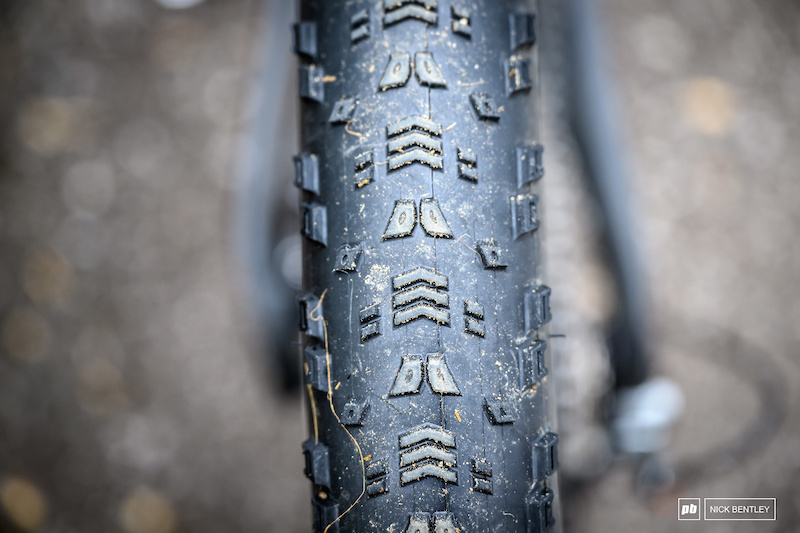
Well, our favorite tire is the Maxxis Aspen Tire, so we run that 90% of the time. Nino likes the Aspen ST, which is a really fast rolling tire. It’s almost like a slick, and we always run a 2.4″ wide tire on a 30mm internal rim. And the pressure, in terms of the bars, is 17.6 psi on the front and 18 psi on the rear right now. We’d actually like to go lower, but you know, the rim and tire combo holds the pressure. That’s the problem.
Is it to keep the tire under enough air pressure to keep it from coming off the rim?
Yes, that’s right. He is stable and not burping or anything.
Tire inserts are a big topic in XC. Do you use tire inserts?
Actually, it’s something new for us. In other years we tested a lot, but mainly we skipped it. But for the Olympic selection we decided to run it just to be safe, especially on rocky courses like Novo Mesto. But usually we don’t run it.
The weather is a bit changeable and there may be rain today. Will it be difficult for the riders to change their favourite tyre set-up?
No, not really. They train in Aspen. They know exactly what is needed. They are always moving between traction and rolling resistance, so that’s the main part, and they always try to be on the faster side of the tire. Ultimately it’s their choice. We can support them. But if they tell us what they want to ride, we’re ready.
Are your tires at the same pressure, do they tend to fluctuate or do they stay at a constant pressure?
Well, rims and tires are within a range because they have to work together, so we know the minimum requirements and we want to stay within that range, so we take the risk of having a flat tire or whatever else goes wrong.
Trek Future Racing: Ian Ackert
What is your typical race tire setup?
Typically I use Maxxis Aspens, around 17-18 psi depending on the track, and always with a rear insert.
Was there nothing there before?
No, I haven’t tried it yet, but I wouldn’t be opposed.
It’s a little muddy here but dries quickly. Do you tend to stick with the Aspen or do you change it if it gets too muddy?
I run the tyre pressures to the max and if there’s still no grip I’ll put on some beefier tyres, so sometimes I’ll go down to 15 psi in the rear with inserts, and if I need to go even lower I’ll put on some mud tyres.
You’ve got 120 TPI tires on here. Is that also pretty standard?
Yes, I do that all the time. I tried a lighter casing today and got a flat tire, so I’ll stick with what I normally use.
The XC World Cup courses are becoming more and more difficult downhill. Does this affect your tire choice?
I don’t think so. Growing up in Canada and with a West Coast riding style, I think you tend to push the limits there and that translates well to World Cup tracks.
BMC Race Team: Jordan Thurlow
What tire setup are you going to use here?
I use Pirelli XC RC 2.4 and run between 18 psi and 20 psi.
It doesn’t even perform an insert, right?
No no.
Do you change your tires often? It might be muddy here. Are you thinking about changing them?
It’s already dry, but it’s not dry and it’s drying fast, so I only use dry tires.
When it comes to tire pressure, do you keep that pressure constant or do you vary it depending on the conditions?
Yes, it will change it by 1-2 psi, but not by much.
Schwalbe: Oliver Fuhrmann
First, let me introduce myself a little.
Hello. I’m Oliver Fuhrmann from Germany and I work at Schwalbe as Race Support Manager. I’m here in Val di Sole to support the team and try to find the best tire solution for them.
Today we’re talking about XC tires. What are the most common XC tires that your team uses?
It depends on the track conditions. So if it’s muddy like here, everybody is going for a slightly different pattern, something with higher knobs or more grip in the wet. We’re also seeing a trend where riders are going for tires that have more grip as opposed to tires that roll faster. So we’re working on some different rubber compounds. We already have some aftermarket products that are great for wet conditions, like Speed Grip, and that’s one way we can help riders.
Tire pressure is always an interesting topic that people debate. Tire pressures in cross country will probably be the lowest they’ve ever been. Have you received any feedback from teams about low pressures?
It all depends on the size of the tire. Now everybody wants bigger tires. Five or seven years ago everybody was talking about lighter, smaller tires. Now everybody wants the biggest tires, and if the tires are bigger, obviously you can go lower on the pressure. Then depending on how you ride, your weight, the course you’re on, you can go lower on the pressure. Some riders go as low as 11.6 psi.
That’s really low. A lot of them also use inserts, which they say are to prevent punctures and get to the technical zone. Are you guys doing a lot of work with them on that?
No, I don’t really recommend inserts because if you need inserts, my understanding is that the rim manufacturers won’t offer a warranty because it puts stress on places that reduce the weight of the product, and I also believe that the tire won’t perform the same if you need inserts.
Some inserts you can test yourself by putting the valve in a bottle, filling it with 1 bar of air, putting some of the insert in and seeing what happens to the insert. Soft inserts usually shrink. They don’t help with puncture protection. The only advantage I can see is that if you get a cut and the seal isn’t closed you can run into the tech zone.
XC tracks are becoming more and more demanding. They are becoming more of a challenge. Are you seeing riders choosing different compounds and sidewall materials?
Well, a lot has changed in cross-country in the last 5 years. As I said before, a few years ago everyone went for light and fast rolling. Now we mostly see small enduro bikes on XC courses, but it’s up to the riders to come back. Some riders still think that light, stiff and stiff is the fastest way to be. But if you test with the riders a lot, they will come to a different conclusion.
Cube Factory Racing: Finn Troydler
What tire setup are you currently using on your bike?
I’m using Schwalbe Racing Ralphs most of the time, I’ll start with those today, see what the track conditions are, and when it dries out over the weekend I might switch to a faster tire, but I’ll probably stick with the Racing Ralphs.
Do you change your tires often? Do you tend to stick with the tires you like?
Normally I change tires depending on the situation, but for the most part I run Racing Ralph and have been very happy with their performance – they roll well and have great grip.
You are also using tire inserts, but you have larger ones in the back and smaller ones in the front, correct?
Well, we look at the track conditions and we decide on that setup most of the time, but sometimes we change to something bigger on the front, and for me it’s very important to have the inserts.
Are you using this as a safety measure so you can get back onto the technical if you get a flat tire?
Yes, exactly. You also save a little on the rim, so the tire bounces a little more and you can run lower pressures.
Do you think this is more important than ever as the courses are getting more and more extreme? I mean, there are some pretty big rocks on this course.
Yes. I think especially the speeds are also increasing. Now that we have more confidence that we can perform functions faster, we need to provide more protection.
What is the tire pressure?
I usually run a little more pressure than the bars, i.e. 16.6 psi in the front and 17.4 psi in the rear.
Do you change it that often or stick to one pressure?
I don’t usually change it much, just very slightly depending on the condition of the track.
Liv Racing: Linda Indergand
You guys are a Maxxis team, what kind of tyres are you running on this bike?
Yes I do, I use Maxxis 2.4 inch Aspen MaxxGrip with a 170 TPI casing.
Aspen both front and rear. Is this fairly common?
That’s almost always typical.
It’s muddy out here, not like the Valley of the Sun this week, do you think there will be a tire change to deal with the conditions?
If I were to make a change, I would go for the Severe 2.25 inches and run the Aspen tires on 25mm rims instead of 30.
What was the reason for the rim change?
This is to keep the tire volume as designed and to allow clearance in the frame – if mud on the grass gets sticky I would expect the grassy areas to get muddy.
The field section here, the start finish straight etc. What pressure are your tyres in?
So you’d set it at 0.9 bar on the front and 1.0 bar on the rear, so basically you’d have 13 psi on the front and 14.5 psi on the rear.
I think it’s lower than people would expect. Will that change a lot?
If Linda felt like she was kissing the rim, she might go up to point 1 bar, or whatever that would equate to.
You have tire inserts on the front and rear. Is that something you always do?
That’s always been the case: short courses are likely to always be run entirely on grass, where you can get away without tire inserts, but you’ll usually run lower pressures to keep the air in the tire, and make pedaling into technical zones much easier if you get a flat.
Giants: Jens Schuurmans
What kind of tyres is Jens on? Will this be what he will be using in the race?
Once dry, well, he tends to prefer the Rekon lace front and the Aspen rear.
Is he really messing around with it?
He normally doesn’t do that, he plays around with tire pressures and stuff, but this tends to be his race set-up.
When it’s really raining, what’s your mindset? Do you immediately move to a wet setup?
Yeah, I’ll go with the Sebeles. If the mud is bad, there’s also the Maxxis Beaver, which is a little narrower and has a little more open tread.
Is there a big gap between the tires or is it easy to get over? Looking at the Severe from here, there isn’t a huge difference in the tread between the Aspens and the Severe. Is there really a bigger difference with the mud tires?
So yeah, the mud tires are really big jumps. They’re a little more open. They don’t pack as much as the Rekon Race, which packs because the knobs are a lot lower. But if it gets really muddy, I’ll switch to them.
Tyre pressure, what is his usual race set-up?
Normally the pressure in the front is 15.9 psi, but with the insert in the rear it goes up to 16.6 psi.
Downhill riders change their tyre pressure a lot – does Jens do this too?
Actually, it depends. So if you change to a slightly narrower tire, you’ll increase the pressure a little bit.