


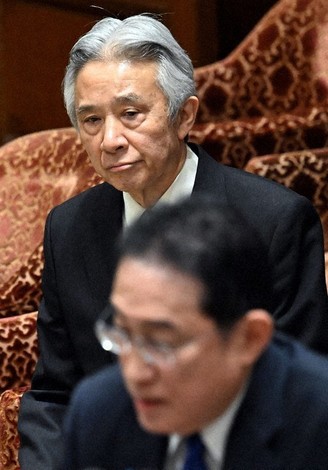
Japan’s Minister of Humanities, Culture, Sports, Science and Technology Masa Moriyama is said to have received support from Unification Church-related groups during the 2021 House of Representatives election. However, the minister has repeatedly given dishonest answers to parliamentary questions regarding this issue and has not fulfilled his accountability regarding the relationship with the church (officially the Family Federation for World Peace and Unification). Clearly, he is not suitable for the position of Minister of Culture, whose role is to oversee religious administration.
The Asahi Shimbun newspaper reported that Moriyama had received a letter of recommendation from a member organization, with a photo of him holding it in his hand. National newspapers subsequently reported that Moriyama had signed a document confirming the recommendations, a de facto “policy agreement” with the group, according to a source familiar with the matter.
In a September 2022 investigation into the relationship between Liberal Democratic Party members and the Unification Church, Moriyama answered that he had given a speech at a meeting of a related organization. He did not report receiving any election assistance.
What makes me uncomfortable is Moriyama’s explanation. At the House of Representatives Budget Committee meeting on February 7, he said, “When I saw the photo, I vaguely remembered it.” Regarding the policy agreement, he said, “It is possible that he signed it without reading the contents carefully.”
However, the next day, he reiterated that he had no recollection of it, reversing his earlier statement, saying, “I don’t even remember whether I signed it.” He claimed that he had destroyed all letters of recommendation he had received from more than 200 organizations in the run-up to the general election, and that he had not compiled a list and could not confirm that they had been presented.
Questions and Answers in the Diet are an opportunity for ministers and other executives to provide explanations to the people’s representatives. The fact that Mr. Moriyama so easily retracts his own statements suggests that he does not understand the significance of what members say in Congress.
Even if you don’t remember or have no records, you can ask the church and they will find out. Refusing to fact-check their claims on the pretext that they have severed ties with the cult is nothing but deceptive logic.
The Ministry of Education, Culture, Sports, Science and Technology has filed a petition with the Tokyo District Court to order the Unification Church to dissolve. A hearing on the request will begin soon. If it is revealed that a senior official of the Ministry of Education, Culture, Sports, Science and Technology has signed a controversial group’s policy promotion document, there will be doubts as to whether the court will be able to proceed with a fair review.
Some of the church’s victims, including those who were forced to make large donations, complain that they cannot fight the church as long as Moriyama continues as pastor.
Now that a new connection between the pastor and the church has surfaced, Prime Minister Fumio Kishida should dismiss the pastor unless Moriyama himself provides an explanation. If this issue is left unaddressed, public distrust in politics will only increase.
This incident exposed the sloppiness of the Liberal Democratic Party’s internal surveys, which relied on self-reports. A thorough re-examination is essential for the party to end its long-standing relationship with the Unification Church.