

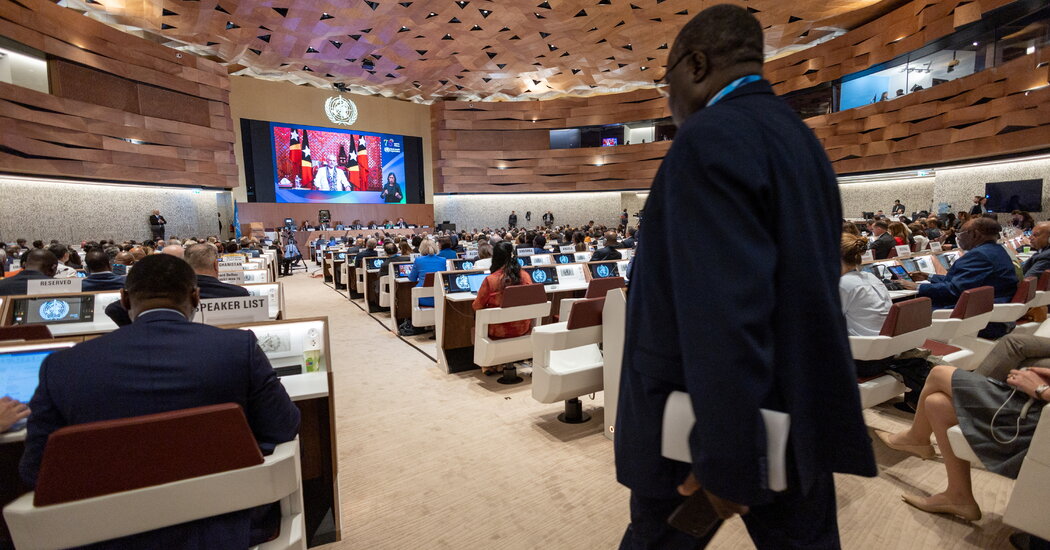
Countries around the world have been unable to overcome the nationalistic spirit born during COVID-19 and reach agreement on the terms of a treaty that would unite the world in a strategy to combat the inevitable next pandemic.
The talks, due to be the centrepiece of a week-long meeting of the World Health Assembly starting on Monday in Geneva, were aimed at redressing inequalities in access to vaccines and treatments between rich and poor countries that have become evident during the COVID-19 pandemic.
While the urgency around COVID-19 has faded since treaty negotiations began two years ago, public health experts remain keenly aware of the potential for emerging pathogens, familiar threats like avian flu and measles (Madagascar) and once-eradicated diseases like smallpox to spark pandemics.
“Those of us in public health know that a new pandemic is very much on the horizon,” said Under Secretary of Health and Human Services Lois Pace, who serves as the U.S. liaison with the World Health Organization and oversees the negotiations.
Negotiators had hoped to adopt the treaty as soon as next week, but cancellations and bitter disputes, sometimes over just one word, have stalled agreement on key parts such as equitable access to vaccines.
The negotiating bodies are expected to seek more time to continue talks.
“I remain optimistic,” said Dr. Jean Kaseya, director of the Africa Centers for Disease Control and Prevention. “I think the continent wants this deal. I think the world wants this deal.”
If adopted, the treaty would provide WHO member states, including the United States, with legally binding policies on pathogen surveillance, rapid sharing of outbreak data, and local manufacturing and supply chains for vaccines and therapeutics.
Contrary to claims by some US and UK politicians, the bill would not allow the WHO to dictate national policies on mask-wearing or use militias to enforce lockdowns or vaccination mandates.
Next week’s deadline is self-imposed and some public health experts say it’s too ambitious for such a complex undertaking — most treaties take years — but negotiators are pushing to get the treaty ratified before elections in the United States and several European countries.
“Donald Trump is in the room,” said Lawrence Gostin, director of the WHO’s Centre for Global Health Law, who helped draft and negotiate the treaty.
“If Trump is elected, he could potentially undermine the negotiations and withdraw from the WHO,” Gostin said.
Trump cut ties with the WHO during his presidency and recently suggested he might close the White House pandemic response office if re-elected.
The most contentious aspect of the draft treaty is the “access to pathogens and benefit-sharing” clause, which would require countries to rapidly share genetic sequences and samples of emerging pathogens – information that is essential for the rapid development of diagnostic tests, vaccines and treatments.
Low-income countries, including those in Africa, are seeking compensation for information – rapid and equitable access to any tests, vaccines and treatments developed – and are calling on pharmaceutical companies to share information so that local companies can manufacture products at lower cost.
“I don’t want to see Western countries collecting pathogens, going out with the pathogens, making medicines and vaccines and not giving the benefits back to us,” Dr Kaseya said.
Member states have previously agreed to only one health-related treaty – the 2003 Framework Convention on Tobacco Control, which strengthened regulations on the tobacco industry and reduced smoking rates in member states. But the devastating toll of the COVID-19 pandemic and the inequalities it has exacerbated have prompted member states to reach a second treaty.
Countries are also working to strengthen the WHO’s International Health Regulations, which were last updated in 2005 and provide detailed rules for countries to follow in the event of an outbreak that could cross borders.
In May 2021, an independent review of the global response to COVID-19 “found weaknesses at every point in the preparedness and response chain.”
The pandemic has also deepened mistrust between rich and poor countries. By the end of 2021, more than 90% of people in some high-income countries had received two doses of a COVID-19 vaccine, while less than 2% in low-income countries had. Lack of access to vaccines is believed to be the cause of more than a million deaths in low-income countries.
The treaty would signal a recognition that wherever an outbreak occurs, it threatens the entire planet and that providing vaccines and other resources is in everyone’s interest. Mutations of the coronavirus that emerged in countries with large unvaccinated populations have spread rapidly around the world.
“With variants accounting for nearly half of all deaths in the U.S., it’s in everyone’s interest to have a strong agreement,” said Peter Maberdach, director of Public Citizen’s access to medicines program.
In December 2021, WHO established a negotiating group to develop a legally binding treaty to ensure all countries have the ability to prevent, detect and control communicable diseases and ensure equitable allocation of vaccines and medicines.
More than two years after talks began, negotiators have agreed, at least in principle, to some of the draft provisions.
But much of the goodwill generated by the pandemic has evaporated, and national interests have come to the fore again: countries such as Switzerland and the United States have been reluctant to accept conditions that could affect their pharmaceutical industries, while others such as Argentina have opposed tough restrictions on meat exports.
“It’s clear that people have very short memories,” said Dr Sharon Lewin, director of Melbourne’s Cumming Global Pandemic Treatment Centre.
“But it could happen again, and it could happen with a pathogen that is much harder to deal with than COVID-19,” she warned.
One proposal on pathogen access and benefit sharing would require vaccine manufacturers to reserve 10 percent of their vaccines for donation and provide a further 10 percent to the WHO at cost for distribution to low-income countries.
But the idea proved to be too complicated, said Roland Dries, one of the negotiating leaders. “Along the way, we realized it was too ambitious in terms of the timeframe.”
Instead, a working group set up by the World Health Assembly will be tasked with working out the details of that section by May 2026, Dries said.
The terms of the proposed deal have caused some confusion: In the UK, conservative TV personality and populist politician Nigel Farage and other conservative politicians have argued that the WHO would force wealthy countries to provide 20% of their vaccines for free.
But Dries says that’s a misinterpretation of the proposed agreement. “It’s not countries that have to develop the vaccine, it’s companies,” he says. Pharmaceutical companies would participate in the system in exchange for guaranteed access to the data and samples they need to manufacture their products.
A Department of Health spokesman told Reuters earlier this month: “The UK will not sign the treaty unless it is in the UK’s national interest and respects national sovereignty.”
In the United States, Republican senators have urged the Biden administration to veto the treaty, saying it “could undermine U.S. sovereignty.”
WHO Director-General Dr Tedros Adhanom Ghebreyesus has sharply criticised what he has called a “spree of lies and conspiracy theories”, and noted that the WHO does not have the power to dictate national public health policy, and does not seek such power.
The secrecy surrounding the negotiations makes it difficult to counter misinformation, said James Love, director of Knowledge Ecology International, one of the few nonprofits with inside knowledge of the talks.
Love said allowing more people into the discussion room and seeing the progress of the draft would help clarify complex aspects of the treaty.
“And I think if the public reads the actual agreement on a regular basis, they’ll feel a little more comfortable,” he said.
Some proposals in the draft treaty would require huge investments, another sticking point in the negotiations.
To monitor emerging pathogens, wealthy countries support the so-called One Health strategy, which recognizes the interconnectedness of humans, animals, plants and the environment they share. They want low-income countries to regulate live animal markets and limit trade in animal products, which would be a major economic blow to some countries.
The Biden administration last month released its own global health security strategy, focusing on bilateral partnerships aimed at helping 50 countries strengthen their pandemic response capabilities. The administration hopes to expand the list to 100 countries by the end of the year.
U.S. assistance will help countries in Asia and Africa strengthen their One Health Systems and better manage the outbreak.
Public health experts said the U.S. strategy should complement international treaties, not replace them.
“In my view, this is the most important moment in global health since the WHO was founded in 1948,” Gostin said. “It would be an unforgivable tragedy if we let this slip away after all the suffering we’ve experienced from COVID-19.”