

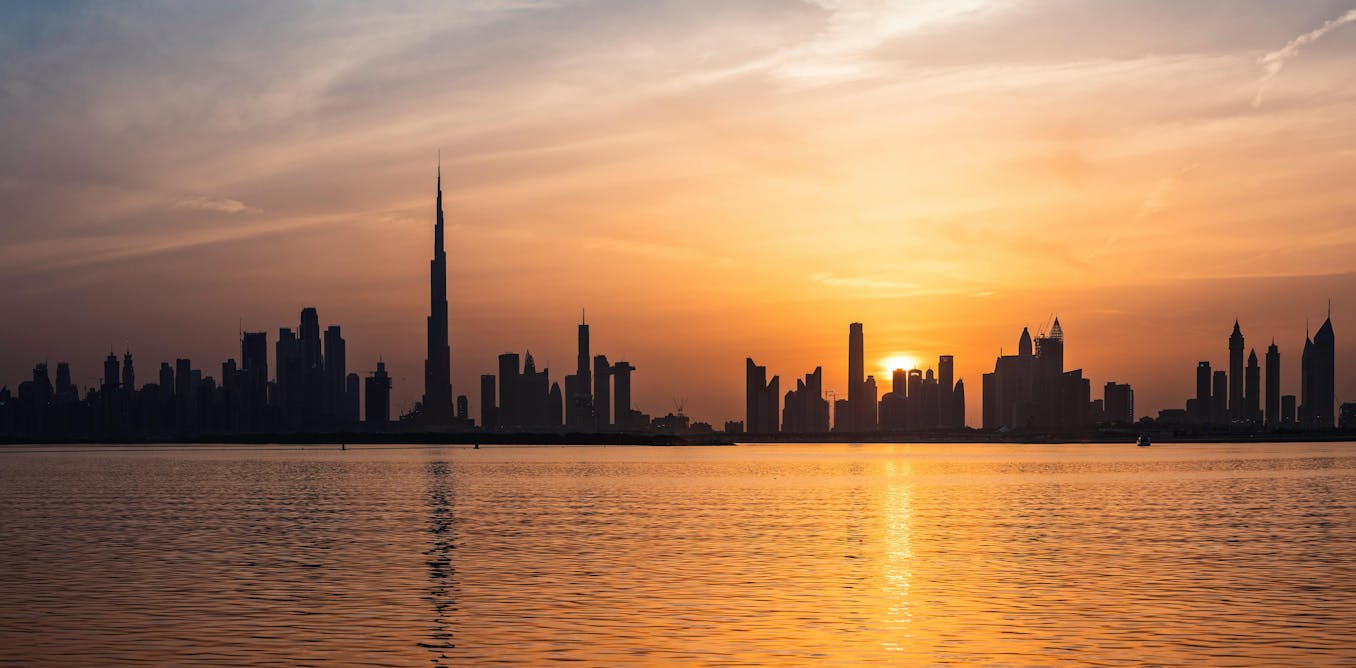
Since ancient times, people have built sky-reaching structures, from the steep spiers of medieval towers to the grand domes of ancient cathedrals and mosques. Today’s quest is to build the world’s tallest skyscraper like Burj Khalifa in Dubai. The decorative spire, which towers above the others, accounts for 29% of its total height, and 4,000 tons of structural steel were used just for its beauty.
Burj Khalifa is not unique in this respect. “Vanity height,” the extra height from the highest occupied floor of a skyscraper to its architectural top, shapes the skylines of cities around the world.
In a world where environmental considerations are paramount, is such architectural vanity justified?
Our research shows that the pursuit of “looking good” is a pressing issue. Even a modest spire adds about 15% to the carbon emissions associated with producing structural materials for skyscrapers.
Building skyscrapers is more than just architecture. It’s big business. Ranking as one of the world’s tallest buildings can turn an ordinary skyscraper into a globally recognized icon. This creates an incentive to look great.
The solution we propose is to rethink the global standard for ranking the world’s tallest buildings.
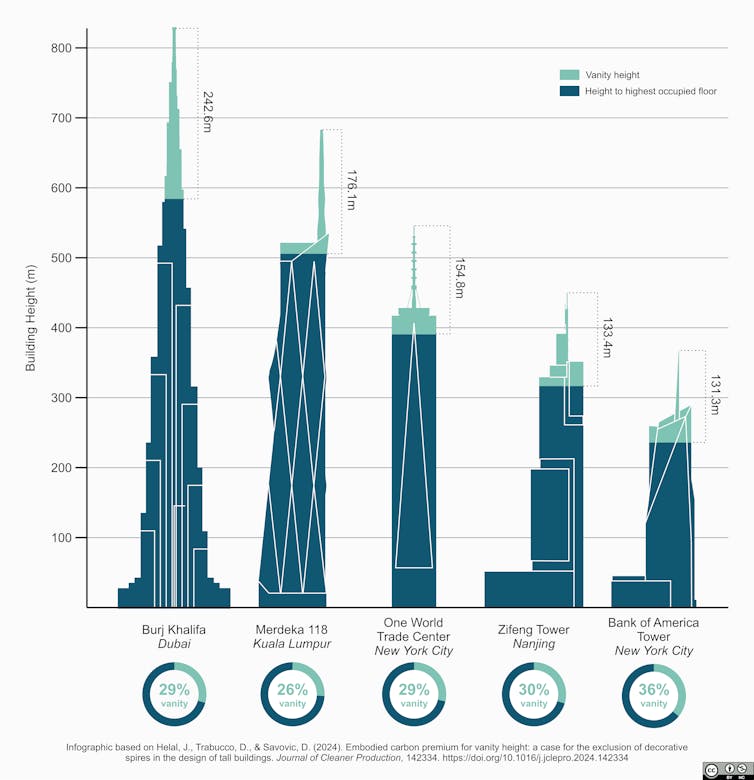
Quoted from Helal et al. (2024), using data from CTBUH Skyscraper Center, CC BY
measurement problems
At the heart of this issue is how to measure the height of a skyscraper. The Council on Tall Buildings and Urban Habitat (CTBUH) is the ultimate authority on skyscraper heights. It gives it the coveted title of “the world’s tallest building”.
Historically, there hasn’t been much debate about the height of skyscrapers because early buildings usually had flat roofs. The first major problem occurred in 1929 when New York City’s Chrysler Building installed a last-minute spire, securing the self-proclaimed title of “world’s tallest building” above the Manhattan Bank.
The Council on Tall Buildings and Urban Habitat, founded in 1969, established standards that included decorative spires in the early 1970s. This formalized a practice that was often the subject of debate.
A landmark moment in the council’s history was the 1998 showdown between the Petronas Towers in Kuala Lumpur and the Sears Tower in Chicago, now known as the Willis Tower. Imagine two giant buildings side by side: the 88-story pointed spire of the Petronas Towers and the 108-story flat-topped Sears Tower. However, the City Council uses the “height to the top of the building” which includes decorative spires. As a result, the Petronas Towers surpassed the Sears Tower and were declared the tallest buildings in the world.
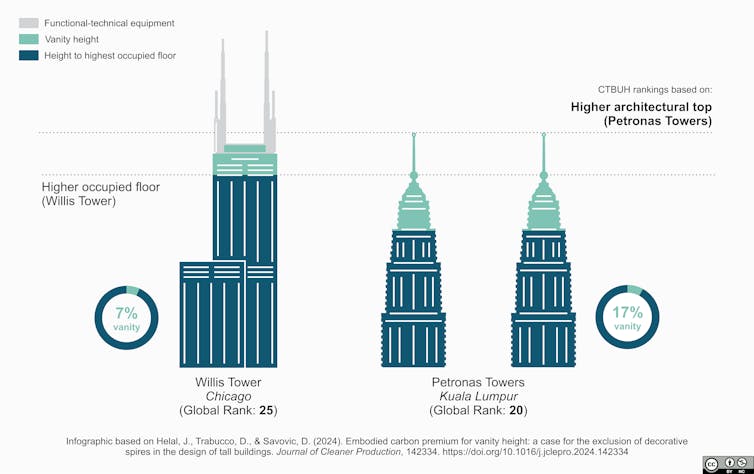
Quoted from Helal et al. (2024), using data from CTBUH Skyscraper Center, CC BY
Back in Chicago, this ruling was unpopular. Imagine the people on his 108th floor in the Sears Tower, looking down on the celebrations on his 88th floor in the Petronas Towers, mystified by how that extra spire made a difference. please. The decision permeated pop culture, with Jay Leno joking on The Tonight Show:
All the City Council does is look up at the sky once every 10 years and say, “Yes, that’s the tallest!”
Height still matters, even if it doesn’t make it into the top 100 tallest buildings in the world. Skyscrapers gain valuable prestige, either by being the tallest in their city, region, or country, or by achieving use-specific honors such as “world’s tallest restaurant” or “world’s tallest religious space.” obtain.
The hidden cost of high vanity
Sixty years ago, the famous Bangladeshi-American architect and engineer Fazlur Rahman Khan demonstrated that the height of a building has an exponential effect on the amount of materials needed for construction. In fact, if you double the height of a building, the required structural materials could triple. Stronger structures with more materials are needed to withstand the higher wind and earthquake loads of tall buildings.
This means there is a large “tangible carbon premium for height”. This premium is the additional greenhouse gas emissions associated with producing the additional materials needed for taller skyscrapers.
A striking example from our research shows that even a modest spire, which accounts for 16% of the building’s total height, can increase the carbon content of a 90-story skyscraper by 14%. Masu. When maximizing building height for aesthetic, status, or economic reasons, designers prioritize these concerns over environmental sustainability.
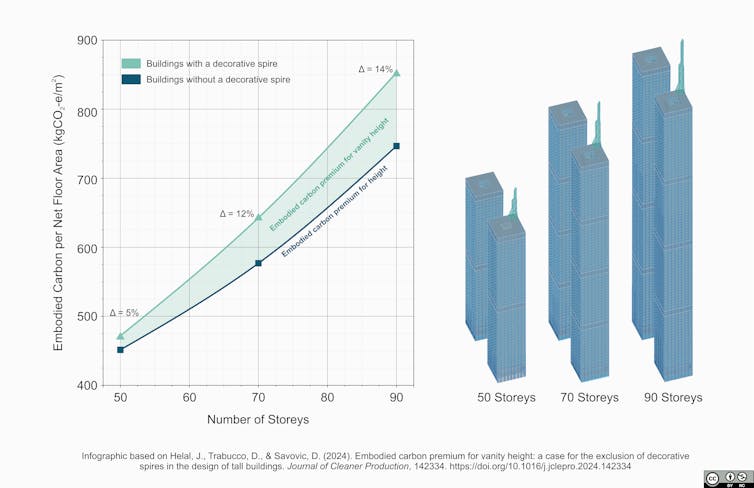
Quoted from Helal et al. (2024), CC BY
We took a closer look at Dubai, a city known for its towering skyline. It turns out that the vanity heights of the 100 tallest buildings add up to more than 3.5 kilometers.
It is estimated that these decorative elements contribute to at least 300,000 tons of greenhouse gas emissions. This is the carbon built directly into the spire and, more importantly, the built-in carbon added by reinforcing the building to support extra structural loads.
To put this impact into perspective, 300,000 tonnes of emissions is equivalent to the solidified carbon associated with the construction of around 2,400 average homes in Australia. Decorating 100 skyscrapers with pointy hats and exaggerating their height and position in world rankings is a very high price to pay.
Redefine height to set more sustainable standards
Championing the motto ‘Towards sustainable vertical urbanization’, Tall Buildings and Urban Habitat Councils have a significant opportunity to lead the change. What if the way tall buildings are measured and ranked was revised to better reflect this sustainability commitment?
Given our findings, we call on the council to remove incentives for vanity. We propose to adopt “height to highest occupied floor” as the main criterion for ranking skyscrapers by height.
Such changes can be controversial. Burj Khalifa will retain its title as the world’s tallest building, but One World Trade Center, for example, which stands at a vanity of 155 meters, will drop nine places and lose its status as North America’s tallest building. become.
However, if a building falls in the ranking, other buildings will also move up. Our research shows that there are more winners than losers in the 100 tallest buildings around the world. Therefore, support for this change may outweigh resistance.

Quoted from Helal et al. (2024), using data from CTBUH Skyscraper Center, CC BY
As cities continue to grow, environmental problems become more serious. There is an increasing need to re-evaluate our approach to architectural design. In particular, vanity buildings, such as overly decorative spiers, strain not only the skyline but also the environment.
After all, we would all be better off if we changed the way we rank the world’s tallest buildings.