

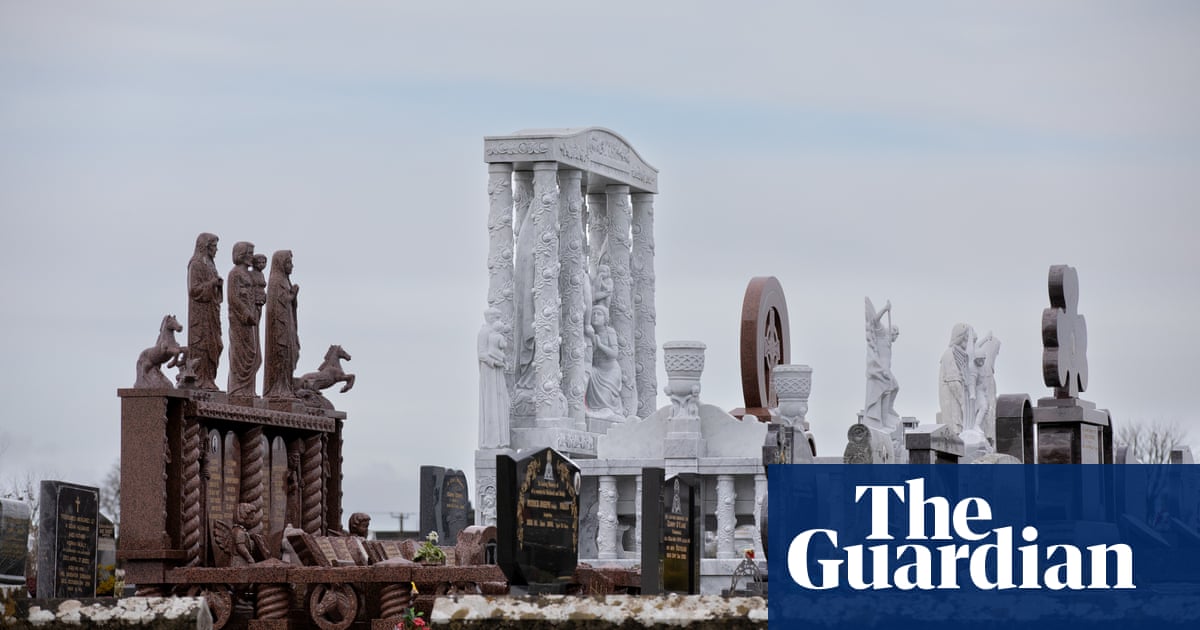
TA recent addition to Ballyhaunis Cemetery in County Mayo, Ireland, it towers over the adjacent tombstones in a blaze of white marble and decoration. Columns crowned with roses surround tableaus of statues representing biblical scenes, including Jesus, angels, cherubim, and a sculpture of Leonardo da Vinci’s “Last Supper.”
Bereavement is expressed in golden letters on marble slabs, photographs of the deceased gaze from carved stone benches, and diamond-shaped light bulbs and electrical sensors are mounted on the sides of the central slab. There is a lantern provided.
It is the tombstone of a beloved wife and mother, and the latest flashpoint in a debate over aesthetics, culture and tolerance that has polarized Irish public opinion.
Members of the Traveler community have erected large, elaborate gravestones in recent years that, depending on your point of view, serve as moving evidence of grief, loss, or a showy spectacle of one-manship.
Some have grown flags and fake jukeboxes, while others feature marble depictions of cars, football jerseys, pets, beer bottles, boxing gloves, dartboards, and more.
Martin Collins, co-director of Pavie Point, which represents Travelers and Roma, said the exhibitions were an expression of love from a marginalized community with alarmingly high mortality rates. “They’re remembering the person who died. It’s really important that travelers are seen as receiving a good send-off. It’s not a materialistic thing, it’s a very religious and sacred thing. is.”
The monument at Ballyhaunis set a precedent of sorts by becoming a tourist attraction. “I heard about it in the pub and couldn’t leave without seeing it,” said Paul Walsh, 34, who braved the frigid wind to visit the cemetery last week. “I went to the Vatican recently and this gives it a Vatican feel.”
His friend Niall Plenty, 34, said it was impressive. “It was certainly more luxurious than I expected. It’s over-the-top and outrageous, but it doesn’t bother me. Fair play to them.”
But opponents say the oversized gravestones breach planning rules, obscure other graves and introduce an element of competition.
“They’re getting bigger and bigger,” said Michael McCullagh, 84, who has been challenging Galway County Council over headstones at Cree Cemetery, on the outskirts of Ballinasloe, about an hour’s drive from Ballyhaunis. “Ballinasloe Cemetery is not an exhibition hall. It is a quiet place, a sacred place to our ancestors. Once underground, we are all equal.”
Mr McCullough’s daughter, parents and grandparents are buried in Cree, and Mr McCullagh has a private plot of land for himself and his wife. “That building,” he said, pointing to a black marble tombstone with swirling columns, “does that mean they have a deeper love for the dead than we do?” the auctioneer told the Travelers. He said he had no animosity toward him, but said some of the gravestones were bordering on “monstrous.”
It is said that some recent monuments were erected by crane at night. Galway County Council said it had received 11 complaints, including one at Creagh, and would like to question the contractor.
The controversy extends to Sheffield, England, where the city council decided to build Shire Green in 2022 to honor Irish Traveler “King” and bare-knuckle boxing champion Willie Collins, who died in 2020 at an early age. There is pressure to remove a 37-tonne mausoleum erected in a cemetery. 49.
His widow, Kathleen, told reporters: “The whole family is extremely hurt and angry by the vicious comments on social media from people who hate the Traveler community.” People are threatening to pull down or deface the monument, and the city council says it may have to change it, but if that happens there will be war. ”
Traveler representative Martin Collins said Traveler families should respect planning rules but called for tolerance and understanding from settled communities. “What is happening here is a clash of cultures and cultural values. Care must be taken to respect everyone’s traditions.”
He said prehistoric burial sites, such as the famous Newgrange Monument and the graves of famous people in Glasnevin Cemetery in Dublin, dwarfed Traveler headstones.
At Ballyhaunis Cemetery, one woman said she would not object to a large monument as long as it was not too close to her son’s grave. Fahed Kezze, 39, who was visiting the Muslim section, said his family should be able to have a large monument erected, but that was not his family’s preference. “My mother is in a simple grave, but we have built two wells in India named after her,” he said.