

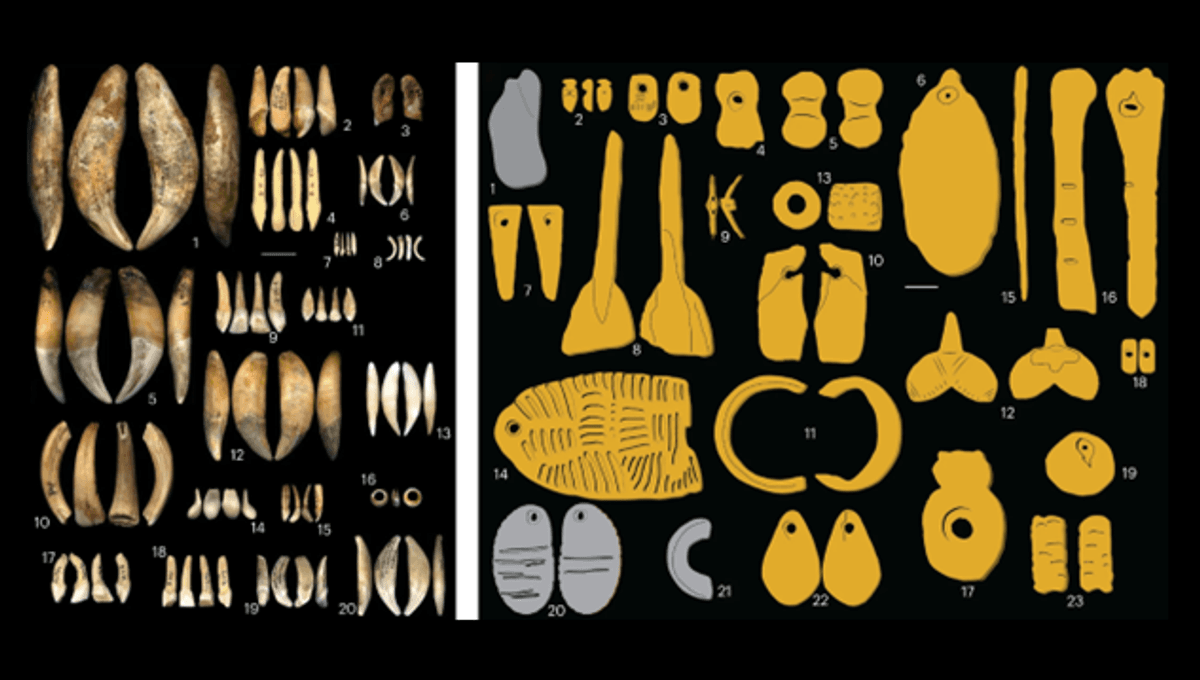
Archaeologists from the University of Bordeaux have built a continent-wide database of ornaments worn by Europeans between 34,000 and 24,000 years ago, known as the Gravettin Technocomplex. Combining the locations where these were found and genetic data revealed nine distinct cultures. “We demonstrate that the variability of Gravettian ornamentation cannot be explained solely by distance isolation,” the authors write.
Humans have been decorating their bodies with items such as seashells for at least 140,000 years. Over time, the range of items used expanded, and around 45,000 years ago there was an explosion in the variety of beads made from raw materials such as bone, shells, ivory, and stone.
At this point, the study authors note, jewelry became a useful cultural marker for modern archaeologists. “The idea behind this approach is that ornaments are communication techniques used to convey privileged information about group membership and social status,” they write.
Items buried with someone may have special meaning. At least the fact is that there was a culture of burial, which was not universal at that time.
Some archaeologists use differences in jewelry styles to distinguish between cultures of the time. However, some disagree, arguing that this reflects the isolation caused by distance when all travel was by foot. For example, if seashells were not used far inland, it could mean difficulty importing shells, rather than a cultural break.
The authors of the latest research note should be able to test these two competing explanations. If the second interpretation is correct, then the differences in styles are determined by distance. First, factors such as language, environment, and ethnic differences will also play a role. If we look back 30,000 years, some of it may not be measurable, but others will have left traces.
To test which one is correct, we need a large database of ornaments and their locations. This is what first author Jack Baker built for his PhD thesis using his 112 location examples.
Even at this point, shells were the most common ornament, with 79 found compared to 26 teeth and 29 made of other items. Thirteen of the shells were either of freshwater species or were made from fossils deposited in areas of Europe that were once underwater, suggesting they may have originated inland, but the majority were transported from distant shores. It is considered that it was discovered.
Along with the raw materials, the study also identified differences in styles of ornaments from place to place. As Baker told his Science magazine, Gravettian culture was not “a monolithic thing.”
Although geographic distance is certainly a factor in the variation seen between sites, the authors concluded that it is not the only difference. They identified nine archaeological sites characterized by commonalities found in each. Three of these consisted of burial sites and six occupied sites.

Location of the Gravettian cultural cluster on a map of modern Europe (sea level at that time was 100 meters lower). Note that despite the fact that there is an ocean between Europe and Greece, there are interesting similarities.
Image credit: Baker et al., Nature Human Behavior 2024
It’s not just ornaments that reveal cultural differences. In Eastern Europe, all burial grounds date from the early and middle Gravetti period, after which this practice seems to have ceased for some reason. Burials, on the other hand, appear to have taken place in Italy only in the middle and late Gravezzian period. Perhaps Eastern Europeans cooled off to the whole idea of burial once they learned that Italians were doing it.
“Our results demonstrate that Gravettian hunter-gatherers followed, at least to some extent, conventions dictated by their sense of cultural group membership when selecting personal ornaments, and that there was little pervasiveness between groups. “This is consistent with the view that there were cultural boundaries that facilitated cultural boundaries,” the authors write.
Recently, it has become possible to extract DNA from Ice Age humans, allowing populations to be identified by genetic groups rather than cultural factors as previously. Baker and his colleagues note evidence of a genetic break between Western Europe and the central and southern parts of the continent at the time, but this was clearly not the only cause of the cultural divide.
Peter Jordan, a professor at Lund University who was not involved in the study, told Science Magazine: “Archaeology is fighting back and creating new stories that also use a very rigorous and quantitative approach to studying the material. It shows what can be done.” tradition. ”
Genetic analysis is proving popular as a shiny new thing, but Baker and his co-authors argue that much of the continent is not covered and DNA has only been obtained from a small number of individuals from the time. points out.
The study is published in the journal Nature Human Behavior.