

- author, Chris Baraniuk
- role, Technology Reporter
As far as IT updates go, this was the most nerve-wracking.
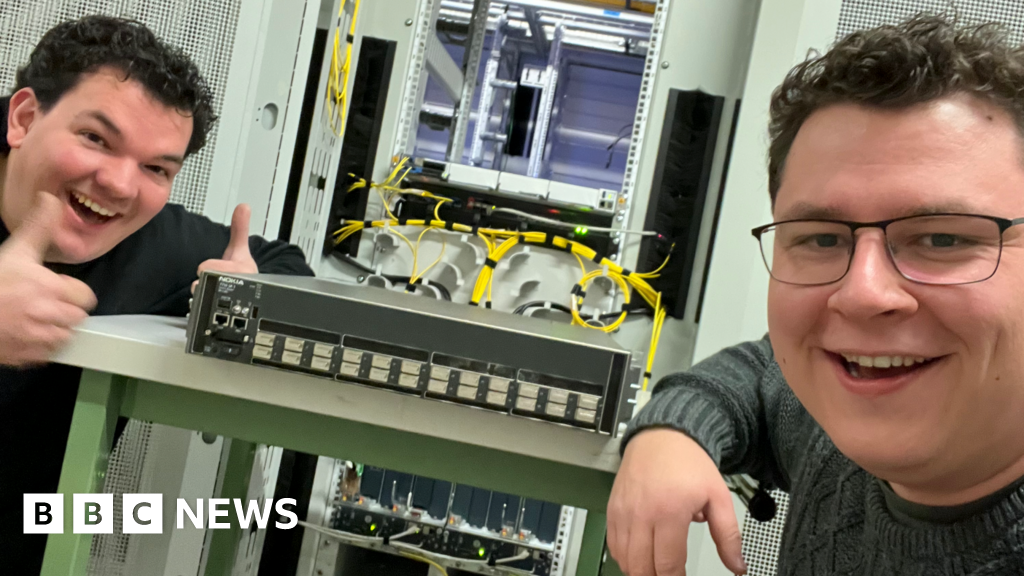
In February, deep inside a warehouse at CERN in Switzerland, home to the Large Hadron Collider (LHC), the world’s largest scientific experiment, two network engineers held their breath and pressed a button.
Suddenly, a screen in front of them displayed text against a black background. It worked. “We even did some high-fives,” recalls Joachim Opdenakker of SURF, a Dutch IT association that supports education and research institutions. “It was really cool to see.”
He and his colleague Edwin Verhoul have just installed a new data link between the LHC in Switzerland and a data repository in the Netherlands.
The data link could reach speeds of 800 gigabits per second (Gbps) – more than 11,000 times faster than the average UK home broadband speed – and the idea is to make the results of LHC experiments more accessible to scientists.
Subsequent tests, conducted in March using special equipment loaned from Nokia, proved that the desired speeds were achievable.
“These transponders that Nokia are using are like celebrities,” Verheul said, explaining how the kits were booked in advance for use at various locations. “We only had a limited amount of time available for testing. If we had to postpone it for a week, the transponders would no longer work.”
This bandwidth approaches one terabit per second, which is very fast, but some undersea cables are hundreds of times faster and use multiple fiber strands to achieve these speeds.
Image source, Nokia and Surf
In labs around the world, networking experts are developing fiber optic systems that can transmit data even faster than this, achieving staggering speeds of several petabits per second (Pbps) – 300 million times faster than the average UK home broadband connection.
This is so fast that it’s almost impossible to imagine how people will use such bandwidth in the future, but engineers aren’t wasting any time proving it’s possible — and they just want to make it even faster.
The duplex cable (with a transmit or receive core) from CERN to a data center in the Netherlands is just under 1,650 km (1,025 miles) long, snaking from Geneva to Paris, Brussels, and Amsterdam. One of the challenges of reaching 800 Gbps is sending pulses of light over such long distances. “Over the long distances, the power level of the light decreases, so it needs to be amplified in various places,” Opdenakker explains.
Every time a tiny particle collides with another during an experiment at the LHC, the impact produces a massive amount of data: about 1 petabyte per second, enough to fill 220,000 DVDs.
It has been slimmed down for storage and research, but still requires a lot of bandwidth. Plus, with upgrades scheduled for 2029, the LHC is expected to produce even more science data than it does today.
“This upgrade will increase the number of collisions by at least five times,” said James Watt, senior vice president and general manager of optical networks at Nokia.
But it may not be long before 800Gbps feels slow. In November, a team of Japanese researchers broke the world record for data transfer speeds, hitting an astounding 22.9 bps. That’s enough bandwidth to provide Netflix streaming to everyone on the planet, plus billions more, says Chigo Okonkwo of Eindhoven University of Technology, who worked on the study.
In this case, in a laboratory environment, huge amounts of meaningless but pseudo-random data were sent over a 13km coiled fibre optic cable, and Dr Okonkwo explains that the data was analysed for integrity after transmission to ensure it was sent quickly and as reported, without too many accumulated errors.
He adds that the system he and his colleagues used relied on multiple cores, a total of 19 cores in a single fiber optic cable — a new type of cable that differs from the standard cables that connect many people’s homes to the internet.
But digging up and replacing old fibre is expensive, and extending its lifespan is beneficial, argues Vladek Forisiak of Aston University in the UK. He and his colleagues recently achieved speeds of around 402 terabits per second (Tbps) over a 50km-long fibre with just a single core, around 5.7 million times faster than the average home broadband connection in the UK.
“I think this is the best in the world. I don’t know of any better results,” says Forciak. Their technology relies on using more wavelengths of light than usual to transmit data over fiber optic lines.
For this reason, alternative forms of electronics are used that send and receive signals over fiber optic cables, but such setups are easier to install than replacing thousands of kilometers of cable themselves.
But in some applications, reliability can be even more important than speed: “In remote robotic surgery 3,000 miles away, you definitely want to avoid a scenario where the network goes down,” says Cleaner.
Dr Okonkwo adds that training AI will require moving increasingly huge datasets, and he argues that the faster this can be done, the better.
Ian Phillips, a colleague of Forciak’s, said bandwidth tends to find uses as soon as it becomes available: “Humanity finds a way to consume it.”
Image source, Telegeography
Petabits per second far exceed the needs of today’s Web users, but Lane Burdett, a research analyst at telecom market research firm TeleGeography, said it’s surprising how quickly demand for bandwidth is growing: Currently, demand for transatlantic fiber-optic cables is up about 30 percent year over year.
She points out that content delivery (social media, cloud services, video streaming) consumes much more bandwidth than it used to: “In the early 2010s, it was around 15% of international bandwidth. Now it’s three-quarters, 75%, which is huge.”
Andrew Carnahan, public affairs director for the Internet Service Providers Association, said most home users now have access to gigabit-per-second speeds.
But only about a third of broadband customers subscribe to the technology, and Carnahan says there’s no “killer app” right now that really requires it — although that could change if, for example, more TV is watched over the Internet.
“It’s definitely a challenge to get the message out and get people more aware of what they can do with the infrastructure,” he says.