

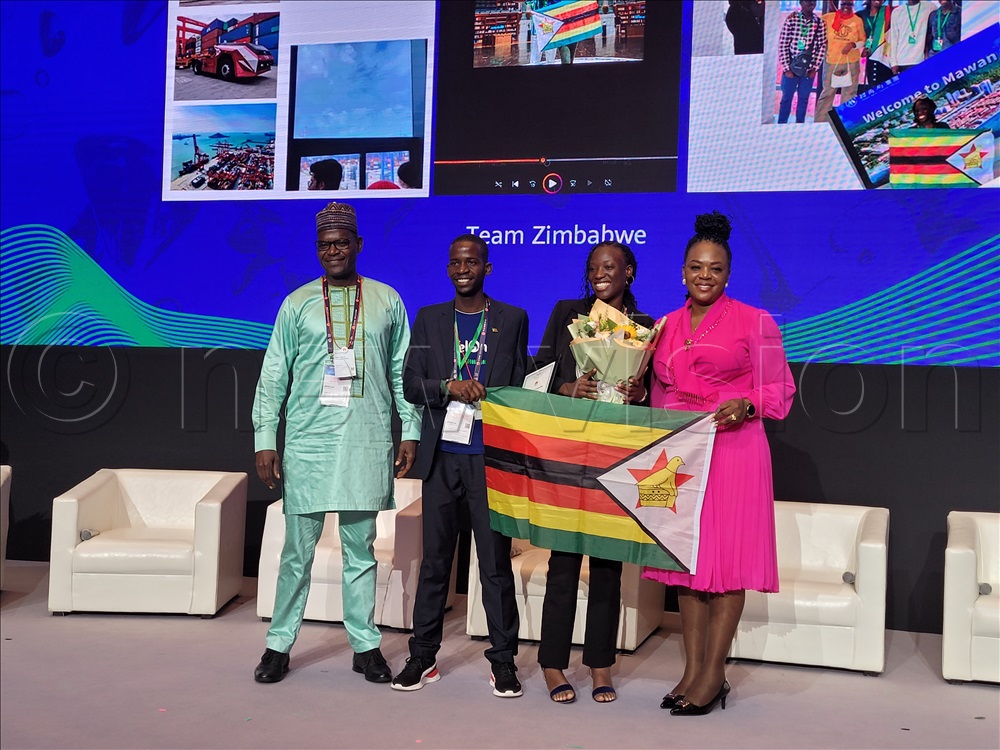
African communications and information technology executives have called on governments across the continent to lower the cost of digital equipment as one way to narrow the digital divide and improve efficiency in different sectors of the economy.
They made the appeal at the LEAP (Leadership, Employability, Progress, Opportunity) Summit held in Shanghai, China on Friday, June 28th.
The summit was part of the Mobile World Congress Summit, which began on Tuesday, June 24th and concluded on Friday, June 28th in Shanghai, China.
John Moe, secretary-general of the African Telecommunications Union, the telecommunications arm of the African Union, has rallied tech companies to work with governments to set up equipment manufacturing plants on the continent.

Permanent Secretary at the Ministry of Information and Communications Technology and National Guidance, Sophia Nantongo, was on Friday attending the Leadership, Employability, Progress and Potential (LEAP) Summit in Shanghai, China.
“In terms of affordability, these companies will increasingly base their manufacturing on the continent and governments need to work with them to reduce taxation on both systems, devices and services, to ensure easy access to the services we need. The biggest cause of access disparities in our country is digital literacy. A large portion of our population, especially the less privileged in rural areas, do not feel able to fully use the gadgets that you and I use,” he said.
Moe also called for the empowerment of young people to use digital tools productively to prosper.
“Africa has an astounding number of young people who are hungry for digital opportunities to realise themselves, yet we are yet to give them the opportunities they need to realise their full potential. The average age of a young person in Africa is 19, so the potential of that population is enormous. If we can collaborate instead of compete, we can do so much more for our people,” he added.
Uganda’s Permanent Secretary for Information and Communications Technology and National Guidance, Sophia Nantongo, echoed Mo’s appeal, calling for tax cuts on digital devices to make them more affordable for young people.
“On internet tariffs, as a government we are drafting legislation to reduce taxation on broadband. If Africa is to go digital, that is something we need to look at. If tariffs are high, the digital agenda will not be achieved,” she said.
More than 90% of digital devices used in Uganda are imported and subject to numerous taxes, including 18% VAT, excise duty and withholding tax, making them difficult to obtain and affordable. Apart from physical devices, online services such as mobile money are heavily taxed, including a 0.5% tax on all withdrawals.
Nantongo also urged technology companies to set up gadget manufacturing factories in countries like Uganda.
“We urge Huawei to come to Uganda and set up a gadget manufacturing factory so that accessibility can be improved,” she said.
Zimbabwe’s ICT Minister, Tatenda Mabetera, urged young people to harness ICT for future opportunities.
Kenya’s Chief Education Commissioner, Dr Beatrice Muganda, has called on global technology companies to make African universities their training hubs.
“We appreciate the partnership with Huawei but the target population is huge. You cannot do it alone. We know you have partnered with our universities. 25 years have passed and we want to achieve more but this can only be achieved if you recognise more of our universities as training bases. So how will this be achieved? This can be achieved by going beyond the internships you give to our students and involving our experts, lecturers and researchers in your efforts,” she said.
Gao Xian, Huawei’s president for Africa, said that over the past 26 years, the company has rolled out various digital talent training programs tailored to local development needs.
In 2022, the company launched its LEAP (Leadership, Employability, Progression, Enablement) digital skills development programme, which is being implemented across multiple higher education institutions in sub-Saharan Africa.
“As of today, I am happy to announce that we have developed over 120,000 digital talent in the region over the last 22 months,” he said.