

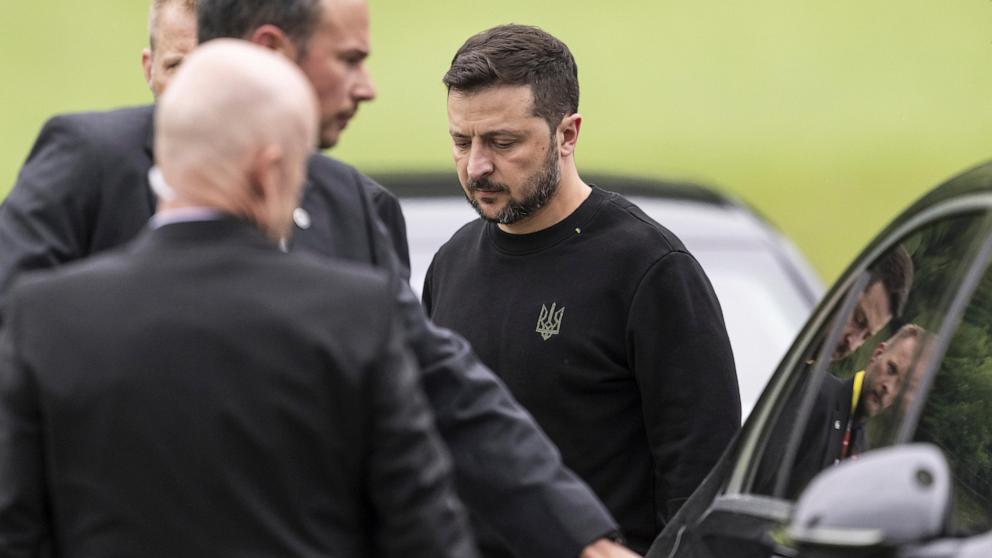
OBUERGEN, Switzerland — The presidents of Ecuador, Ivory Coast, Kenya and Somalia will join a host of Western heads of state, government and other leaders in a meeting this weekend aimed at taking first steps toward peace in Ukraine, but Russia will be notably absent.
Swiss officials, who are hosting the conference, said more than 50 heads of state and government, including Ukrainian President Volodymyr Zelenskiy, will take part in the gathering at the Bürgenstock resort overlooking Lake Lucerne. Around 100 delegations, including from European institutions and the United Nations, are also due to attend.
Who will and won’t attend has been one of the key points of contention at the conference, with critics saying it will be meaningless without the attendance of the government of Russian President Vladimir Putin, who invaded Ukraine in February 2022 and is pushing for war.
As US Vice President Kamala Harris arrived, shuttle buses roared up the winding mountain roads to the venue, causing occasional traffic jams, while police checked journalists’ IDs along the way and helicopters carrying VIPs flew overhead.
Meanwhile, Turkey and Saudi Arabia have sent their foreign ministers, while major developing countries such as Brazil, India and South Africa, which are attending the conference as observers, will also be represented at lower levels.
China, which supports Russia, would join a host of other countries not at the conference, many of which have more pressing problems to deal with faraway Europe’s bloodiest conflict since World War Two. Beijing has said any peace process needs the participation of both Russia and Ukraine and has put forward its own peace plan.
Last month, China and Brazil agreed to a six-point “common understanding” on a political solution to the Ukraine crisis, and called on other countries to recognise it and play their role in facilitating peace talks.
The six points include an agreement to “support an international peace conference at an appropriate time approved by both Russia and Ukraine, with equal participation of all parties and a fair discussion of all peace options.”
President Zelenskyy has recently been leading a diplomatic effort to attract participants to the Swiss summit.
Russian forces, who now control almost a quarter of eastern and southern Ukraine, have been expanding their territory in recent months. When talks of Swiss-sponsored peace talks began last summer, Ukrainian forces had only recently recaptured large swathes of territory, mainly around the cities of Kherson in the south and Kharkiv in the north.
Maneuvering diplomatically against the backdrop of a battlefield, summit organizers laid out three topics on their agenda: nuclear safety, including at the Russian-controlled Zaporizhia Nuclear Power Plant; humanitarian aid and prisoner exchanges; and global food security, which has at times been disrupted by disruptions to shipping through the Black Sea.
While this to-do list covers some of the least contentious issues, it falls far short of the proposals and expectations set out in President Zelensky’s 10-point peace plan later this year.
The plan includes ambitious demands, including the withdrawal of Russian troops from occupied Ukrainian territory, a cessation of hostilities and the restoration of Ukraine’s border with Russia, including Crimea.
Putin’s government, meanwhile, wants a peace deal based on a draft agreement negotiated early in the war, which includes provisions for Ukraine’s neutral status and limits on its military power and postpones talks on Russian-occupied territories. Ukraine’s long-standing push to join the NATO military alliance has irritated Moscow.
Analysts say Ukraine cannot negotiate from a position of strength.
“The situation on the battlefield has changed dramatically,” said Alexander Gabuev, president of the Carnegie Russia and Eurasia Center, adding that Russia “cannot immediately achieve its maximum military objectives, but it is gaining momentum and is pushing Ukraine very hard.”
“So many countries at the summit will be questioning whether Zelenskyy’s peace formula is still valid,” he said in a telephone press conference on Wednesday.
With the world’s attention recently shifting to the Gaza conflict and the 2024 elections, Ukraine’s supporters want to refocus attention on Russia’s violations of international law and restoring Ukraine’s territorial integrity.
Putin on Friday called the meeting “just a ploy to distract everyone.”
“Unless there is a big surprise at Bürgenstock, this event is unlikely to have any major consequences,” the International Crisis Group, a consulting firm that works to end the conflict, wrote this week.
“Nevertheless, the summit in Switzerland is an opportunity for Ukraine and its allies to underscore their recognition that Russia’s full-scale aggression is a clear violation of international law, as recognized by the UN General Assembly in 2022 and reiterated in its February 2023 resolution on a just peace in Ukraine,” the statement said.
“The Swiss have been keen to see Russia join the process, as have their Ukrainian counterparts,” he said.
“Presumably, the three items under consideration will be approved by the participants, but then the big question will be: ‘Now, what comes next?'” Gabuev said. “And I don’t think there’s a clear answer to that question yet.”
As the leaders made their way to the conference venue, the war raged.
Vyacheslav Gladkov, governor of Russia’s southern Belgorod region, posted on social media that Ukraine was responsible for Friday’s shelling of a five-story apartment building in the city of Shevekino, killing five people. There was no immediate comment from Kiev.
In Ukraine, artillery fire killed at least two civilians and wounded eight on Friday and overnight, regional authorities said. Oleh Shniekhbov, governor of Kharkiv region, the focus of recent Russian attacks, said one shell had fallen near a kindergarten and others had hit a residential home.
___
Ken Moritsugu in Beijing and Joanna Kozlowska in London contributed to this report.