

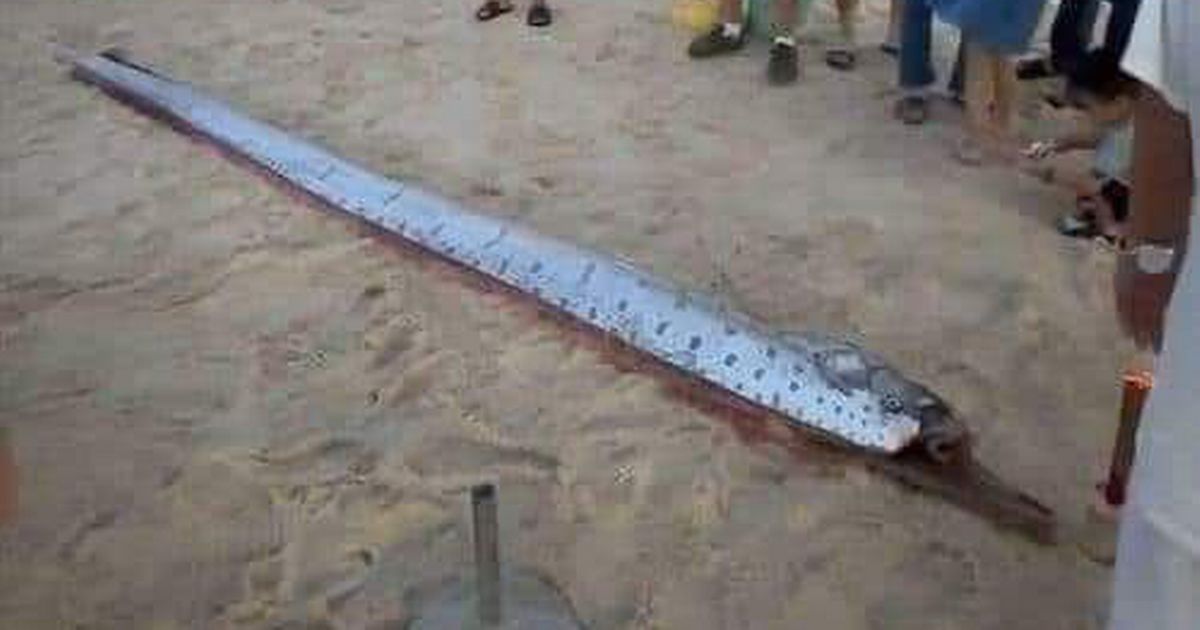
A giant sea creature has washed up on the shore near the Vietnamese city of Hue, with some people believing it to be a sign of natural disaster and locals snapping photos.
An oarfish, a deep-sea fish said to predict natural disasters, has washed up on the shore.
Children were amazed at the creature’s discovery and lifted the enormous fish, which then lay in the sand on a straight piece of tree bark while locals took photos on their mobile phones.
After the sea creature washed up near the Vietnamese city of Hue, a group of locals are said to have eaten the large fish at a beach feast, but the creature is often referred to as a “harbinger of natural disasters.”
“One of the best-known legends,” said one local resident, “is that the sighting of an oarfish is a sign of natural disasters, especially earthquakes and tsunamis,” Daniel said, “Then a major disaster will occur,” and Gustavo wrote, “An earthquake is coming!”
The oarfish resembles a “sea serpent” due to its size and shape, and in mythology is said to be an omen of earthquakes and misfortune. It is thought to be one of the longest fish in the ocean, growing up to 55 feet in length and weighing more than 440 pounds.
Oarfish can be found in most of the world’s oceans except the poles, due to their ability to adapt to a wide range of temperatures. Oarfish are known to live at depths of 200 to 1,000 meters (656 to 3,280 feet), and are less commonly spotted.
However, this fish can also be found washed up on the shore after a storm or when someone has been seriously injured. This fish is often said to appear as a sign of an impending natural disaster. However, scientific research has shown that this legend is unfounded. Still, for some people, the appearance of this fish is often seen as an omen.
In March, the Mirror reported that an oarfish washed up on a Mexican beach right in front of holidaymakers. The tourist spotted the creature, who appeared to be barely moving in shallow water. Once on shore, curious onlookers crowded around the strange fish. A few minutes later, the creature was spotted lying on the sand, seemingly dead, right in front of the holidaymakers.
The deep-sea fish was discovered in March off Stone Island in the Mexican state of Sinaloa, but it’s unclear whether the group contacted authorities to remove the massive carcass.