

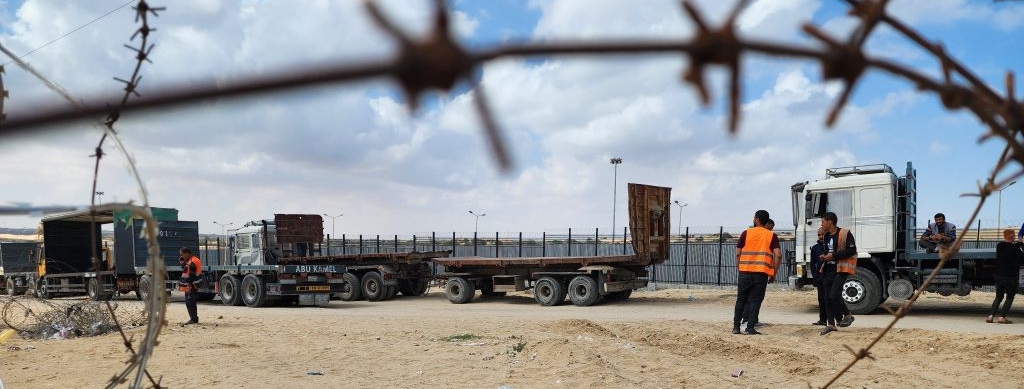
Despite repeated calls by heads of state, UN officials, and humanitarian NGOs for Israel to refrain from escalating ground attacks on Rafah, Israeli forces entered the province on May 7. More than 1.5 million people, including 600,000 children, are at serious risk.is more than 450,000 Palestinians have been evacuated from Rafah since Israel issued its first illegal “evacuation order” in Rafah on May 6. Israeli forces have already taken control of urban areas within Rafah, but the issuance of a new “evacuation order” on May 11 is a stepping stone for further advances. A military invasion would lead to the complete collapse of life-saving services. Israeli military attacks have cut off aid access to Gaza through the Rafah and Kerem Shalom/Qalm Abu Salem crossings.
“We went back to October last year due to the Israeli invasion of Rafah, when we had to suspend almost all our activities. Our team has to run away from Rafa and we don’t know where to go. So he had to close two clinics that we opened and that were treating about 500 patients a day. We are currently setting up new medical camps in areas where people have been evacuated, but this will take several days,” said Florence Rigal, president of Médecins du Monde France.
“Meanwhile, people are being left without medical care. For months, we have been warning that if we do not stop the Israeli incursion into Rafah, Gaza will face an even bigger humanitarian catastrophe.” We have warned that inaction by third countries is seen as a lack of concern for the impact on devastated civilian populations. This is unacceptable and we must take immediate action to prevent further suffering. yeah.”
Third countries have a responsibility to act quickly To end and hold accountable the serious violations of IHL occurring in Gaza. The first step for third countries to uphold their legal obligations to ensure respect for IHL is to stop the Rafah invasion, open all land routes and remove internal barriers to humanitarian access. That’s true. As a major supplier of arms to Israel’s military operations, the United States bears significant responsibility for Israel’s IHL violations. In addition to halting the transfer of large bomb loads, the United States should also do everything in its power to halt ongoing military operations in Rafah. Indeed, all arms suppliers must respect the Human Rights Council resolution, voted on April 5, calling for an end to the sale, transfer, or diversion of arms, munitions, and other military equipment to Israel. . All countries must act now to ensure an immediate and lasting ceasefire.
The Israeli military’s “evacuation order” is illegal, amounts to forcible removal, and is a serious violation of international humanitarian law (IHL). Israel ordered hundreds of thousands of Palestinians to evacuate without providing clear information or deadlines to civilians or humanitarian workers. IHL sets out clear conditions for evacuation to be lawful. Occupation forces must ensure that these evacuations are temporary and that the displaced persons are provided with satisfactory conditions of hygiene, health, safety and nutrition, and that members of the same family are not separated. You must ensure that the Israeli authorities do not meet any of these requirements. The people of Rafah, who have already been forced to live in multiple evacuations, are being forced to evacuate again amidst destroyed infrastructure and streets contaminated with unexploded ordnance. Displaced people have taken refuge in the Central Region, Khan Yunis, and Almawasi, despite high levels of destruction, lacking all essentials to sustain their lives. The concept of a “humanitarian safe zone” is invalid because areas previously designated as such have been targeted by bombing and ground operations. Relentless shelling continues in Rafah, while airstrikes and ground attacks have intensified in the north, leading to further displacement in the enclave.
Israel’s military incursion into Rafah has disrupted the humanitarian response, prompting UN Security Council Resolutions 2720 and 2728 and orders to enable Israel to provide basic services and humanitarian assistance. This violates the interim measures of the International Court of Justice. As a result of Israeli military operations in the northern governorate in recent months, humanitarian actors have been forced to relocate a significant portion of Rafah’s aid capacity, including facilities and warehouses. The Israeli offensive has already forced some humanitarian staff and operations to close or relocate to other areas in extremely dangerous conditions. A warehouse storing urgently needed life-saving aid east of Rafah remains inaccessible due to the Israeli military presence.Rafah medical facilities close one after another[1].
Every hour Israeli forces occupy the Rafah and Kerem Shalom/Karm Abu Salem intersections, more Palestinians are exposed to starvation and denial of medical care. The Israeli military has completely prevented humanitarian aid workers and workers from using the Rafah crossing. The intense militarization around the Kerem Shalom/Karm Abu Salem crossing caused by the Israeli ground invasion does not provide conditions for the sustained movement of humanitarian aid convoys. These two intersections constitute the main critical lifeline for aid entry into the enclave. The closure of these crossings has plunged Gaza into an even greater humanitarian disaster. Starvation levels in northern Gaza have been confirmed by the World Food Program, and stocks of critical aid supplies such as food, water, fuel and medical supplies are rapidly depleting, while the health system is further threatened with collapse. This has already led to the closure of services essential to civilian survival.[2]. The extremely limited reopening of northern land routes and the prospects for sea routes cannot be used to justify reduced access by crossing land to the south.
Fuel depletion poses a significant risk of halting humanitarian operations and essential services. The entire humanitarian response, including meeting the priority needs of more than 1.7 million displaced people, depends on fuel.Immediate priority access for fuel is critical to sustaining Gaza’s devastated health system and humanitarian response[3].
Jamil Sawarmeh, ActionAid Palestine Country Director | Occupied Palestinian territory.
“The only consequence of the ongoing ground invasion in Rafah is that more human suffering will be caused. People are being forced into already overcrowded so-called “humanitarian zones” where many People can’t even find shelter. The time has come to apply maximum pressure on Israel and the international community to end the repeated forced displacement of Gazans. It is equally important to ensure the reopening of Rafah Crossing, the only lifeline for more than 2 million vulnerable people. ”
Signer:
- action aid
- action against hunger
- American Friends Service Committee (AFSC)
- amnesty international
- AM Kattan Foundation
- Anela
- Church for Middle East Peace (CMEP)
- Dan Church Aid (DCA)
- Humanity and Inclusion/Handicap International (HI)
- IM Sweden Development Partner
- Intersos
- Médecin du Monde International Network
- Mennonite Central Committee
- Mercy Corps
- Norwegian Church Aid (NCA)
- Norwegian People’s Aid
- oxfam
- plan international
- relief international
- war children alliance
[1] Al-Najjar Hospital, the province’s largest medical facility, has ceased operations because it is located in an area occupied by the Israeli military, and Al-Kuwait is currently among the areas under threat from Israel’s “evacuation order.” Hospitals are likely to follow suit.
[2] Eight out of 12 bakeries in southern Gaza are at risk of shutting down due to a lack of supplies and fuel across the enclave. Medical evacuations are abruptly halted and critical patients, including children, are directly sentenced to death.
[3] Of particular concern, at least 10 hospitals, 8 bakeries, 28 ambulances, 23 clinics and 17 primary health centers will cease operations if emergency transport of fuel within the enclave is not allowed. That’s a possibility. The lives of babies in intensive care, women with complicated pregnancies and births, and trauma patients are at risk. Severe fuel shortages are also putting communications at risk and are already having a negative impact on humanitarian operations in Gaza.