

Dharamsala, India (AFP) – From teaching them centuries-old crafts to cataloging their language, Tibetans in exile are defending the cultural identity of a homeland that most people have never seen or dared visit. They claim it is eradicating heritage.
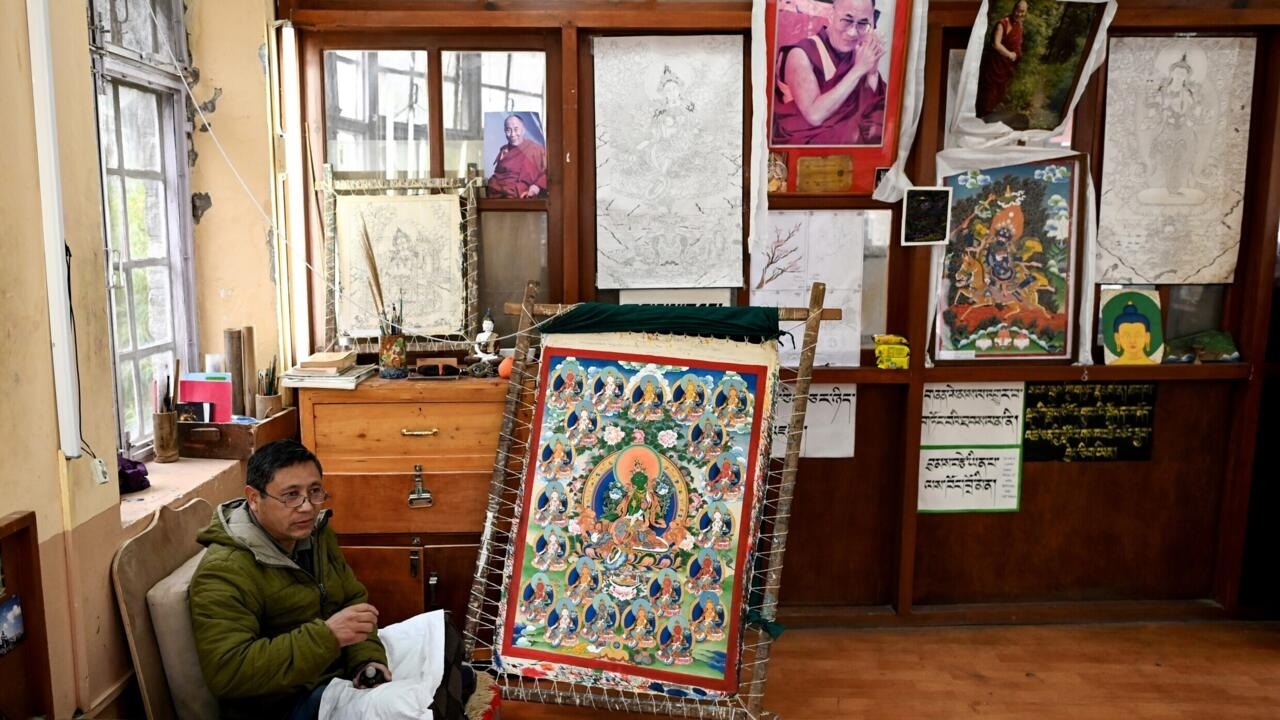
Artist Lobsang Tenzin squats over a detailed devotional ” thangka ” painting of Buddha as he teaches students in northern India.
“It’s important to preserve our historical traditions,” the 49-year-old said as six young Tibetan trainees looked on, applying a needle-thin brush to deep blue paint made from crushed lapis lazuli. Soaked.
“These techniques were almost lost, but we are passing them on by teaching them to young artists.”
On March 10, Tibetans will mark the 65th anniversary of the 1959 uprising against the Chinese military that forced their spiritual leader the Dalai Lama into exile and sent tens of thousands of his people into exile.
Within Tibet, the turmoil of China’s Cultural Revolution from 1966 to 1976 left temples destroyed and monasteries in ruins, and destruction continued for decades.
Today, activists say this is a determined effort by the Chinese government to erase what remains of Tibet’s cultural and religious identity.

Radon Thetong, director of the Tibetan Institute for Action, condemned what she called “cultural genocide”, including the Chinese government’s severe restrictions on the Tibetan language, which forced children to be “indoctrinated” in state-run boarding schools. There is.
The Chinese government, which insists that “Tibet is part of China,” vehemently rejects this accusation.
Chinese Foreign Ministry spokesperson Mao Ning said this week that Tibetans are “living a happy life” in response to claims by UN rights envoy Volker Turk that China is violating fundamental rights. .
He said Tibet enjoys “social stability, economic growth, unity among all ethnic groups, and harmony between different religious beliefs.”
“Former glory”
Robert Barnett, a Tibetologist at London’s SOAS University, called the Chinese government “a foreign ruler who decides what’s best for a people who know very little of their culture.”

“Culture and history are being chipped away,” Barnett said.
“It is a process of gradually eliminating all historical, ethnic, cultural, and social elements that are inconvenient to the new ruler.”
Tibetan authorities say there are 130,000 Tibetans in exile, many in India and Nepal but also in more than 25 countries around the world, a fraction of the 7 million people living under Chinese rule. It’s nothing more than that.
As the decades pass, preserving cultural identity becomes more difficult.
Tenzin studied at the Norbulingka Institute and now teaches at a social work center that trains more than 300 men and women in the fields of painting, embroidery, weaving and wood carving.
A complex of red and green Tibetan-style buildings near the Dalai Lama’s headquarters in the Himalayan hill town of Dharamsala, India, employs highly skilled artisans who make a living doing repair work. was established in 1995 to
“After the great masters came to India, they ended up taking odd jobs as they tried to build a life in their new country,” said Tsultrim Dorje, a senior manager at the institute.

“The Institute helped utilize their skills…The goal was to restore Tibetan art to its former glory.”
Some, like 29-year-old artist Tashi Nima, take a more contemporary approach. His vivid cartoon-style canvases still reflect people’s traditions and political battles.
Nyima, who was born and raised in Dharamsala, where monks and nuns in red robes crowd the streets alongside Tibetans in baseball caps and jeans, said the younger generation was struggling with a “very complex identity.” Ta.
But he remains committed to the cause.
“I have always believed that Tibet will be liberated one day,” he said in front of a painting of a shackled monk.
“If I didn’t have this belief, I wouldn’t be doing this work. I would have just quit.”
‘long haul’
Another battle is to keep the language alive.
Google Translate offers 133 languages, but Tibetan is not one of them. However, the Exiles released their own version of his 223-volume dictionary in 2022, which is now available online.
“Once the language is preserved, everything will fall into place,” said Dorji Damdur, director of New Delhi’s Tibet House, founded by the Dalai Lama to promote the people’s traditions.

“Language is like a medium through which all flows of culture and philosophy take place.”
However, young Tibetans in India are increasingly seeking opportunities in Europe and North America.
Damdur, who was born in India in 1968 and is a former interpreter for the Dalai Lama, admits maintaining identity is a “huge challenge”.
“In Tibet, assimilation by force is occurring against the communist Chinese,” said the Buddhist scholar. “In the West, we are so free that we sometimes end up assimilating into nature.”
The Dharamsala-based Tibetan government-in-exile said it was trying to keep the increasingly dispersed community connected, including through online conferences to teach history to younger generations.
“If they understood Tibet a little more, they could be the best defenders,” said Pengpa Tsering, who was elected by Tibetans around the world to be the government’s sikyong, or leader.
“Even though we are physically far apart, we are spiritually close.”
Tsering’s government oversees more than 60 Tibetan schools and supports nearly 300 monasteries and nunneries in India and Nepal.
“We are here for the long term,” Tsering said. “Don’t think we’re just going to disappear.”
© 2024 AFP