

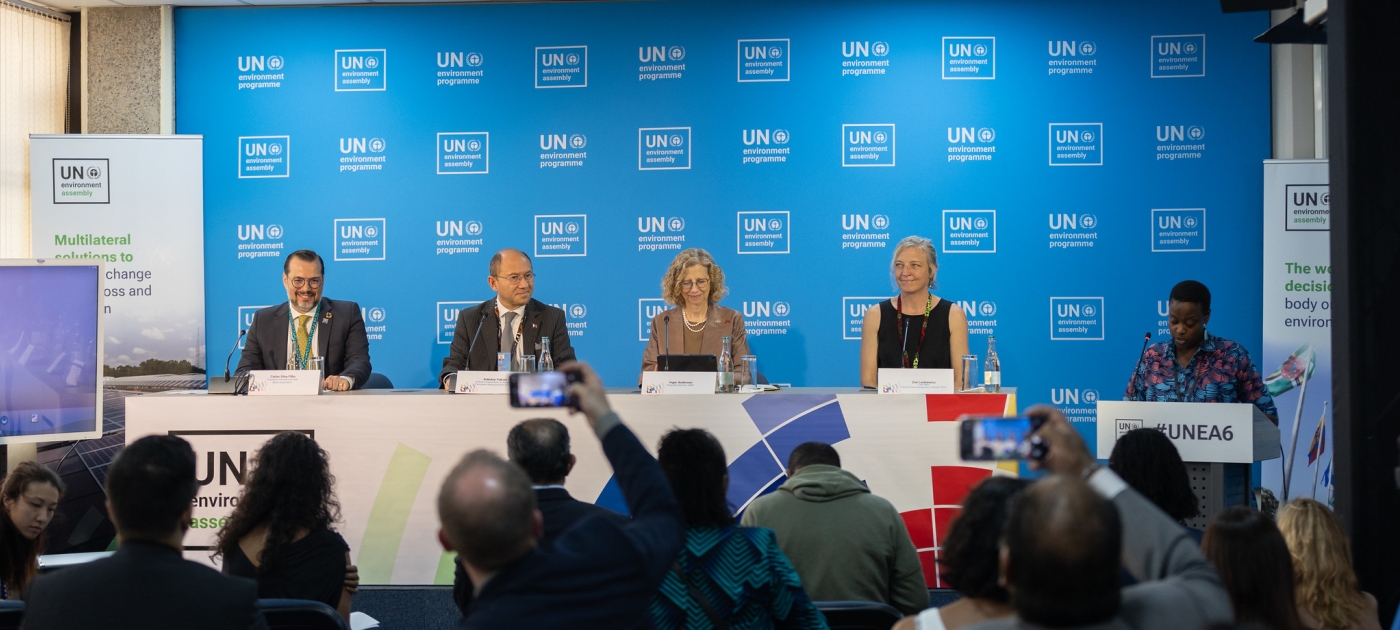
We would like to thank the media for covering the presentation of the Global Waste Management Outlook 2024 during the Sixth United Nations Environment Assembly (UNEA-6).
I would also like to thank Mr. Turkiye, who is a strong advocate of zero waste.
The conference considers ways to slow the triple planetary crisis: the climate crisis, the nature and biodiversity loss crisis, and the pollution and waste crisis. This triple crisis is, in effect, a single crisis, and a big message in the enormous amount of waste our economy produces.
The report shows that the direct costs of waste management in 2020 were USD 252 billion, which increases to USD 361 billion when externalities are included. These externalities include pollution costs that cause health hazards and greenhouse gas emissions from waste. Without urgent action, waste generation could increase and total annual costs could almost double.
But we can’t continue to face the waste problem by trying to control what we throw away. Open burning of waste is a disaster. Garbage dumps are a disaster. The huge amount of waste cannot be processed through recycling. To realize the vision of a zero-waste society, we need to redefine what waste is. Much of what we throw away is valuable resources, so we need to start rethinking the design and delivery of products and services to keep resources in the economy.
The issue of plastic waste is a key example. Only 9 percent of plastic waste is recycled, 17 percent is incinerated, 22 percent is left uncollected, and 46 percent ends up in landfills. And, of course, millions of tons of plastic end up in the ocean. The solution is not just waste management. However, in a continent like Africa where solid waste management infrastructure is largely undeveloped, this is an important aspect. The world needs to eliminate single-use and unnecessary plastics. Redesign your product. Redesign your packaging to use no or less plastic. Redesign systems for reuse, replenishment, and recycling. It is for this reason that two years ago the United Nations Environment Assembly began negotiations on a text on plastic pollution, which is due to conclude this year.
The same approach applies to the minerals and metals needed for the energy transition. Products must be designed with repair, remanufacturing, recovery (often referred to as urban mining), and recycling in order to economically preserve minerals and metals rather than extracting them from the earth and throwing them away. Currently, up to 7 percent of the world’s gold may end up in e-waste. It’s pointless.
Therefore, we need to start thinking about waste as a resource, move towards zero waste practices, and ensure a just transition for informal workers such as waste pickers and gender and socio-economic disparities in their communities. there is.
If we can develop and put this idea into practice, we will not only delay the triple planetary crisis. This would generate an annual net benefit of US$108.5 billion over current waste management costs. If that’s not the ultimate manifestation of the old saying, “Waste not, want not,” I don’t know what is.