

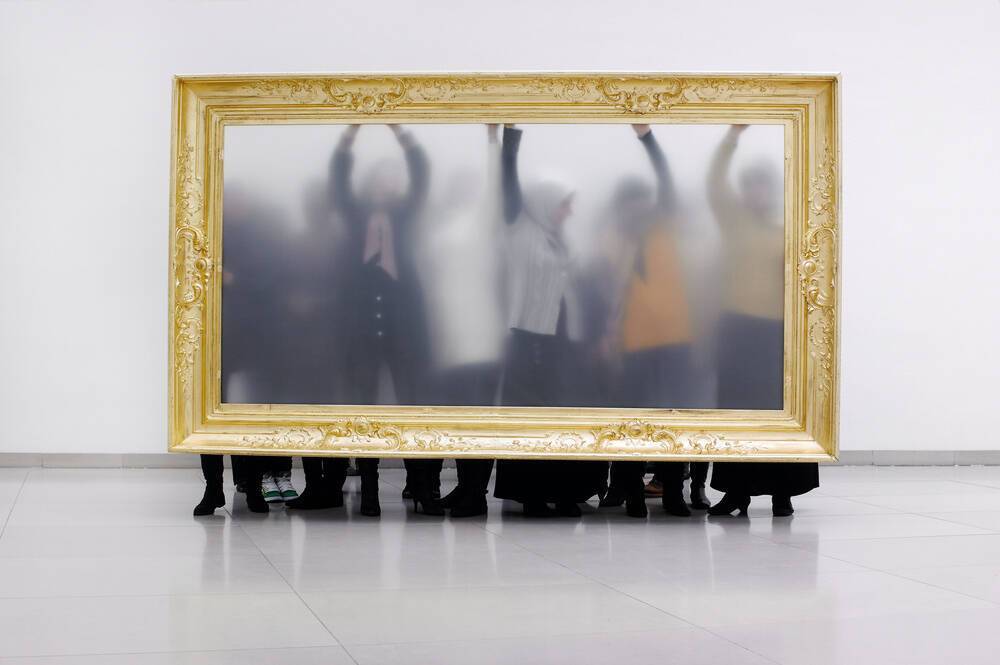
Image: Danica Dakić, SAFE FRAME III, 2012, C-Print © VG Bild-Kunst Bonn
Liberating the individual, preserving social cohesion: the two poles of democratic interests. These goals and values make more sense than ever, given the temptation to withdraw that is pervasive in modern society and can cause rifts. By recognizing the diversity, specificity and freedom of artistic expression, by facilitating access not only to works but also to practices, by enabling the sharing of aesthetic and cultural experiences, we are making history for this country. By tracing the lives of individuals and restoring their paths and avenues, Diversity and Cultural Policy fully participates in these complementary and inseparable objectives in its mission.
There are always tensions in the joint pursuit of these goals, and there are a number of phenomena at work that lead to a new rethinking of the relationship between culture and individuals and groups, and thus to questions of identity and belonging.
French society is more diverse and arguably richer than it was a few decades ago. But if the fact that anyone can feel that he or she belongs to more than one group or community is an asset to the global collective, then an identity in which an individual fully and clearly assimilates to a group is an asset to the global collective. This tension is fraught with contradictions. Therefore, the term identity itself is ambiguous. This is because the word identity, depending on the context of its use, refers to the uniqueness of a person or to its reduction to the same enclosure.
At the same time, the effects of globalization of economic exchange are further exacerbated by the digital economy and the hyper-personalized marketing it enables. The competition for social differentiation through the consumption of symbolic goods and products paradoxically leads to the massification of cultural practices and the “industrial production of difference,” so that people ultimately eliminate all the singularities of reality. You will be stripped away and confined to a community of tastes and opinions. . Moreover, the profiling operations that digital technologies enable and that serve the strategies of cultural operators to conquer their audiences reduce individuals to a few characteristics and lock them into their status as consumers.
Finally, a number of economic, environmental and geopolitical tensions are creating phenomena in our society that have very concrete effects at a cultural level. Anxiety promotes withdrawal reflexes and can result in a rejection of everything that may be culturally perceived as extrinsic and therefore threatening. Anger is also growing, fueling popular rejection of the legacy of the Enlightenment, universalism, and its associated cultural and ethical values.
Therefore, how can we come together without necessarily being similar?
We feel that the challenges are many and that translating these issues into cultural public policy is difficult. In this complex and globalized context, we offer proposals, devices and places that allow for a fruitful dialogue of identity and change at the various scales where each nation needs to think about its relationship with the world and build its own life. What do you think?
The challenge is to enable everyone to fulfill themselves, that is, to shape their own lives, build their own idiosyncrasies while fostering relationships with others, and ensure that it is agreed upon. It’s about being able to break out of narcissism and clan culture, whether it’s based on . .
Cultural subjects play an important role in this respect, especially as fields of dialogue become more diverse, and since there is never a pure ‘same’ or an absolutely different ‘other’, any cultural It helps us realize that dialogue is necessarily translation. Many issues, places of life, classes, genres, bodies, imaginaries are involved…
Finally, in thinking about our humanity in cultural terms, we must also pay attention to our relationships with those we call non-humans. We multiply, interact, and even hybridize with them, always completely unconsciously. We are therefore faced with the need to rethink our conception of the human being, who is certainly unique in the chain of life, but infinitely interdependent. Similarly, our technologies seem to be developing autonomy and power that reflect our identities.
How should we position ourselves amidst such upheaval? We can embrace language by choosing creative freedom, knowledge transmission, and attention to the diversity of our connections. This is a whole question of cultural policy at a time when we are being forced more than ever to acknowledge our interdependence on a global level.
Download the brochure
session calendar
9 modules from September 2024 to October 2025: 5 in Paris and 4 in the regions.
Optional: Two-day Auditor Networks in December and June will be open to auditors from the current session and previous sessions.
Module 1 – Opening Seminar
September 12th, 13th and 14th – Opening at the Ministry of Culture and seminar on the outskirts of Paris
Recognizing the diversity of identities, defining and questioning cultural identities: key issues and challenges of the subject of identity and change and their translation into cultural public policy.
Module 2 – Cultural Dialogue
October 10 and 11, 2024 – Paris and Hauts-de-France
How can we promote dialogue between cultures recognized on all sides within our territory? How do we think about migration phenomena and the consequent conjugate identities? For French and the French language, influence What is its place and role as an element of inclusiveness?In this second module, we explore a number of cultural and diplomatic issues.
Module 3 – European and International Affairs
November 14, 15 and 16, 2024 – France and abroad
To what extent does Europe in the region also exist beyond its borders, becoming a hotbed of cooperation between European countries and a source of exciting projects? In this, his third module, we examine these issues and work together on territorial identities, the frictions and prides they generate, and the levers of attraction they represent.
Module 4 – Media and Cultural Industries
4th December 5, 2024 – Paris
This fourth module covers the recent upheaval that the media and cultural industries are experiencing with the advent of artificial intelligence, which is not only completely transforming the information factory, but also developing new models for digital art.
Network day for former auditors (optional)
December 6th – Paris
Module 5 – Artistic Creation: Cultivating Singularity
January 9th and 10th, 2025 – Paris Suburbs
How has the current artistic scene seized the stakes of identity and made creation a means of expression of singularity as well as a site of production of otherness? In this fifth module, we explore contemporary creation benefits from the participation of diverse actors (art schools, third places, labeled places, performing arts artists) to interrogate the development of these issues at the heart of .
Module 6 – Wealth
February 6 and 7, 2025 – Paris
Are the models and roles of Western universalist museums being questioned in terms of the subject of identity? How should we think about not only the globalization of culture but also the risks of returning works to their countries of origin? Have heritage institutions ever grappled with the problem of re-evaluating invisible identities?
Module 7 – Business and Culture
March 13 and 14, 2025 – Paris
This module addresses the connection between business and culture by evoking the world of fashion, but also exploring the role of business infrastructure and new models of cultural entrepreneurship.
Module 8 – Convergence of cultural issues in the region
May 14, 15 and 16, 2025 – Auvergne – Rhone-Alpes
Territory cannot be reduced to administrative boundaries, but is an ecosystem composed of interrelationships that constitute its wealth. Living in a territory means engaging in communication and being attentive to one’s connections with others and the balance of one’s environment. Therefore, it immediately exhibits an identity with other beings. Supporting and building the emergence of new territorial cultural policies means taking the time to uncover and listen to these ecosystems, whatever their scale. We are also rebuilding spaces and frameworks for collaboration to think together about new cultural approaches to the region. Human, institutional and political challenges. Exploring Auvergne-Rhône-Alpes.
Network day for former auditors (optional)
June 13 and 14, 2025 – From Paris
Module 9 – Closing Seminar and Report
9th and 10th October 2025 – Paris
About the visuals chosen for this session 2024-2025:
“Safe Frame” is an installation created in 2013 by artist Danica Dakic. The installation is inspired by Paul Almasy’s 1942 photo “Louvre, Paris”, which shows the walls of the Louvre covered with empty frames during the occupation. In Danica Dakic’s installation, 23 young immigrant women tell and sing their personal stories and meet her MMK Museum in Frankfurt.
Dakic, an artist born in the former Yugoslavia (Bosnia and Herzegovina) and currently living in Germany, works in a variety of mediums, from painting to photography, video and sound, film and sculpture. Using performative and participatory processes, she creates images and voices that question changing social, political and cultural contexts and consider their utopian potential.