

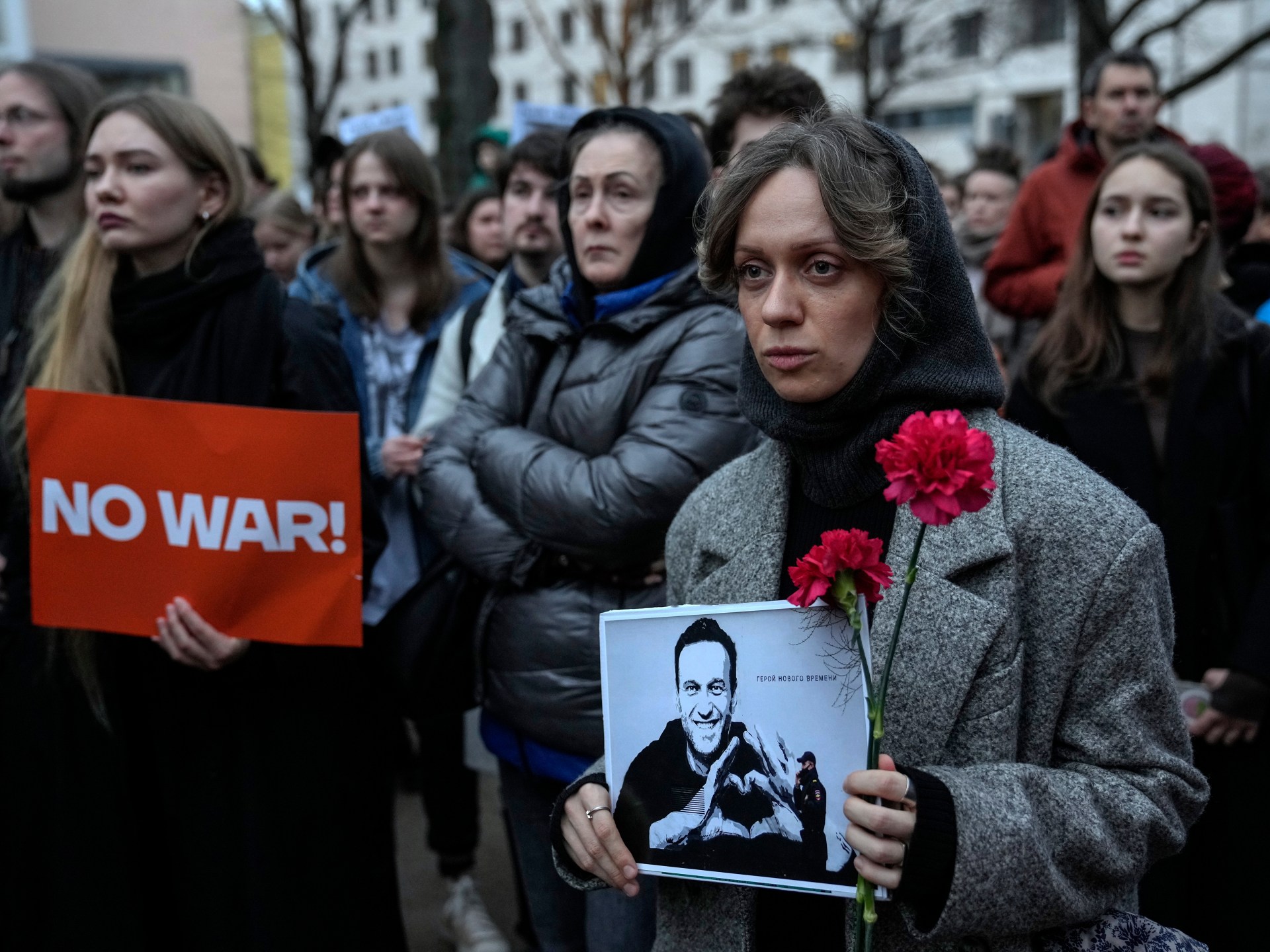
It doesn’t matter what caused Russian politician Alexei Navalny’s death. He was murdered by Vladimir Putin’s regime.
This execution began with poisoning with the chemical Novichok in 2020, followed by the insane and daring act of returning to Russia in January 2021, followed by a slow execution followed by sadistic torture in prison. It was an execution.
The official statement that the 47-year-old politician suddenly died from a blood clot on Friday may or may not be true, but the blame for his death still lies squarely with the Russian president.
Mr. Navalny was outstanding in every sense of the word. Superior in charisma and bravery to all Russian politicians, and perhaps all modern European politicians, he had immense optimism until his last days in prison in the Arctic. He was a man of hope and an irresistible sense of humor.
He resembled the hummingbird from Salman Rushdie’s Midnight’s Children, a charismatic politician trying to stop the exodus of newly independent India. Mr. Navalny was an extremely inspiring and unifying figure who could bring together what was becoming divided in the current era of conflict and polarization.
His anti-corruption campaign, in which he exposed the ill-gotten wealth of regime officials in a series of well-produced YouTube videos, has built him a vast support base and Russia’s largest regional opposition network. He rallied liberals, nationalists, and leftists, people who were fed up with the corrupt secrecy that had ruled Russia for a quarter of a century.
Mr. Navalny has taken opposition politics to regions and small towns far from Moscow and St. Petersburg. Internet-savvy and well-versed in modern culture, he ushered in a generational shift among Russia’s dissidents. Most of his supporters were young people in their 20s and even teenagers who had never experienced any political regime other than Putin’s.
He personified the hope that change could be brought about through nonviolent resistance, like the Velvet Revolution that overthrew the communists from 1989 to 1991. Mr Navalny, who was born to a Ukrainian father and spent his happiest childhood in Ukraine, could have helped mend the rift between the two neighbors, who are currently locked in a bloody war. Maybe.
His death rests squarely on Russia’s political leadership, but the hopes he represented have been dashed by the new geopolitical conflict between Russia and the US-led West. He was a thorn in the side of the conflict’s beneficiaries, which included, first and foremost, Putin himself.
But Mr. Navalny and his movement are the subject of constant bashing by anti-Russian troll farms and hawkish pro-Ukrainians with ties to the military-industrial complex and autocracy in NATO capitals. But there was.
The accusations leveled at Mr. Navalny boil down to the fact that he is a Russian nationalist and would have done the same thing as President Putin, but perhaps even more effectively because he would have cracked down on corruption. It means being deaf.
Early in his political career, Mr. Navalny did flirt with far-right politics, but he long ago moved away from that in favor of outspoken pro-Western liberalism.
There is no simple answer to the question of how Navalny would have acted if he had actually become president of Russia instead of Putin. It is certainly difficult to say to what extent the events between Russia, Ukraine, and the West were about individuals. It is important to remember that Putin himself has undergone an evolution from a Western-backed candidate for Russia’s liberal elite to a murderous authoritarian. In this process, the West’s frivolous and arrogant attitude toward Russia’s core security interests played no small role.
Two years ago, a few weeks after Russia’s full-scale invasion of Ukraine, Oleksiy Arestovich, one of the main spokesmen for the then-Ukrainian government, announced that Russia’s Liberal Democratic President had also invaded Ukraine in a similar manner. Deaf, he said. It was the logic of geopolitical conflict.
This kind of thinking presumes that the Western powers, led by the United States, intended to humiliate Russia and inflict a strategic defeat on Russia in a way that Russia’s leaders would never have accepted. That is, in fact, what many hawkish commentators in the West are calling for today.
Navalny is first and foremost a Russian politician, which is why he made the seemingly suicidal choice to survive the poisoning and return to Russia.
It was the only way to maintain political influence in Russia. He didn’t want to be anyone’s pawn. In the West, he would have been, at best, like General Charles de Gaulle in London during World War II, leading to mistrust and isolation. How did he deal with the insane xenophobic attacks on social platforms that his exiled allies are now subjected to on a daily basis? How would he have reacted to visa and travel restrictions that hurt anti-Putin Russian exiles far more than regime supporters?
Unlike de Gaulle, he would have had little chance of returning to play a role, as geopolitical conflicts threatened to strengthen Putin’s regime and bring Europe into another half-century of Cold War and Iron Curtain. .
In Russia, they thought they could at least gamble on growing war fatigue and become an Eastern European version of Nelson Mandela and wait for freedom.
If he had miraculously succeeded in coming to power, he would still be facing a very hostile West that would rather defeat and humiliate Russia than find a common language or an uneasy compromise. would have faced the nations.
However, he was very different from President Putin in that he was not simply the type of politician who liked conflict. He was not a man of our current age of conflict and polarization. Perhaps he belonged to a better future that Eastern Europe would still have after years of misery.
Has he succeeded in finding compromise-minded interlocutors in the West and sidelining aggressive hawks? He would have had a good chance. This is why he was a less beloved figure in those circles.
Navalny is a tragic figure, perhaps only comparable to Ukraine’s Volodymyr Zelensky. Initially a very united peace advocate, he now finds himself in an increasingly desperate battle with the master of conflict, Vladimir Putin.
But Mr. Navalny has raised a generation, of which there may be dozens or even hundreds, like him, who can work toward realizing the “beautiful Russia of the future” he famously described in his major political pledges. Ta.
The views expressed in this article are the author’s own and do not necessarily reflect the editorial stance of Al Jazeera.