

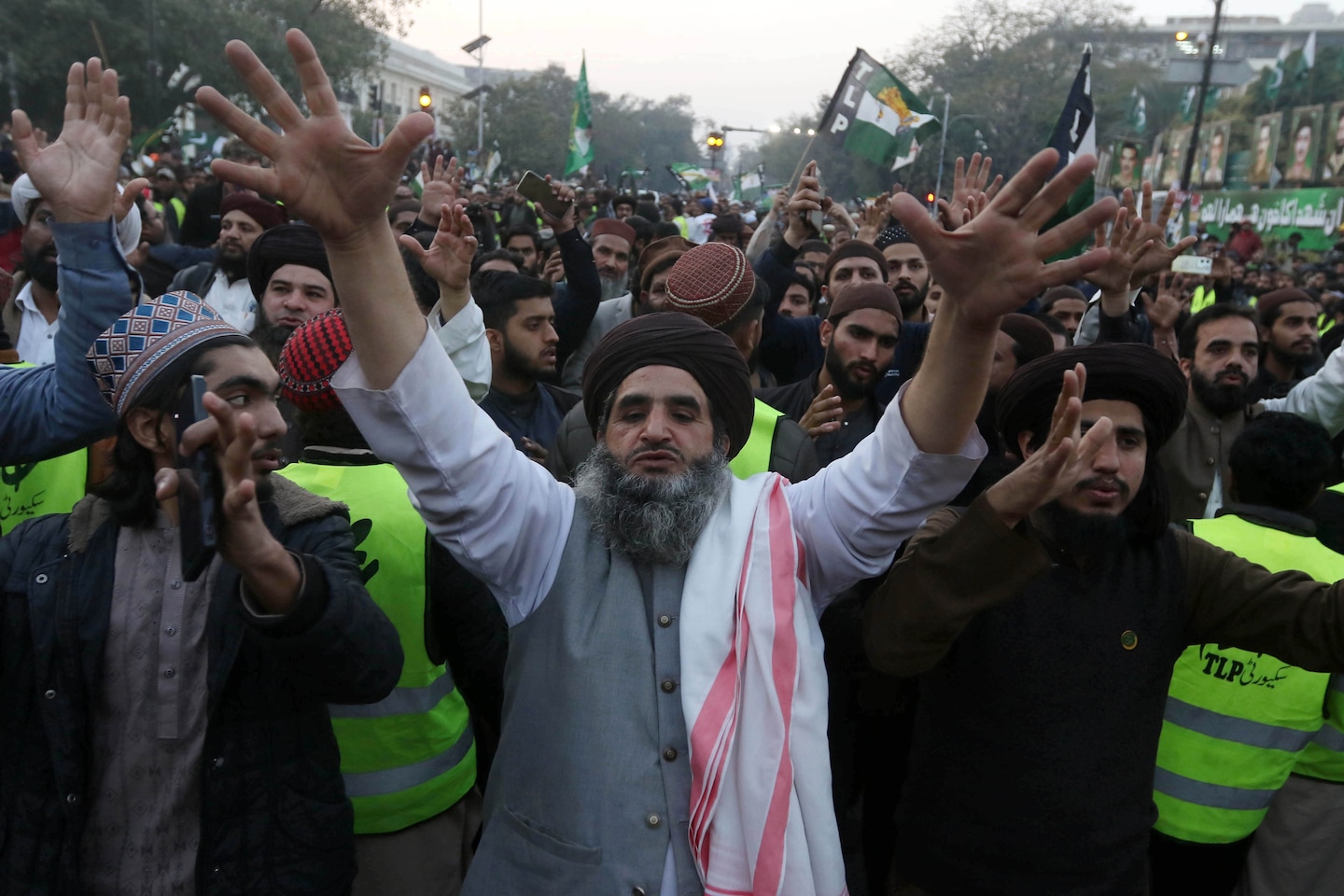
Tensions have been high for months since Mr Khan, a celebrity cricketer turned politician, was arrested in August. Days before voting began, he was sentenced to two more prison terms. However, his Pakistan Tehreek-e-Insaf Party (PTI) is leading with around 93 out of 266 seats. The imprisoned Khan, or at least someone like him, AI-generated victory speech.
PTI’s share is not enough to form a governing majority. But this is enough to plunge Pakistan into protracted coalition negotiations and perhaps further turmoil, as it has been experiencing since 2022, when Mr. Khan was ousted as prime minister in a feud with his generals. Throughout Pakistan’s 76-year history, the military has ruled either directly or behind the scenes, promoting or undermining the civilian government as needed. I may have miscalculated this time.
Pakistan has never had an elected prime minister for a full term, and civilians have been careful not to confront the country’s ultimate authorities, at least not directly. But after Mr. Khan was ousted, he became more defiant, criticizing military leaders and calling on his supporters to hold mass protests, some of which turned violent.
The military detained party leaders, raided their homes, and harassed their relatives. Many, under apparent coercion, denounced the PTI and distanced themselves from Mr. Khan. Journalists were under censorship orders to avoid mentioning the party or its embattled leaders. Additionally, the PTI was banned from using its ubiquitous symbol, the cricket bat, on its ballot papers. This is a huge blow in a country where more than a third of people are illiterate.
Critics rightly called the election one of the least reliable in Pakistan’s history. But despite (or perhaps because of) these efforts, it has become one of the most competitive. For the first time, the military’s preferred candidate, in this case Nawaz Sharif of the Pakistan Muslim League (PML-N), failed to win more than one seat, coming in a distant second with about 75 seats. Ironically, he was ousted as prime minister in 2017 after Sharif himself lost support from the military. Initially, the generals found a kindred spirit in Imran Khan, but soon found his enduring popularity, freewheeling foreign policy, and lack of respect to be at first frustrating, then intolerable.
As prime minister, Mr. Khan has increasingly tilted toward the United States in world affairs, which has irritated the Biden administration. After Russia’s invasion of Ukraine, Khan shamefully visited Russian President Vladimir Putin in Moscow. Meanwhile, it has become difficult to avoid the impression of American indifference to Pakistan’s democracy, or what remains of it. In response to a question about human rights in the midst of a pre-election crackdown, the State Department gently noted that “Pakistan has room for welcome improvement.”
On election day, mobile networks were cut off for an extended period of time, delaying voting results and raising suspicions of vote tampering. On Friday, the State Department condemned the “attacks on media personnel and restrictions on access to internet and telecommunications services” and called for a “thorough investigation” into allegations of election interference. But the statement only goes so far, and the Biden administration will continue to send a clear and consistent message to Pakistan’s military leaders in the critical days and weeks ahead that any attack on the integrity of the democratic process will have repercussions for the U.S. and Pakistan. must be sent to. relationship.
Whatever coalition government, likely to be led by Sharif with support from other anti-PTI parties, comes together, it will struggle for legitimacy. Against considerable expectations, Pakistani voters showed growing distrust of his military and its proxies at the polling stations. With Pakistan’s economy in turmoil and dependent on emergency bailouts from the International Monetary Fund, further destabilization is the most likely outcome.
That foreign strongmen promise both credibility and order is a lesson the United States has often learned the hard way, and often too late. However, military intervention in politics rarely brings long-term stability. In Pakistan’s case, the military’s unwillingness to cede control to civilians, or voters, created a fundamentally fractured politics. This election is a reminder of that.