

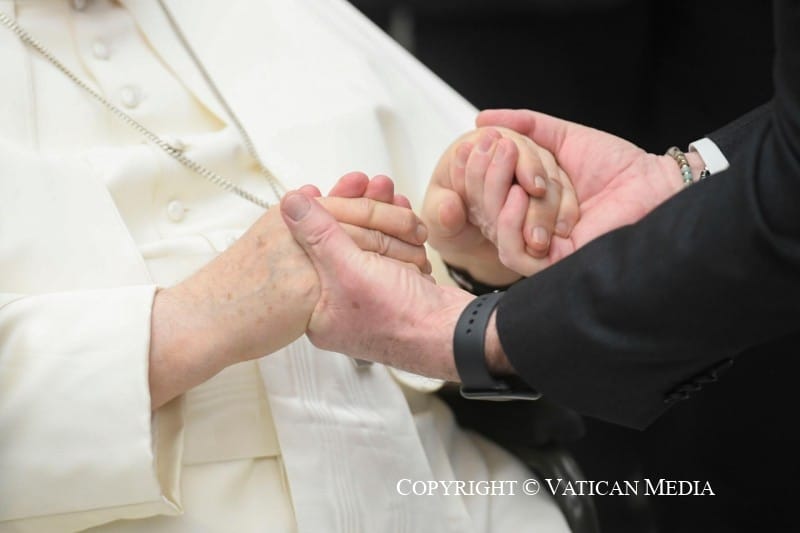
This morning Pope Francis had an audience with the Compartigianato delegation in the Paul VI Hall.
In this address, Pope Francis paid tribute to the work of artisans, emphasizing the importance of their manual labor and their role in society.
The Pope begins by reflecting on the hands of craftsmen, comparing them to the hands of God. “Manual work allows the craftsman to participate in God’s creative work,” he says. “Doing and producing are not the same.” The hands of the craftsmen work not only with skill, but also with passion and heart, transforming materials into works of art.
We have included below the speech that the Pope gave to those in attendance during the conference.
speech by the pope
Good morning, dear brothers and sisters!
We are happy to welcome many entrepreneurs and representatives of federations from all over Italy. Greetings, Mr. President and members of the Compartigianato.
Born from the ashes of World War II in 1946, your association has contributed to the revitalization and development of the national economy. In recent decades, the handicraft sector has undergone a remarkable transformation, moving from small workshops to enterprises producing goods and services even on a large scale. The use of technology has increased the potential of this field, but it is important that technology does not replace the imagination of humans, who are created in the image and likeness of God. While humans invent, machines reproduce, albeit at exceptional speed.
Your activities value human ingenuity and creativity. In particular, I would like to note how your work connects with his three parts of the body: hands, eyes, and feet. My heart is missing…

hand. Manual work makes the craftsman a participant in God’s creative work. Making and making are not the same. It exercises creative abilities that can integrate the abilities of the hands, the passions of the heart, and the ideas of the head. Your hands know how to accomplish many things that make you a colleague of God. Thus says the Lord: “As clay is in the potter’s hand, so are you in My hands.”jar 18:6). You bless and thank the Lord for the gift of your hands and the work they express. We know that not everyone is this lucky. There are people sitting around doing nothing, people who are unemployed, and people who are looking for work. These are all human situations that need to be healed. In some cases, companies may be looking for qualified personnel but cannot find them. Do not be discouraged in providing jobs and do not be afraid to employ the most vulnerable groups: young people, women, immigrants. Thank you for your contribution to breaking down the barriers of exclusion for people with severe disabilities, perhaps due to accidents at work, and for people who are marginalized and exploited. Everyone must be recognized with dignity as a worker. Let’s never cut off the wings of the dreams of people who want to make the world a better place through their work and who want to use their hands to express themselves.
eye. hands, eyes. Craftsmen have their own vision of reality. He or she has the ability to recognize masterpieces in inert materials even before recognition. What may be a block of marble to others is furniture to a craftsman. What might be a piece of wood to someone else is a violin, chair, or frame to an artisan. Craftsmen are the first to intuit the destiny of beauty in matter. And this brings him closer to the Creator. In Mark’s Gospel, Jesus is called “the carpenter” (6:3). The Son of God was a craftsman who learned his trade from St. Joseph in the workshop of Nazareth. For several years he lived among planes, chisels, and carpenter’s tools. He learned the importance of things and work. Consumerism has propagated the ugly spirit of disposableness. However, creation is not the sum of things, but a gift, “a joyful mystery to be pondered with joy and admiration” (Encyclical). Laudato Si’, 12). And craftsmen help us see reality differently and appreciate the value and beauty of the materials God has placed in our hands.
ft. Hands, eyes…feet. Products born from your activities “walk” and color the world while meeting people’s needs. Craftsmanship is a path to work, develop imagination, and improve the environment, living conditions, and human relationships. For this reason, I like to think of you as fraternity craftsmen. Parable of the Good Samaritan (cf. Luc (10:29-37) This word reminds us of the craftsmanship of relationships, of sharing together. The Samaritan approached him, bent down, picked up the wounded man, helped him to his feet, and dignified him with a gesture of concern. Thus, “this parable illustrates how a community is rebuilt by men and women who recognize the weaknesses of others, reject the creation of an exclusionary society, and instead act as neighbors, rescuing and reintegrating fallen people.” “The common good” (Encyclical) Fratelli Tutti, 67). Thanks to our feet, we can meet many fallen people along the way. Through our work, we can enable them to walk with us. In the midst of a culture of indifference, we can be fellow travelers. Every time we step closer to our brothers, we become artisans of a new humanity.
In this time when war continues to cause casualties and the voices of the poor are not being heard, I encourage you to become an artisan of peace. Your hands, eyes, and feet are signs of your creative and generous humanity. And may your heart always be engrossed in beauty. Thank you for your good results. I entrust you to the protection of St. Joseph. May he protect you, your family, and your business. I sincerely congratulate you. And please pray for me. thank you.
______________________________________________
Pontifical Press NewsletterFebruary 10, 2024